Notes for Methods and Techniques of Social Research, Fall 2004,
Goertzel.
Here are the formulas I used to compute the grades::
Total Score = [Attendance]*0.05+[Enrolling]*0.05+[Human Subjects
Letter]*0.05+[Quizzes]*0.25+[Midterm
Grade]*0.25+[Final Exam]*0.35+[Extra Credit Points]
Assignments = ([Enrolling]+[Human Subjects Letter]*3+[Interviews or
Content Analysis]*3+[Historical Trends]+[ExcelRegression])/9
Quizzes = ([Microcase Intro]+[Workbook 1]+[Workbook 2a]+[Workbook
2b]+[PercentQuiz]+[Sampling]+[Workbook 5]+[Crime Drop]+[Workbook
8]+[Workbook 3]+[Research Design]+[Statistics Review]+[Review Quiz])/13
Final Exam = ([Final Multiple Choice Items]*0.75+[Final Statistics
Items]*0.25)
December 13:
Here are some points covered with multiple choice questions:
- The differences between survey research, field research,
experimental research, focus groups and content analysis
- The field research, content analysis and other studies covered in
the last two weeks of class. If you weren't in class, you can
check these out on the notes.
- History effects, maturation effects, testing effects, regression
to the men and subject mortality in experimental research.
- Criteria for establishing causation. Independent,
dependent, antecedent and intervening variables.
- Levels of measurement: dichotomous, nominal, ordinal,
interval and ratio. The levels of measurement required to use
statistical techniques such as percentages, chi square, correlation,
regression, means, standard deviation.
- Interpreting a time series graph, such as those we did with the
Historical Trends module of WEBCT. Fitting a linear regression
equation to a time series graph.
- Tests of reliability: inter-rater, test-retest, internal
consistency.
- Tests of validity: criterion, construct, convergent, face.
- Types of samples: simple random, stratified, quota,
systematic, cluster.
- Interpretation of scattergrams, e.g., height and weight.
December 8 and 10: Statistics Review This is not covered in
our book, but on some WEB pages, one on
Descriptive Statistics and one on Inferential
Statistics Review. The class notes for October 1 (below) show
how to calculate many of the statistics. On December 10 we did
some statistics
review questions taken from last semester's final.
December 1
Content Analysis - "unobtrusive
data" Data created
by a bureaucratic system, e. g. police records, or often by the
media.
Television or Newspapers either because that is our interest, the
media,
or as a way of getting information, e.g., on crime reported in the news.
Similar to survey research, except
that you do coding
instead of interviewing. Coding means that you assign numbers to
phenomena that you observe. Counting things. Each of your
variables
is coded from the published information.
Conceptualization.
Measurement. Reliability and Validity.
Manifest Content - what's it's about on
the surface
Latent Content - things that we infer
about the content,
e.g., does the writer sound angry? Indignation, sexy?
A Content
Analysis Study of Editorial Cartoons. A
Content Analysis of Internet-Accessible Written Pornographic Depications.
Links to Content Analysis studies.
Video: Junk
Science Critique.
Junk Science.com Prayer
Study: Science or Not? Vitamin C: defense
of Pauling.
November 29
Experimental Research. Experimental Designs. See the graphs in the book
or on Trochim's WEB site: Types of
Designs.
Essential
characteristics:
- Two or more groups are matched, usually by random assignment,
sometimes by a kind of stratified random selection, e.g., an equal
number
of men and women or black sand whites in each group. But the key
is random assignment so that the groups can be assumed to be the same
on
all variables. "Quasi-experiments" are when we use groups that
are
pretty much the same but we didn't assign people at random
- The Independent Variable is "manipulated," i.e.,
it is applied
to one group and not to the other
- Change in the Dependent Variable is measured
Experiments can be done:
- In laboratory settings with volunteers, e.g.,
student volunteers
- In institutional settings such as prisons,
hospitals, rehabilitation
centers, etc., where people are assigned to treatment groups
- New drugs and medical treatments generally must
be shown
to work in experiments before they are approved for use. Often,
 treatment
is compared to a placebo. These experiments are usually
"double-blind,"
to control for the psychological effects of knowing one is getting
treatment.
This is a way of controlling subject bias and experimenter bias/
treatment
is compared to a placebo. These experiments are usually
"double-blind,"
to control for the psychological effects of knowing one is getting
treatment.
This is a way of controlling subject bias and experimenter bias/
- In criminal justice, one might do an experiment
comparing
a "half way house" to drug treatment program to a prison term for
offenders.
To do this, you would have to get the judge to assign offenders to
different
programs at random. Ethical issues are raised here and there are
likely to be objections
- Occasionally in natural settings, for example
- welfare reform
experiment, assign some recipients to the
old program, some to
 the
new. This didn't work very well, there
were
errors in the group assignments and the women often forgot which group
they were in anyway
the
new. This didn't work very well, there
were
errors in the group assignments and the women often forgot which group
they were in anyway
- vaccination experiments
- guaranteed annual income experiments
Although logically experiments are the most rigorous
way
to test causal hypotheses, there are practical problems:
- It may be hard to manipulate the independent
variable effectively,
it may not have enough importance to people that they notice it
- Experimental conditions may not be realistic
enough, e.g.,
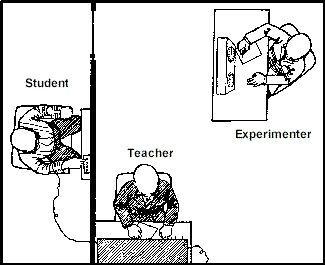
the Milgram experiments having people apply electric shock to people,
experiments
that simulate being in prison. An experiment is not the real
world
and people know it. This is called external validity, does the
experiment
match real world conditions
- There may be problems of internal validity,
difficulties
in carrying out the experiment:
- "History" effects - the world changes during
the experiment,
people get older, more mature, they are effected by things in the real
world
- Maturation, people get older, learn more
- Testing effects, taking the pretest measure
effects people,
causes them to change. Sometimes we have a matched but untested
control
group that is measured only after the experiment.
- Instrument effects, the testing instrument may
change.
You can't use the same exact test sometimes because people will
remember
it, so items change
- Regression to the mean, just by chance the
people who got
extremely high or low scores on a pretest are likely to get more
average
scores on the second test.
- Subject "mortality" - we may lose people.
This is especially
a problem in testing things like drug rehabilitation, it works for the
people who stick with it, the failures drop out
- Ethical concerns: people may not be willing
to be experimented
on, or it may be harmful to subject them to experimental conditions,
e.g.,
- Tuskeegee syphillis experiment denied some men
penicillin.
You can only deny an experimental drug if you are not "certain" that it
works or if the condition is not serious, e.g., common cold research
- A big strength of experiments is resolving
questions that
involve different recollections of events, e.g., children's reports of
abuse. You don't know what "really" happened and people disagree
on how well they accept the recollections of different people. In
an experiment, you know what really happened, so you can check the
accuracy
of perception. We find that children often remember things that
didn't
really happen. "20/20 report on Child Abuse experiments
(VIDEO shown in class) demonstrates false memory because we know what
really happened since it happened in a controlled experimental
setting. This is much more difficult to establish in real life
case histories: Loftus: Who Abused Jane
Doe?
November 19
The Review Glossary is not adequate as a guide to
this
chapter. Some points to be covered:
- Field research is needed to gather data on
processes, especially
those involving personal interaction
- It is good for observing behavior rather than
getting reports
of behavior or attitudes
- It takes a lot of time, and is less likely to be
replicated,
leading to problems of reliability. Would another researcher
observe
the same thing? Validity issues are difficult to assess, what
abstract
concepts are being used?
- By its nature field research is likely to be inductive,
people go to see what's happening rather than to test a theory.
But
observers may have a "hidden agenda" that leads them to see what they
want
to see.
- Selection of sites and topics is likely to
reflect the special
interest of the researcher. There may be a bias toward the
bizarre,
or towards cases that will prove a particular point.
- Getting access is problematic, groups may not
want to be
observed. Sometimes deception is used, which raises ethical
issues.
The whole question of ethical review is difficult to apply to field
research,
e.g., "informed consent."
- There can be structured and unstructured
observation.
You can count things. Observation through a one-way mirror is
sometimes
possible, e.g., of day care centers. This might be done with
WEB-cams.
- Notes are important, need to be recorded
quickly. Data
base programs can be used, here there might be validity issues, in the
coding of observations, e.g., was a certain remark a case of "sexual
harassment"?
- Accounts tend to be descriptive, there is a bias
toward things
that are interesting. It is possible to combine field work with
quantitative
data collection.
Some examples of field resarch:
Margaret
Mead, the only anthropologist (or  sociologist)
to get her own postage stamp, won fame through field work, primarily
her
book Coming
of Age in Samoa. Later, this book was denounced by
anthropologist
Derek Freeman in his book Margaret
Mead and the Heretic : The Making and Unmaking of an Anthropological
Myth.Anthropologists
have come to Mead's defense, and
have restudied the case, but I would have to agree with your text
that
"had Mead come back from Samoa with an accurate ethnographic report, it
would not have made her famous." Here is the NY Times Review of Freeman's
critique of Mead.
sociologist)
to get her own postage stamp, won fame through field work, primarily
her
book Coming
of Age in Samoa. Later, this book was denounced by
anthropologist
Derek Freeman in his book Margaret
Mead and the Heretic : The Making and Unmaking of an Anthropological
Myth.Anthropologists
have come to Mead's defense, and
have restudied the case, but I would have to agree with your text
that
"had Mead come back from Samoa with an accurate ethnographic report, it
would not have made her famous." Here is the NY Times Review of Freeman's
critique of Mead.
More recently, there has been a raging controversy about the book Darkness
in El Dorado about research on the Yanomamo in Venezuela is the
latest
ethical controversy, which also raises important methodological
questions.
Many of the book's allegations, however, have
been contested by the National Academy of Sciences.
The combining
of fiction with factual research is increasingly common both in
anthropology
and in biographies. Sometimes this is  openly
done as a literary form, in other cases such as that of Rigoberta
Menchu,
it is only admitted when
critics discover it.
The
Rigoberta Menchu Controversy by Arturo Arias.
openly
done as a literary form, in other cases such as that of Rigoberta
Menchu,
it is only admitted when
critics discover it.
The
Rigoberta Menchu Controversy by Arturo Arias.
There
are many problems with field research: ethical issues, problems
of
reliability and validity when data are gathered by only one researcher,
etc. A controversial book is Laud Humphrey's Tea
Room Trade, which raises ethical issues. He studied gay sex in a
men's
room in a park in St. Louis, without informing the participants what he
was doing.
Field researchers sometimes seem to find examples that fit their
preconceptions,
and their work is often ignored by those who do not like the results,
e.g.,
Leon Dash's book When
Children Want Children and
Rosa Lee which are just ignored by welfare advocates who prefer
more sympathetic treatments. One of the best field studies is
Kathryn Edin's book Making
Ends Meet. which is highly sympathetic to the mothers.
However,
Edin collected statistical data as well her illustrative
observations.
The statistics showed that almost none of the mothers actually lived
off
their grants alone. Eli Anderson's book Streetwise
on men in a Philadelphia ghetto has been well received, in large part
because
goes beyond one-sided advocacy.
A great strength of field work is observing behaviors that the people
themselves
don't understand or aren't even aware of., or at any event, are unable
or unwilling to talk about. Anthropologist Jules
Henry spent a week living in each of the homes of several children
who had grown up mentally ill,  trying
to discern patterns in the family interactions that contributed to the
illness. Myra Bluebond-Langner's book The
Private Worlds of Dying Children has been very influential;
she
has just published a sequel called In
the Shadow of Illness : Parents and Siblings of the Chronically Ill
Child
Field reserch offers a richness of description and possibility of new
insights
that is unparalled by any other method. Unless it is supplemented
with other methods, it does not provide statistical data, and it is
hard
to replicate.
trying
to discern patterns in the family interactions that contributed to the
illness. Myra Bluebond-Langner's book The
Private Worlds of Dying Children has been very influential;
she
has just published a sequel called In
the Shadow of Illness : Parents and Siblings of the Chronically Ill
Child
Field reserch offers a richness of description and possibility of new
insights
that is unparalled by any other method. Unless it is supplemented
with other methods, it does not provide statistical data, and it is
hard
to replicate.
Myra Bluebond-Langner of our Anthropology Department wrote a classic, The
Private Worlds of Dying Children, and more recently, In
The Shadow of Illness.
Coming
of Age in New Jersey.
The
Corner.
Black
American Students in an Affluent Suburb. by John
Ogbu.
November 5: optional class in BSB 108 to
work with Excel.
November 3: Hight
Weight excel file. Election data on CNN.com. Use of Excel
to prepare secondary data analyses. Sources of
Data.
November 1
Research Design. How research is organized or structured to
accomplish
different ends.
| Purpose of Study |
Preferred Design |
Advantages/Disadvantages |
Exploration - To get some new ideas,
or at least ideas that are new to you.
|
1. Literature Review - library research
2. Secondary Analysis - Using data that is already being collected
by a country, a government office, a company. Criminal justice
systems
generate a lot of data for their own purposes. You are limited to
the questions someone else designed and asked.
3.Field Observation - Go into the natural setting and observe what is
going on. You may talk to people and ask questions as well, but
the
really unique aspect is observation.
4. Focus Groups - Group interviews lasting about an hour and a half.
5. Case Studies - based on documents, interviews or sometimes
observations
|
1. Get insights of others. Avoid
reinventing the wheel./ Tends to repeat the past, not generate new
ideas.
2. Access a tremendous amount of information quickly and
cheaply./ Limited to the questions asked by others.
3. Get new insights in natural setting/ Difficult and time
consuming, small sample. Access difficult.
4. Detailed, inductive subtle understanding of patterns./
Difficult to generalize.
|
Description - To get accurate and
relatively precise information, especially about large groups or
|
1. Secondary Analysis - Data banks of surveys
are available, many other kinds of data also.
2. Surveys - Questionnaires or interviews.
Often on the telephone.
3. Content analysis - Looking at media as a source of data:
tv shows, letters to the editor, newspaper articles. Written
documents.
You can go back in time. |
1. Excellent data, especially for trends
over time/ Limited to questions asked by others.
2. Ask your own questions, choose your own sample/ Time
consuming of expensive. Limited to topics people can answer
accurately
3. Unobtrustive, allows study of media./ Limited to topics that
involve published media.
|
Explanation. To answer
questions about cause and effect.
|
1. Experiment - In an experiment we manipulate
the independent variable. The independent variable is the
"cause"
. Then we measure the dependent variable or "effect" both before
and after on experimental and control group.
2. Multivariate Statistical Analysis of Survey Data
|
1. Best method of proving causal
relationships./ Hard to maintain rigor of design (internal validity)
and to generalize beyond the limits of the experiment (external
validity). Serious ethical and practical limitations.
2. Can use servey and secondary data and address wide range of
important topics/ Data sets must include good measures of all
relevant variables and wide range of data. Not valid unless the
models can be shown to predict trends in fresh data. Most useful
for making predictions to be evaluated with fresh data.
|
Samples:
Crackdowns.doc
Crackdownsgraph.doc
A study of UFO Abduction Status.
NY Times Election Survey on todays Times
Home Page.
October 25:
We will discuss path analysis and interpreting
regression models, following the textbook and the discussions in:
A Brief
Intro to Path Analysis. A longer
introduction with more examples. A more technical Intro to
Path Analysis. Skeptical
Inquirer Cover. Text.
For the exam, you should know how to set up the regression equations
to fit a path diagram. The rules are the follows:
- There should be a regression equation for each variable that has
an arrow pointing towards it.
- For each equation, the variable having arrows pointing into it is
the dependent variable, and goes to the left of the euqals sign.
- For each equation, the variables on the left of the dependent
variable that have arrows pointing into it are the independent
variables. These are listed to the right of the equal sign and
connected with + signs.
- There is no need to include an intercept, because we are
interested only in the standardized regression equations or beta
weights.
An example. Suppose we have the following diagram:

For this diagram, we would need the following equations:
vote for perot = alienation
from government + alienation from society + finances worse
alienation from government =
status
deficiency
alienation from society
=
status deficiency
If we got measures for these variables from a National Election Survey
(Status Deficiency would be an index we would have to calculate), we
could use the Regression procedure in Microcase to enter the three
regression equations and get Beta coefficients which we could put on
the diagram, as follows:

October 22: NJ
polling. Post
Tracking Poll. Rasmussen. Zogby.
Today we will look at testing causal
hypotheses.
On page 93 in the text, we have the example of the relationship between
Height and Liking Basketball. This is anIV and a DV. An
obvious
TEST VARIABLE is Gender. This would be Antecedent, Gender
determines
both your height and liking for basketball. We could draw this as
a path diagram (on board).
When we introduce the control, we split the table
into
two parts, e.g.,
Males
Females
Total
Tall
Short
Tall Short
Tall Short
Likes
BB
85%
85%
25% 25%
65%
45%
Does
Not
15%
15%
75% 75%
35%
55%
Total
100% 100%
100%
100% 100% 100%
In the real world, things are never this
sharp.
Let's look at some real data, using FEAR
WALK, PLACE SIZE and R.INCOME from the GSS data set:
In the total sample, the low income
respondents are more likely to feel there are areas near them where
they should fear walking. However, this effect disappears for
some of the respondents when we control for the size of the town in
which they live.
To make it a finished Table:
Small Town or rural
Small
City
City/Surb
Total
Low Med
Hi
Low Med Hi Low Med
Hi
Low Med Hi
Fear
Walk
30% 27%
24%
48 42% 20% 56 41
43 51% 39% 41%
No
Fear
70% 73%
76%
52% 58% 80% 44% 59%
57%
49% 61% 59%
p =
.710
p = .043 p
= .000 p=.000
N =
251
N =
133
N = 1253 N = 1637
To to a more complete causal model of
Fear of Walking at Night, we should introduce more variables.
Some of them may be in our data set, others now.
What variables should we look at?
Variables
Hypotheses
Gender
Females more fearful than males.
Age
Elderly more fearful, also Children. Might be curvilinear.
Crime Rate
People
in high crime communities
Street Lighting
Freq of Patrols
Graffiti, Broken Windows, Trash, other
indicators
of an "out of control" neighborhood
Bicycles
Number of Pedestrians
Physical Shape
Training in Self Defense
We can examine some of these variables with our
data. We may find it useful to use regression rather than
cross-tabulation.
We can also use pages
Today we will look at testing causal
hypotheses.
On page 93 in the text, we have the example of the relationship between
Height and Liking Basketball. This is anIV and a DV. An
obvious
TEST VARIABLE is Gender. This would be Antecedent, Gender
determines
both your height and liking for basketball. We could draw this as
a path diagram (on board).
When we introduce the control, we split the table
into
two parts, e.g.,
Males
Females
Total
Tall
Short
Tall Short
Tall Short
Likes
BB
85%
85%
25% 25%
65%
45%
Does
Not
15%
15%
75% 75%
35%
55%
Total
100% 100%
100%
100% 100% 100%
In the real world, things are never this
sharp.
Let's look at some real data, using FEAR
WALK, PLACE SIZE and R.INCOME from the GSS data set:
In the total sample, the low income
respondents are more likely to feel there are areas near them where
they should fear walking. However, this effect disappears for
some of the respondents when we control for the size of the town in
which they live.
To make it a finished Table:
Small Town or rural
Small
City
City/Surb
Total
Low Med
Hi
Low Med Hi Low Med
Hi
Low Med Hi
Fear
Walk
30% 27%
24%
48 42% 20% 56 41
43 51% 39% 41%
No
Fear
70% 73%
76%
52% 58% 80% 44% 59%
57%
49% 61% 59%
p =
.710
p = .043 p
= .000 p=.000
N =
251
N =
133
N = 1253 N = 1637
To to a more complete causal model of
Fear of Walking at Night, we should introduce more variables.
Some of them may be in our data set, others now.
What variables should we look at?
Variables
Hypotheses
Gender
Females more fearful than males.
Age
Elderly more fearful, also Children. Might be curvilinear.
Crime Rate
People
in high crime communities
Street Lighting
Freq of Patrols
Graffiti, Broken Windows, Trash, other
indicators
of an "out of control" neighborhood
Bicycles
Number of Pedestrians
Physical Shape
Training in Self Defense
We can examine some of these variables with our
data. We may find it useful to use regression rather than
cross-tabulation.
We can also use pages 114-122 in the workbook as examples..
October 20: It's
hard to poll. NJ
Race. Causal Analysis - Chapter 5.
The
Art and Science of Cause and Effect. (powerpoint)
Probabilistic cause, not an absolute
cause, not a
cause
that is sufficient or necessary. "Cigarette smoking causes
cancer." WHat we mean is, smoking cigarettes
increases
the likelihood of getting cancer. How much?
There are multiple causes for
everything. What
we
want to find out is how much each thing contributes. There are
also
causal linkages, or indirect causes. A
causes B
and then B causes C.
Diagraming causal models. We put the
dependent
variable
at the right. We draw arrows going into it for each causal
variable that effects it directly. Then we
can
have arrows that go into the arrows, steps into the causal analysis, as
in
this sample file:
http://crab.rutgers.edu/~goertzel/homomale.htm
Criteria of Causation - how do we know
that
something
is a cause of something else.
1. Time Order. The cause comes
before
the
effect. Sometimes we sort out the time order theoretically, we
assume
that
education preceeds employment. Or we can use
a
research design that involves gathering data at two points in
time.
If
you don't have measurements at two points in time,
this
is shaky.
2. Correlation. The two
variables vary
together.
When one is high, the other is high OR when one is low the other is
high. This gets at the degree of causation,
the
higher the correlation the strong the causal relationship.
3. non-spuriousness, we want
to know
that
the correlation is not cause by something else. This can be
tested rigorously with experimental designs, when feasible. But with most sociological or criminal justice problems
experimental rigor is not possible, so we may use statistical controls
as an alternative. This is much less rigorous, but
often all we can do is see whether the relationship holds up when we
control for other variables that might account for it.
Causal Models: representations of the complex
causal
relationships between variables. Variables have different causal
roles, but this is determined by our causal our causal model, it is not
inherent in the variables. One person's cause can be
another's
effect.
Dependent Variable - that is what we want to
explain.
Often these are opinions or behaviors
Independent Variable - what we use to explain
it.
Often there are traits or physical characteristics, e.g., sex or race,
almost always independent.
If you study the relationship of race on voting, for
example,
race would be independent and voting dependent.
Antecedent variables, things come before the
independent
variable. This helps us to deal with a causal chain.
Antecedent variable cause IV which causes the DV.
If the antecedent variable "explains" the
relationship,
we have an "explanation", we say it is "spurious".
Intervening Variables, this that are intervening,
e.g.
Race determines ideology which determines the vote.
This is an "interpretation" it tells WHY the causal
relationship exists.
Path
Models: a way of graphically expressing complex causal models.
Example: Determinants
of Adult Homosexuality in White Males.
Example: The Seattle
Social Development Project. 
October 18: Midterms returned. Polling issues. Literary
digest poll.
Grading formulas at Midterm:
Quizzes = ([Microcase Intro]+[Workbook 1]+[Workbook 2a]+[Workbook
2b]+[PercentQuiz]+[Sampling])/6
Midterm Grade = [Midterm Statistics]*0.25+[Midterm Multiple Choice]*0.75
Predicted Grade = [Attendance]*0.05+[Enrolling]*0.05+[Human Subjects
Letter]*0.05+[Quizzes]*0.25+[Midterm Grade]*0.6
When you look at the "predicted grade" ignore the (out of 35.00). I
have never been able to figure out where it gets those numbers or how
to get rid of them. All the grades are out of 100.
October 10: Interviewing
Guidelines Trochim on
interviewing.
October 6. NY
Times Poll. Other
Polls.
Notes, October 1
SAMPLING is used when we are
interested in studying a population that is too large for us to study
each individual. The first step is to define the
population
we wish to make statements about, e.g. adults in New Jersey, probable
voters, people convicted of felonies, graduates of our
department. We might want to study the entire population of the
USA. If we try to collect data from everyone, this is a
census. The Census Bureau does this once every decade, and misses
a lot of people. Everyone else does sampling, we select a
cross-section to represent the population. If you
try to study the whole population, you often fail to do a good job.
Gallup:
How Polls are Conducted.
Size of the sample. How big of a sample do I
need?
Size
of the sample does not depend on the size of the population.
How do we select the sample size? Decide on the
margin of error you will tolerate? Margin of error is equal to
one
divided by the square root of the sample size. Sample of
400,
the square root is 20. 1/20 = .05 or 5%. If you interviewed
400, 300 were white, 50 were black and 50 were others. For the
blacks,
with a sample of 50, we would have a 14% margin of error. For the
whites, with a sample of 300, we would have a 5.8% margin or error.
Take 300, the square root of 300 is =
17.32
1 /17.32 = .0577 * 100 = 5.8%
Sample statistic - what the sample says
population parameter - what the real figure is
Even if the sampling is done well, the response rate is less than 100%.
Weighting is done to make the sample more like the population.
m = 1/sqrt(n)
Solve for N: m2 =
1/n
n * m2 = 1 n = 1/ m2
If we need a margin of error of 3%, or .03. n = 1/ .032
If you have a sample size
and need to know the margin of
error, use m = 1/sqrt(n)
If you are given
a margin of
error
and asked how large a sample you need, use n = 1/ m2
In these
formulas
n = the size of the sample (not the population). m =
the margin of error expressed as a proportion, not as a percent.
Thus, if the questions says "we need a margin of error of 5%, then m =
.05.
If our sample is stratified, this means we really have several
sub-samples and we need the same size sample for each of them,
regardless of the size. For example, if we want sample white,
black and Hispanic respondents and make statements about each group, we
need the same size sample of both regardless of their size in the
population. Thus, if we need a margin of error of 5% for each of
the three
groups,
then the answer is 3 * (
n = 1/ m2 ).
Terms:
Margin of Error: How much a sample statistic is likely to vary
from the population parameter. We say that we are 95% sure that
the sample is not off by more than the margin of error. How this
is presented in
NY Times. "19 out of 20" is another way of saying 95%.
Confidence level: we always use a 95% confidence level.
Confidence interval: the range within which we think a
statistic would fall, e.g., if the margin of error is 3% and the sample
statistic is 67%, the confidence interval is from 64% to 70%. We
are 95% sure that the true figure is within this limit.
September 29 -
Discussion of designing research
projects. How do we decide what to study? Supplementary
reading
in Trochim on the
structure of research. You may prefer his "hourglass"
metaphor
to the circular one on page 14 of our textbook.
- Selecting a topic. Typical
motives include:
- Finding out something we don't
know. This may include
something local, e.g., what do people in Camden think about the new
Governor's
actions, something that has been unresolved in earlier research,
something
that hasn't been studied because it is new, etc. This is what the
authors of your book mean when they say "research always starts with
wondering."
- Another purpose that motivates
research is proving to other
people that what we "know" is true really is true. This is
"advocacy"
research, and it can be very one-sided and lead to sloppy work.
Often
this involves causal arguments, proving "why" something happens.
This kind of research may not start with "wondering" but with "arguing."
- Answering a question posed to us by
our employer or by a
client, applied research. Here someone else really chooses the
topic.
- Formulating a Research Question.
This means formulating
a "statement" which will involve variables. We have an argument
or
story in mind at this point.
- Defining the Concepts. Usually
not a lot of time goes
into this stage of empirical research, but some people do write
articles
focusing on this, e.g., what does "race" or "poverty" mean, what is the
difference between "sex" and "gender" An example: the
measurement of romantic love.
- Operationalizing the Concepts. A
lot of effort goes
into this. Quantitative research means you have to measure
your variables and a lot depends on having good measurement.
Sometimes
this is difficult, e.g., measuring "intelligence" or
"liberalism-conservatism"
or "mental illness" or "crime rates (various kinds)". Often we
use
standard measures created by the government agencies that collect
statistics.
- Formulating Hypotheses. This is
usually pretty easy.
There is a distinction between "null hypotheses" and regular
hypotheses,
which is explained on page 13. It means testing the hypothesis
that
your hypothesis is not true. Thus, you hope to "reject the null
hypothesis"
rather than "accept the (regular, not-null) hypothesis". So far
as
I know, there is no word for the opposite of Null, it might be
Substantive?
Type One Error: accepting that a relationship exists when it
doesn't.
Type two: rejecting a relationship when it really does exist.
- Making observations. This is a
major step unless we
just get the observations from someone who already did the work.
- Analyzing the Data. This is
"number crunching"
running data through the computer. Of course, one can also
analyze
qualitative data from interviews or observations, but today even that
tends
to get quantified (content analysis).
- Assessing the results. This is
really part of the analysis.
If the hypothesis doesn't work out, often researchers go back and
change
the hypotheses and pretend they knew all along what was going to happen
- Publishing the findings.
This assumes
that you are doing
"scientific" or "pure" research, much applied research is actually
distributed
only within the organization that paid for it. This may be done
in
person, with a "power point" presentation. Refereed
publications:
you paper is sent to other specialists for review to decide if it
should
be published. "Refereed journal." Press
release.
Publication can be online as well as on paper. You publish the
research
so you can get credit, see your name in print, get promoted, and also
so
that you can inform others, and perhaps most important, so that other
people
can criticize or attempt to replicate it. Usually
people replicate
research in the hope of overthrowing it, if you just find the same
thing
as before, there is less interest. This cancels out a lot of the
bias in social research, since there is usually someone with the
opposite
bias to correct it.
Here are some samples we can
look at:
Papers
presented at the 2000 ASA meetings in Washington, a Study
of Tire-Crash Patterns (Word Format with Excel
File Used to Reproduce Graphs.) The controversy over a
study on the effects of sex abuse. Compstat in the
NYC and Philadelphia
Police Departments.
The origin and development of
the
project
on South Jersey's Identity that we workied on in this class in
2000.
Results are on my
home page. Last semester we worked on a survey
of graduates
of this department. The Questionnaire
is available online. We did an earlier survey in 1995, a Report is
available.
Contacts between Police and the Public.
The 2002 Final Report on the National Drug Control Strategy.
And the
2003 version - the emphasis on the goals has been lessened, with
the excuse of discontinuities in data collection. 2003
Tables in HTML presentation form .
September 27:
Quality
of Measures -
Reliability - you get the
same thing
over and over. Consistency.
inter-rater
- two different raters get the same answer.
test-retest, if you take it twice the answers are the
same.
internal consistency - are theitems on a test
consistent.
Chronbach's alpha is a statistic that measure inter-item reliability.
Validity is it "really"
measuring
what it is supposed to measure.
Face Validity - does it look right?
Predictive or criterion validity - does it predict what we want to
predict,
some "true" measure. SAT test predicts college or law or medical
school grades.
Convergent
validity - do several measures give the same result.
Construct
validity - does the measure perform as our theory says it
should.
We use this when we have no criterion.
This is the most difficult, it is used when things are inherently
difficult to measure.
An example: a study of UFO Abduction Status.
September 24: We will do some statistical
computations in class, and do an exercise which is available online.
September 22
Levels of Measurement. What is
our measurement
really
saying about the relationship between the values?
Dichotomous Measurement -
Two and only
two
categories. Can be a natural dichotomy or a "dummy
variables" - we take a complex variable and
divide
it into a series of dichotomous variables.
Nominal Measurement. Categories
that could be
put
in any order.
Catholic,
Protestant,
Jewish, Moslem, LDS, Buddhist, Episcopalian, Baptist
variable one, category of religion, variable two denomination.
Illnesses: adjustment disorder, borderline
personality
disorder, paranoid schizophrenic
Crimes: burglary, assault,
Each individual should go into one
and
only one category on a variable, one value on a variable.
For example: What is your favorite food, we have a long list, but
each person is allowed only one.
Sorting
people
into categories must be reliable and accurate or valid.
Ordinal Measurement. Here
we have
categories
in a logical order. Very short,
short,
medium, very tall, tall . Often we take continuous variables and
make them ordinal. Income: Under
$20,000
$20 to 40,000 $40 to 60,000 $60000 plus.
Interval Measurement:
TEMPERATURE IN
FAHRENHEIT
OR CENTIGRADE, 0 degrees is not the absence of heat. How about
the day that the "temperature
doubled" in New York City?
Ratio Measurement:
Income in
dollars:
a continous numerical value PLUS a meaningful zero point. Height
in inches.
Scaling is when we use a number of measures,
such as
test scores or questionnaire items, to measure a more general
concept. We can do this by adding them up (in which case your
text would call it an "index", although many people still use the form
scale) , or they may be ordered from lowest to highest (in which case
it is a true scale as the term is used in your book). Your test
is an example. I just add up the points, to measure the general
variable "knowledge of research methods as covered in the first part of
the course." Another approach would be to rank the items from
easy to hard and see which you could do. This is tricky, because
some people can do the hard ones and not the easy ones. When we
make an index or scale, we get measures that can be treated as
interval, even if they are not strictly interval. Scaling methods
can be more precise, but these are not used much in sociology or
CJ. For example, we could scale the seriousness
of crimes. There are various methods of
measuring this. - paired comparisons means asking a sample of
people to rate crimes based on their perceived seriousness.
February 11:
September 20:
Today we will begin with Amar
Patel's Chi-Square lesson. This covers the concept of
expected frequencies and observed frequencies, and introduces the
concept of "fairness", the difference statistic and the chisquare
statistic. These are applied to problems where the expected
frequencies are given by a null hypothesis of "fairness".
We can apply this to any distribution where we have a theoretical
reason to expect a certain result. E.g., with two dice, each with
six sides. What results are possible and what likelihood do we
have?
-
- *
Snake-eyes!
-
**
(1 and 2; 2 and 1)
-
*** (1 and
3; 3 and 1; 2 and 2)
- **** (1
and 4; 4 and 1; 3 and 2; 2 and 3)
- ***** (1 and 5; 5 and 1; 4 and
2; 2 and 4; 3 and 3)
- ****** (4 and 3; 3 and
4; 5 and 2; 2 and 5; 6 and 1; 1 and 6)
- ***** (4 and 4; 5 and 3; 3
and 5; 6 and 2; 2 and 6)
- **** (5
and 4; 4 and 5; 6 and 3; 3 and 6)
-
***
(5 and 5; 6 and 4; 4 and 6)
-
**
(6 and 5; 5 and 6)
- *
Boxcars!
Suppose we try real dice 36 times and see what we get:
Total
|
Expected
|
Observed
|
2
|
1
|
|
3
|
2
|
|
4
|
3
|
|
5
|
4
|
|
6
|
5
|
|
7
|
6
|
|
8
|
5
|
|
9
|
4
|
|
10
|
3
|
|
11
|
2
|
|
12
|
1
|
|
We can compute the chisquare with Graph Pad
QuickCalcs on the Internet.
We will then apply the same statistic to crosstabulations where the
expected frequencies are determined by the marginal frequencies.
Last class we worked with observed frequencies, row percent,
column
percent, and total percent. Today we will compute expected
frequencies for each cell in a
cross-tabulation
table, and show how the difference statistic and chisquare statistic
are computed.
We will use a simple 2 by 2 distribution as follows. The
variables are gender and opinion on an issue, each of which has two
values:
25 men agreed
17 men disagreed
65 women agreed
30 women disagreed
| Observed Frequencies or Obtained Frequencies |
Men |
Women |
total |
| Agree |
25 |
65 |
90 |
| disagree |
17 |
30
|
47
|
| total |
42 |
95
|
137 |
We can compute expected frequencies, based on the null hypothesis that
men and women do not differ intheir opinions. We can compute
these
knowing only the marginal or total frequencies. The easy way to
compute them is to multiple the row total for each cell by the column
total for that cell, then divide by the grand total. Another way
would be to convert the row totals to proportions, then multiply then
by the column totals. Expected Frequencies - rt *ct /gt
| Expected Frequencies |
men |
women |
total |
| agree |
90*42/137=27.59 |
90*95/137=62.41 |
90
|
| disagree |
47*42/137=14.41 |
47*95/137=32.59 |
47 |
| total |
42 |
95
|
137 |
What would we get if we used the expected frequencies to make
acolumn percentage table? The percentages would be the same in
each column (except for rounding error). That is the point of
expected frequencies, they are frequencies we would get if all
the columns were the same on percentage term.
Percents Computed from
Expected Frequencies
|
Men
|
Women
|
Total
|
Agree
|
65.7%
|
65.7%
|
65.7%
|
Disagree
|
34.3%
|
34.3%
|
34.3%
|
Total
|
100%
|
100%
|
100%
|
We can use the expected frequencies to compute the "difference
statistic" as described by Patel. This tells us how much each
cell is off from what was expected. As you can see, each cell is
off by 2.59, in either the positive or the negative
direction. This is a rough measure of how much our
observations differ from the expected, plus or minus 2.59, but it is
not widely used. The sum of the differences is zero because the
negatives cancel out the positives.
The statistic that is used is the chi-square statistic. This
is
designed to give more weight to bigger differences and to make all
differences positive so they can be added up to a number that can be
used for probability testing. We have probability distributions
for chi-square, which enables us to tell the likelihood that the
difference could have appeared by chance. Chisquare is
computed by squaring the differences between the observed (Fo) and
expected (Fe) for each cell, then dividing them by the expected for
that cell, then adding them up.
To get the chi square, we add up the computations
for each cell = .2431+.1075+.4655+.2058 = 1.0229.
Programs such as Microcase compute this for us. We can also
get the chi square typing the observed frequencies and into the WEB
chisquare calculator (using the version without the "Yates
correction"). The result is 1.023. The computer this tells
us that the result is not "statistically significant" by chi-square
test. In the days before computers, we looked these up in a table
in the back of a statistics book.
To see these tables, open the EXCEL
2 by 2 chi-square calculator I have prepared. It has all the
tables: observed frequencies, row percents, column percent, total
percent, difference statistic, chi square. In this spreadsheet,
if we change
the numbers in observed frequencies table, the other numbers will
change accordingly.
We do not normally compute these statistics by hand, so I have stopped
requiring students to compute a chi-square as a test question.
However, it is impotant to understand what the computer is doing and
what the results mean. I do ask you to compute row, column and
total percents and expected frequencies with a hand calculator, since
this is not arduous.
September 17:
Survey data are largely nominal or
categorical, which means that there are two or three distinct answers,
rather than continuous. Continuous variables vary on a scale with
a large number of values. This includes things such as height and
weight if measured in inches or pounds, or rates of all kinds, e.g.,
crime rate, divorce rate, birth rate. Votes can be continuous,
e.g., if you say 56% voted for Kerry, 26% for Dean, etc. However,
if you ask how an individual voted, there is a distinct set of
categories: Kerry, Dean, Kucinich, etc. A continuous
variable can be collapsed into categories. A categorical variable
can also be converted to continuous when you are talking about a large
population,e.g, the categorical votes of a number of individuals can be
converted to percents voting for each. So to work with survey
data we need to understand "per cent" and
the different ways of computing and using them. "Cent"
means
100. Per cent is a ratio, with the denominator being 100. A
rate. We have other rates, such as per 1000 or per 100000 or even
per million or per billion.
In computing percents, take our observed frequencies
and put them in a contingency or cross-tabulation table. For
example, if we ask men and women an agree/disagree survey question, we
might get the following results:
55 men agreed
33 women agreee
27
men disagreed
42 women disagreed
The first thing we do is put these into a contingency or
cross-tabulation table. We usually put the Independent or
(causal) variable in the column and the dependent variable in the row
. It is best not to have too many categories on either variable,
unless you have a very large number of cases. This is the
smallest possible table, a 2 by 2 table.
| Observed Frequencies |
men |
women |
Total |
| Agree |
55 |
33 |
88 |
| Disagree |
27 |
42 |
69 |
| Total |
82 |
75 |
157 |
There are three ways to do the percents.
In the row percent, the total is the number in the
row
which is used as the base.
In the column percent, the total is the number in the
column which is the base.
In the total percent, the total is the grand total
which
is the base
1. What percent of the men agreed?
2. What percent of the women disagreed?
3. What percent of those who agreed were men?
4. What percent of those who disagreed were women?
5. What percent of the respondents agreed?
6. What percent of the respondents were women?
Here is the kind of table we would put in a report. It gives the
column percents because the column variable is the Independent
Variable. For most purposes, the percents are based on the
Independent Variable:
| Column Percents |
Men |
Women |
Total |
| Agree |
67.1% |
39.1% |
52.2% |
| disagree |
37.5% |
60.9% |
47.8% |
| Total |
100% |
100% |
100% |
September 13: How does social science
differ from other
ways of
thinking: poetry, philosophy, theology, physical or biological
sciences, history, journalism?
How would
we divide up fields of study? Physical Science,
Social Science, Humanities? Science, Art and Morality? Or,
in
Greek, Episteme, Techne, Phronesis: Three
approaches
to knowledge. At Rutgers Camden we divide knowledge up
differently: Rutgers
Camden requirements. How does social science differ from the
other
categories? Some sociologists like to think of us as a science
similar to chemistry or physics, others see us as closer to history or
journalism. The latter conceptions might make us exempt from
human subjects regulations, if we are not doing research aimed as
generalization. But we do not want to give up the hope of
establishing generalizations.
Social science begins with concepts as do other fields such as
philosophy
and even mathematics if we recognize that numbers are concepts.
The small
integers are especially important, especially Zero and One (or nothing
and something). Religion may also
start with
comments The Bible says In the beginning
there was
the Word, and the Word was with God, and the Word was God. What does that mean? Ask
a
theologian. Religious concepts are good if they provoke spiritual
reflection, as in reciting a Mantra in Buddhism. Literary
concepts are
good if they are beautiful, which social sciences seldom
are. W.H. Auden's poem Under Which Lyre
is an aesthetic attack on social
science and other
applied sciences.
In Social Science, a concept is good if it helps us to understand
empirical reality. A good concept leads to useful generalizations
or
theories. Theories are general statements about relationships
between
concepts that reflect how people think and behave. It can also be
operationialized which means finding
indicators
to measure it. A very common way of operationalizing
a concept is to write a survey question. Others may be operationalized by observation or by physical
measurement
or by counting things. In criminal justice, concepts are often operationalized by having police officers fill
out reports
on incidents. We can find a good list of sociological concepts by
going
to survey research archives, where concepts are translated into survey
questions. Check the General
Social Survey and the
Eagleton poll.Criminal
justice concepts can be found on the Bureau of Justice
Statistics
WEB site.
There are also bad concepts. For an example of one I
think
is bad, click on virtropy. What's wrong with this
concept?
Recently there has been some controversy over "race" as a
concept. Some people say races do not "really" exist.
Biologically, that is true if by "exist" you mean that people fall
into distinct categories. Physical differences exist with regard
to skin
color and other traits, but they are distributed continuously, not in
distinct
categories. Sociologically, racial differences exist and are
important. The people who say they do not "exist" are usually
in favor of using them for affirmative action programs, or even for
reparations, so they concede that they have sociological meaning.
That
meaning differs from society to society, and may change over
time. The
growth of the Hispanic population in the US
is forcing a change in how we think about this. Census
Racial Categories. Census
Document
on Racial and Ethnic Categories. Racial categories in
Latin
America.
Other concepts we can consider are: poverty,
power, crime, murder, race, IQ, liberalism/conservatism, homelessness.
Or we
could look at Personality
Types as
defined by Carl Jung and Measured by Isabel Meyers-Briggs.
September 10: No regular class was
held. Humansubjects movie was offered and a laboratory session.
September 8: Ethics of research with
human subjects. We went through the material in the course on
WEBCT.
September 1: Introduction to the class. Webct and Microcase.