We can distinguish between short,
medium and long-term futurism:
-
short term is largely a matter of projecting
ongoing trends.
-
medium term involves estimating when trends
will change, predicting turning points.
-
long-term is more speculative, more like science
fiction.
Let's begin with the Long Term Future, which
is more familiar since it blends with Science Fiction and because we have
already discussed it on
October 22 when we discussed Peter Russell's The Global Brain Awakes
and read Chapter 10 from the Webmind manuscript. It
will be helpful to review the October
22 notes notes here. Note how J.R. Licklider's writings were
at that time medium-term futurism, but today are reality.
-
In terms of futurist
methods, the primary techniques here are visioning and scenario writing.
-
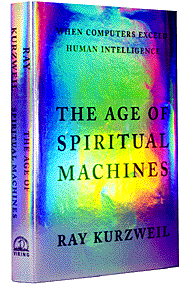
Ray Kurzweil's The
Age of Spiritual Machines is a currently popular long-term futurist
speculation
-
Kurzweil is credible because he has a very successful
record as an innovator and entrepreneur
-
his fundamental argument is that people will
meld with machines, that our consciousness will become separate from our
bodies.
-
he begins with discussion of chaos theory, consciousness
and many of the topics we have covered in this course
-
he then discusses the exponential trends of
computing power (Moore's law) and projects that a $1,000 personal computer
will reach the computing power of the human brain (pp 104-105). Supercomputers
will reach this level of power by 2010.
-
he also discusses speculative new technologies
such as DNA computing and Quantum computing.
-
he has a series of scenarios which are written
as conversations with a person in the future who goes through various stages
of separating from her body
-
he also presents a time line, which jumps from
1999 to 2009, skipping the near and medium term future
-
by the year 2099 in his timeline "there is a
strong trend toward merger of human thinking with the world of machine
intelligence...there is no longer any clear distinction between humans
and computers...most conscious entities do not have a permanent physical
presence."
-
Question: what did the "American in Paris
in 2020 group" come up with? Here is one
I found, but I could not find a page linking them together.
Short term future: in terms of methods,
this relies primarily on environmental scanning and projecting trends,
including short-term technological trends. Forecasters generally
expect more
of the same including more people online - 250
million in five years says one firm.
-
Bill
Gates sees us at the dawn of a less PC-centric age, when people will
use several different mobile devices -- like Internet-enabled cell phones
and personal digital assistants -- to gain access to the Web. "No
one will dominate over the other," he says
-
certainly we will see a wider use of portable,
hand-held Internet devices, combined with cellular telephones, as well
as new Internet Appliances such as the i-opener,
just introduced this holiday season
-
we will have Internet in the car with voice
control and global positioning technology
-
more and more people will have cable or other
high speed connections to homes, making audio and video applications more
convenient
-
the Internet may integrate with television and
radio, all three coming in on the same devices
-
more and more companies will establish customer
WEB sites, and more merchandise will be sold online
-
Java and html may replace Windows and other
personal computer operating systems as the basic hierarchical principle
tying software together
-
Here is a message Stowell
Fulton sent me illustrating a new email technology, as well as a follow-up
message on House
Resolution 906.
-
Keleche
Okiri, Benjamin Ferrer and Sandor Toledo, and "applejax"
had also expressed an interest in making presentations.
The Medium Term - this is perhaps the most challenging
area for futures forecasting - it goes beyond simply predicting more of
the same, yet it is more grounded in reality than long-term speculation.
It is close enough that it is relevant to our decision-making.
-
A number of methods
of studying the future are used
-
cyclical and generational analyses are used
for predicting turning points in social and economic trends
-
scientific and technological forecasting are
used to try to anticipate developments which may lead to important technological
innovations in a five to ten year period
-
Economically, some people believe there are
long term cycles, sometimes called Kondratieff waves after a Russian economist
who first "discovered" them. These relate to major technological
innovations, such as the Information Age which Fukuyama and others discuss.
According to these analysts, we are on an upswing, the Early
Advance of the Information Processing Age. The medium term future
should be positive.
-
Another approach is generational analysis, such
as the Strauss-Howe
four generation model. According to this model, the new generation
which is emerging is an outer-driven, "civic," morally complacent generation
which will institutionalize many of the ideals of the previous generations.
It should be an era of stability and growth.
-
these positive trends may help to explain why
help to explain why crime and welfare dependency are down, the economy
is up, and the United States is the leading force in a new world order.
Certainly most prognosticators are positive, for example
Wired Magazine's "Prophets of Boom".
-
George
Gilder: great wealth is coming, our only problem is overcoming
the temptation to hedonism
-
Walter Wriston: economy will keep booming,
but the political system will not keep up
-
Harry Dent: the Dow will reach 30,000
to 40,000 in the next decade, The "Roaring 2000's," driven by a massive
baby-boom generation. The boom market will end around 2008 or 2009
when the baby boomers pass their peak spending years. This will lead
to a depressionary decade.
-
What does this suggest specifically for the
Internet? According to
The
Economist:
-
the predominance of Microsoft and of PC's will
decline
-
new protocols - such as the html language -
will be developed to let computers, handheld devices and mobile phones
talk to each other in new ways. Perhaps the most important will be
a "wireless application protocol"
-
with the new protocols and new technology, all
kinds of devices will be on the Net, e.g., refrigerators
-
the Internet will become easier to use, requiring
less knowledge on the part of the user
-
broadband technology will make it possible for
people to combine voice, graphics, audio and video in conversations and
working groups online
-
speech may become the main mechanism of connection
to the Internet
-
an eXtensible Markup Language (XML) will make
it clear to the browser what category a program fits in, what should be
done with it
-
encryption has to be improved so that net business
is safe and reliable, so that companies can "sign" contracts and purchase
agreements on the WEB
Another approach to the future is to plan, rather
than to forecast. This can be thought of as "backcasting" - figuring
out where you want to be, then working out how to get there. This
is what companies do, one way or another, they set goals and then work
out how to achieve them. We have been thinking in this way with the
WEBMIND project. Assuming that the fundamental software works as
planned, what could be done with it in the medium-term future. Here
are some ideas:
-
the market predictor - we already talked about,
we believe it will do better than others because it will analyze both textual
and financial information. Initial tests have been positive, but
it needs to be tested with real money rather than in test runs on historical
data
-
my idea, the Webmind Sales Advisor, similar
to the human one Land's
End offers on its WEB site, but better because you would not feel pressured.
It should remember you, carry on a real conversation, make good suggestions.
Here's an email
I sent Ben & Lisa about it. Ben sent me back an email
of
ideas he and Lisa and others had thought up. All of them involve
using Webmind in the background to improve existing software, not marketing
it as a product in itself.
-------------------TEN MINUTE BREAK AT THIS POINT ----------
Review Outline:
-
The distinction between determinist and chaotic
systems and the concepts of evolution and autopoiesis -
Oct 1 notes.
-
One of the characteristics of chaotic systems
is that order emerges out of apparent randomness. There is an evolution
or growth. This tends to go through regular stages, which can be
captured in Peirce's concept of numerical archetypes.- Sept
24 notes I will
use the numerical archetypes as the organizing principle for this lecture.
-
Naught or Nothingness. It seems
odd to talk about nothing, but this tuesday's NY Times Science Section
had a headline: Physicists
Fret About Nothing It reports
that, "according to the theory of elementary particle physics, even a vacuum
is filled with fields containing energy and evanescent particles that flit
in and out of existence, adding heft to nothingness." Some physicists believe
that this quantum vacuum is a "zero-point
field" or "fifth force" which will lead to a unified theory of the
universe (along with gravitational, electromagnetic and strong and weak
nuclear forces). Charles Saunders Peirce had reached much the same
conclusion through metaphysical introspection into the nature of thought,
saying that "even emptiness is something." From this perspective,
nothing is purely passive, there is some consciousness, some potential
for action, in everything including microscopic objects. This is
a philosophy which is widely held in "primitive" cultures, and is found
in many creation
myths. What does this mean for our brains? For artificial
intelligence? The brain is composed of neurons, tiny cells which
are similar to other cells in the body. Of course, these are composed
of atoms and sub-atomic particles. None of this is inert matter,
all of it has potential for energy and action. Energy and "evanescent
particles flit in an out of existence" in our brain as much as anywhere
else, and the quantum indeterminacy this creates may have something to
do with our consciousness. In this sense, there is consciousness
in everything. Our brains are clearly much more conscious than a
table or an amoeba - because this is elaborated in a higher pattern of
organization - but they begin with the same particles as everything else.
Practices such as meditation and prayer often try to recapture this most
simple level of thought. It is difficult to capture artistically,
some efforts I found on the internet include Nihilist Field Marshal Shapiro's
nihilist
art, Max Klinger's "Back
into Nothingness" and The
Really Big Button That Doesn't Do Anything. There is theoretical speculation
about incorporating quantum phenomena in computers, including
one on Ben's WEB site, but little has been done in practice.
There are quantum indeterminacies inherent in Internet packet processing
which may introduce some degree of quantum indeterminacy into programs
such as Webmind. The interaction between the computer programs and
human operators or users may also introduce quantum indeterminacy
-
Firstness is the concept of raw being,
of pure perception. This, of course, is what much art tries to capture,
e.g., Van
Gogh's Starry Night capture a pure feeling, although it can also be
interpreted on different levels. In physics, Firstness is chance
behavior, randomness, what we today call the quantum indeterminacy of particles.
It is something which emerges out of nothingness. It is the essence
of creativity, or thought or action which is not caused by some other force
or variable. How do we think creatively? Partly be meditating,
clearing our minds of elaborated thoughts, getting in touch with our "inner
being" or "contemplating our bully button." Partly by replacing established
links of thought with random ones, as in "brainstorming" or "synectics"
- group techniques that are used to generate new ideas. Computers
have not been particularly good at this up to now, but they will be more
so as they incorporate more and more unstructured input, and as they are
programmed to interact with each other in random ways. Neural net
programming is an attempt to allow the computer to come up with a new solution
to a predetermined problem, by simply trying a large number of connections
until it finds a pattern which works. Ray Kurzweil's Cybernetic
Poet writes poetry by "reading a selection of poems by a particular
author or authors and then creating a language model of that author's work
based on markov models, a mathematical cousin of neural nets." It then
uses a "recursive poetry-generation algorithm" to mimic the author's style,
together with "algorithms to maintain thematic consistency." (p 163
in The Age of Spiritual Machines). The poems are completely new,
but mimic those of the author whose work was read into it. If you
want to try it, you can download a version of it for free. In religion,
monotheism is the cult of Firstness.
-
Secondness is the relationship between
two phenomena, two Firstnesses. We experience secondness when our
will runs smack into someone else's - as when our automobile smashes into
someone else's. Secondness is pure reflex action: every time
you apply force A you get reaction B. Machines are examples of Secondness.
With a typewriter, for example, you push a letter and the key connected
to it hits the paper. With a mechanical calculator or a slide rule,
every time you push the same keys, you get the same result. Electric
typewriters and electronic calculators are not much different. The
industrial age transformed the world with the perfection and elaboration
of Secondness. A mechanical clock is a symbol of Secondness.
A clock has many parts, of course, Secondness does not mean one can have
only two objects - there can be a sequence of parts, each linked in a mechanical
way. Mathematically, arithmetic is Secondness - it tells you how
numbers are related. Artistically, Secondness is captured by literary
works which focus on relationship rather than on description. Novels
are an excellent literary form for expressing Secondness, while poetry
is better for expressing Firstness. Motion pictures are Secondness
- they show forces and objects impacting on each other - while still pictures
are Firstness, capturing the essence of a scene. In religion, Secondness
is expressed in dualism
- the belief that the world is a struggle between two forces, typically
good and evil, all the more so if these are material entities - God and
the Devil. One might also see Secondness in the relationship between
Father and Son in Christian theology, especially when these are viewed
as historical entities rather than as symbols. The struggles of the
Greek Gods, also, are on the level of Secondness even though there were
many of them - they were tangible, physical beings who fought and loved
and otherwise interacted with each other and with humans.
-
Thirdness is habit or pattern.
It is not tangible or material like Secondness, it is more abstract.
Mathematically, Thirdness is algebra, not arithmetic. Thirdness does
not simply mean that three things are relating instead of two, but it is
often difficult to capture the relationship between three things - even
three planets - without an abstract equation.
-
Determinist, "linear" science is the paradigmatic
example of Thirdness. It is very powerful indeed because it reduces
a great many observations down to a few formulas such as Newton's laws
of motion.
-
Recursive computer programs are on the level
of Thirdness. They follow strictly defined rules, and they do it
over and over again - recursively - very quickly. Logically, this
is deductive analysis - given a certain body of information, a certain
set of inputs, the program deduces a certain conclusion. Computer
programs using recursive logic can be very useful, because they do boring,
repetitive tasks for us quickly and efficiently - e.g., word processors
which rewrite and reformat text every time we insert or delete a word and
spreadsheets which recalculate our columns of numbers every time we change
one of them. They are vastly better than using a typewriter, where
we have to make every change ourselves. But we cannot give these
programs instructions in plain English and expect them to understand and
respond. These programs may seem intelligent at first, but after awhile
the repetitiveness makes them seem more like machines. They get the
same results you could get working with a typewriter or hand calculator,
but they do it much more quickly and more reliably.
-
Chatterbots such as Eliza are recursive,
but they cleverly pretend not to be. They minimize repetitiveness
by incorporating random number generators - an element of Firstness - at
certain points in their recursive logic. Thus, you cannot predict
which answer they will give, although you could predict how many times
they would give each of a set of answers over a long period of time.
They also emulate Secondness by interacting with the user. They do
not go onto Fourthness, which is why they are not truly intelligent.
-
Neural
nets and evolutionary algorithms are also examples of Thirdness, although
they are less predictable than recursive programs. They set limits
and patterns and allow the computer to vary at random within these patterns.
Like the Chatterbots, they add a dose of Firstness to their Thirdness.
Also like the Chatterbots, they are meant to interact with a user.
The user sets the goals and tells the program how well it is doing.
This is a more complex and meaningful interaction than the discussion with
a Chatterbot, and if you view the computer and the user as an interactive
system, you can move on to the level of Fourthness.
-
In the brain, Thirdness is the tendency to generalize.
As Peirce said, "...the one primary and fundamental law of mental action
consists in a tendency to generalization. Feeling tends to spread;
connections between feelings awaken feelings; neighboring feelings
become assimilated; ideas are apt to reproduce themselves."
-
In art, we might see Thirdness in the existence
of schools of art which share a general pattern, or in a style which is
characteristic of the works of a particular artist. How do we know
that a Picasso is a Picasso or a Mozart composition a Mozart?
-
In theology, it is tempting to interpret the
doctrine of the Trinity
as Thirdness, although the belief that the three parts of the Trinity form
a higher unity suggests Fourthness. Historically, this doctrinal
innovation was enormously helpful to Christianity as a religious movement,
it was able to incorporate a wide variety of religious experiences and
approaches.
-
Fourthness is a pattern which emerges
from a web of relationships which support and sustain each other so that
the whole is greater than the sum of the parts - this is often referred
to as synergy.
The term autopoiesisis
often used to describe how a system achieves Fourthness. Autopoiesis
it is a form of system organization where the system as a whole produces
and replaces its own components in an on-going structural coupling with
the surrounding environment. A key mechanism for autopoiesis is consciousness,
the
system's awareness of itself. The mechanisms which produce consciousness
in the human brain are as yet not fully understood, but it seems to emerge
from the interaction of large numbers of neuronal groups - there is not
a specific place in the brain where consciousness is located.
-
in music, one could say that a single note is
Firstness. Two notes played in succession could be thought of as
Secondness - they might clash or go well together. If they go well
together, one has a relatioship, a chord, which could be thought of as
Thirdness. A complex cord with three notes creates synergy, it sounds
full, complete, it is more than the sum of its parts. This is fourthness.
Symphonies and c
 complex
compositions which have numerous variations on a theme are also Fourthness,
they are synergies built of synergies. Viewed theoretically, music
is very complex, but people seem to understand its meaning intuitively
without being able to analyze it. Little is known about why different
kinds of music appeal to different kinds of people. You could try
listening to Autopoiesis,
the rock group, and see if it gives you insight into the concept of autopoiesis.
"New Age" music is thought to be more autopoietic, perhaps because it facilitates
meditation. There is clearly some kind of symbiosis between music
and our mental processes.
complex
compositions which have numerous variations on a theme are also Fourthness,
they are synergies built of synergies. Viewed theoretically, music
is very complex, but people seem to understand its meaning intuitively
without being able to analyze it. Little is known about why different
kinds of music appeal to different kinds of people. You could try
listening to Autopoiesis,
the rock group, and see if it gives you insight into the concept of autopoiesis.
"New Age" music is thought to be more autopoietic, perhaps because it facilitates
meditation. There is clearly some kind of symbiosis between music
and our mental processes.
-
in art, some theorists think that cubism
is an example of Fourthness, in that it has a more complex and abstract
four-dimensional
structure portraying the same object simultaneously from different perspectives.
-
in literature, Gertrude Stein's "If
I Told Him: A Completed Portrait of Picasso" might be taken as
a quintessential example of Fourthness - the meaning is in the pattern
of the words and not in their literal meaning.
-
for those of you taking Methods of Social Research,
we might say that Firstness is a univariate frequency distribution, Secondness
is a cross-tabulation, Thirdness is a multivariate crosstabulation or multiple
regression (path) analysis, while Fourthness would require a simulation
where variables could interact recursively over time (the dependent variables
have a lagged influence on the independent variables).
-
in computer programming, the Webmind software
is designed to implement Fourthness. Its is composed of nodes, which
relate to each other both hierarchically and heterarchically. These
nodes learn by assimilating information from the outside, and by interacting
with each other in structured ways. There is a Self Module which
is explicitly charged with maintaining a conscious self-image of the system.
The tricky part is integrating it into a self-sustaining system.
See the lecture
notes for November 5 for an outline.
-
Fourthness is not a matter of having four rather
than three things in a relationship; it is a matter of completeness
or wholeness, a system which is self-sustaining. Often, these systems
have three components, people seem to be naturally inclined to understand
things in
three terms of parts.