

Research
Patterning is controlled by a handful of highly conserved and interacting signaling pathways.
We focus on BMP signaling, a highly conserved pathway from worm to human. Mal-regulation of BMP
signaling was associated with developmental and cancer diseases. Recently, the dynamics of BMP signaling
was characterized in oogenesis. 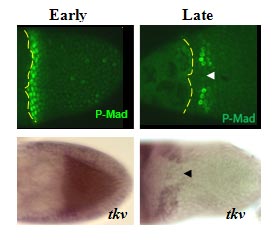 The initial anterior-posterior (AP) signaling polarity, monitored
by P-Mad, later acquired a clear dorsal-ventral (DV) polarity, shown as two domains symmetrically
distributed on both sides of the dorsal midline (Green, arrow head marks the midline).
The dynamics of BMP signaling reflect the changes in the BMP type I receptor Thickveins (Tkv). The early uniformly
expressed tkv appears later as two dorso-lateral patches on both sides of the midline (tkv in situ
hybridization). Currently, we pursue a global analysis of multiple components of the pathway.
The initial anterior-posterior (AP) signaling polarity, monitored
by P-Mad, later acquired a clear dorsal-ventral (DV) polarity, shown as two domains symmetrically
distributed on both sides of the dorsal midline (Green, arrow head marks the midline).
The dynamics of BMP signaling reflect the changes in the BMP type I receptor Thickveins (Tkv). The early uniformly
expressed tkv appears later as two dorso-lateral patches on both sides of the midline (tkv in situ
hybridization). Currently, we pursue a global analysis of multiple components of the pathway.
Morphogenesis is preceded by the elaborate patterning of differentially expressed genes during the
development of a tissue. The Drosophila eggshell is a three dimensional structure derived from the two
dimensional FCs engulfing the developing oocyte. The most prominent structures of
D. melanogaster (D.
mel.) eggshell are the two respiratory tube-like shaped dorsal appendages (DAs) and the operculum (Op),
the opening from which the larva hatches. The diversity in the number of DAs between different species
of Drosophila offers a fascinating opportunity to study the evolution of morphological traits. For example,
D. phalerata (D. pha.) has three DAs, and D. virilis (D. vir.) has four. We hypothesize that the diversity
in the dynamics of signaling networks can account for the changes in the number of appendages.
Specifically, the transition 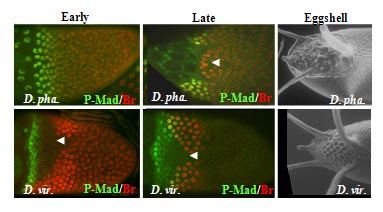 of BMP signaling from purely AP to DV polarity is conserved across species,
but the later DV pattern demonstrates a significant divergence. Currently, we screen for possible candidates
that can account for the diversity of eggshell morphology between different species of
Drosophila.
of BMP signaling from purely AP to DV polarity is conserved across species,
but the later DV pattern demonstrates a significant divergence. Currently, we screen for possible candidates
that can account for the diversity of eggshell morphology between different species of
Drosophila.
 Rutgers,
The State University of New Jersey
Rutgers,
The State University of New Jersey