The Quarterback Abstract:
Ranking the Quarterbacks in Modern Day History
|
The Quarterback Abstract: Ranking the Quarterbacks in Modern Day History |
Online Supplement
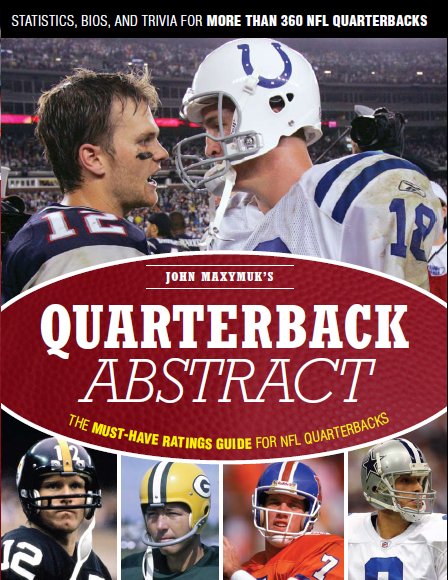
This book contains entries on 367 men and attempts to answer three questions about each quarterback: Who was he? What was his playing style? How good was he?. The bulk of the group is made up of 338 quarterbacks who have started at least 10 games in the NFL since 1950. Beginning with 1950, two-platoon football was made permanent allowing the T-formation quarterback to focus solely on offense without also having to play defensive back anymore. The advent of the two-platoon game also made it easier to track starting quarterbacks. In the book, I also included 27 pre-1950 signal callers, some of whom played at least part of their career as single-wing tailbacks. These men either were likely to have started at least 10 games at quarterback or were passers of such significance that they could not be ignored.
I used a cutoff point of 10 NFL starts in order to keep the book to a manageable length, but there are at least another 240 quarterbacks who started a game in the league. This online supplement contains capsule entries on each of those field generals, divided into seven web pages.
Quarterbacks with 1-9 Starts
A-C | D-G
| H-K | L-M
| N-Q | R-S
| T-Z

| Quarterback | Record |
Comments |
| Mike Rae | ||
| OAK 1976-77 TBB 1978-79 | 4-4-0 |
In 1972, USC swept to the national championship by averaging 40 points a game behind Mike Rae throwing to Lynn Swann, Charles Young and J.J. McKay and handing off to Anthony Davis and Sam Cunningham. The weak-armed Rae was drafted in the eighth round by the Raiders, but played in Canada for three years before reporting to Oakland in 1976. Two years later, Mike’s college coach brought him to Tampa as Doug Williams’ backup. Rae finished his career with the Los Angeles Express in the USFL in 1983. He averaged 6.8 yards per rush in the NFL but just 6.2 yards per pass. |
| Dave Ragone | ||
| HOU 2003 | 0-2-0 |
Ragone was a 6’3” 240-pound mobile lefthander who succeeded Chris Redman as the quarterback at Louisville. Dave was drafted in the third round by the Texans and was stuck behind David Carr for three years, barely completing half his passes. He spent a year in Europe and failed to catch on with the Rams before going into sports talk radio in Louisville. |
| Larry Rakestraw | ||
| CHI 1966-68 | 0-4-0 |
Pocket passer Larry Rakestraw succeeded scrambling Fran Tarkenton as Georgia’s quarterback in 1961. Larry led the Bulldogs to three straight losing seasons and was drafted in the eighth round by the Bears and 11th round by the Raiders. With the Bears, Rakestraw roomed with Brian Piccolo before Piccolo and Gale Sayers famously were paired together. In three years, Larry threw one touchdown pass and seven interceptions, while completing 45% of his passes. |
| Tom Ramsey | ||
| NEP 1986-88 Colts 1989 | 2-3-0 |
Ramsey shared the quarterback job at UCLA with Jay Schroeder and was co-MVP of the 1983 Rose Bowl with defensive back Don Rogers. Drafted in the 10th round by the Patriots, Ramsey signed instead with Los Angeles in the USFL and threw 15 touchdowns and 21 interceptions in two years before reporting to New England. After completing just eight of 19 passes in his one start in 1988, Ramsey was benched in favor of newly-acquired local hero Doug Flutie. He finished his career the next year in Indianapolis backing up Jack Trudeau and Chris Chandler. Tom threw for seven touchdowns and10 interceptions in the NFL. |
| John Rauch | ||
| NYY 1949-51 PHL 1951 | 0-3-0 |
Rauch led the Georgia Bulldogs to four straight bowl games and was the second overall pick in the NFL draft in 1949. Detroit then traded his rights to the New York Bulldogs for the rights to Doak Walker. As an NFL quarterback, Rauch completed just 41% of his passes and went into coaching at the age of 25. Johnny became the head coach of the Raiders when Al Davis became AFL Commissioner in 1966 and Bill Walsh joined Oakland’s staff as an assistant. Rauch was a fiery sort who quarreled with Davis and left Oakland to sign with Buffalo, Unfortunately, Johnny clashed with Bills’ owner Ralph Wilson as well and quit after two years. He continued coaching and scouting in the NFL, CFL and USFL and was elected to the College Football Hall of Fame in 2003. |
| Albie Reisz | ||
| Rams 1944-46 BUF 1947 | 4-6-0 est. |
Albie Reisz was an All American at Southeastern Louisiana and was the Rams leading passer as a rookie in 1944. The next year, he was replaced by rookie Bob Waterfield who led the Rams to their first NFL championship as the team improved from 4-6 to 9-1. Albie doubled as a punter and jumped to the Bills in the All America Football Conference in 1947 |
| M.C. Reynolds | ||
Cards 1958-59 WSH 1960 BUF 1961 OAK 1962 |
3-5-0 |
Mack Reynolds was a running quarterback who played with Billy Cannon, Jim Taylor, Johnny Robinson and Warren Rabb at LSU. Reynolds caught on with the Cardinals for a couple of years and then was traded to Washington for a third round draft pick. The next year, he signed with Buffalo in the AFL, but threw just two touchdowns to 13 interceptions as he battled his former LSU teammate Rabb for playing time. Mack had actually started a game in Buffalo as a rookie for the Cardinals who were looking to move their franchise at the time. After failing in Buffalo and Oakland, Reynolds played a little in the CFL for one year before retiring. |
| Jerry Rhome | ||
DAL 1965-68 CLE 1969 Oilers 1970 Rams 1971 |
1-5-1 |
At Tulsa, Rhome teamed with receiver Howard Twilley in the most dynamic passing offense in the nation under Head Coach Glenn Dobbs and assistant coach Sammy Baugh. As a senior, Jerry led the nation in total offense and passing, threw 32 touchdown passes and finished second in the Heisman Trophy voting. The Jets owned his draft rights and traded them to the Oilers for the top pick in the AFL draft, Joe Namath. Rhome was a short Texan with a slight build and signed with the Cowboys where he found himself behind Don Meredith, Craig Morton and later Roger Staubach. Rhome was traded to Cleveland and then Houston before finishing his journeyman’s career in Los Angeles. He had a long career as a coach and was elected to the College Football Hall of Fame in 1998. |
| Bucky Richardson | ||
| Oilers 1992-94 | 1-3-0 |
Richardson was an option quarterback at Texas A&M and was drafted in the 8th round by Houston in 1992. Bucky gained a following as a local hero by leading a fourth quarter game-winning drive against the Cowboys in the preseason, but was strictly third string behind Waren Moon and Cody Carlson in the regular season for two years. When Moon was traded in 1994, Richardson shared the job with Billy Joe Tolliver and Carlson in a miserable 2-14 season that allowed Houston to draft Steve McNair. Bucky was released and was unable to catch on with the Cowboys, Patriots and Chiefs. |
| Alan Risher (replacement) | ||
TBB 1985 GBP 1987 |
2-1-0 |
Risher was undrafted by the NFL out of LSU and signed with the USFL’s Arizona Wranglers. In two years, Alan threw for 23 touchdowns and 23 interceptions. Signed by the Bucs in 1985, he spent the season holding for kicks as a third string quarterback behind Steve DeBerg and Steve Young. Risher resurfaced in 1987 as the Packers’ quarterback for the replacement player strike games and led Green Bay to a 2-1 record. He later spent one season as a head coach in Arena Football League2. |
| Gene Ronzani | ||
| CHI 1933-38, 1944-45 | 1-1-1 est. |
Marquette’s Gene “Tuffy” Ronzani spent six years with the Bears as a halfback and retired when he reached 30. Five years later, George Halas brought back the 5’9” Ronzani as a quarterback during the War. In two years, Gene threw for nine touchdowns and seven interceptions and often served as the “warmup act” at quarterback before Sid Luckman would enter the game. Ronzani was an assistant coach at Notre Dame and the Bears for five years and then replaced legendary Curly Lambeau as the Packers’ Head Coach in 1950. Gene’s record in four years in Green Bay was a miserable 14-33-1. |
| Jim Root | ||
| Cards 1953, 1956 | 1-6-1 |
Root quarterbacked Miami of Ohio under coach Woody Hayes and his prime target was receiver Clive Rush who would later coach the Patriots. Jim was drafted by the Cardinals in the 23rd round in 1953 and got to start half the team’s games as a rookie in the pathetic 1-10-1 season. He was released in 1954 and spent the next couple of years in the CFL, the Army and in the Browns training camp. He returned to Chicago in 1956 as a backup and stepped in as a starter for two games after Lamar McHan was suspended. In 20 games, Root had 16 passes intercepted and fumbled nine times. He later coached at William & Mary and at the University of New Hampshire. |
| Ed Rubbert (replacement) | ||
| WSH 1987 | 3-0-0 |
6’5” Ed Rubbert went undrafted out of Louisville and was cut as a free agent in training camp by the Redskins in 1986. A year later, Washington brought Ed back for the replacement player strike games, and he led the Redskins to three straight wins on their way to an eventual Super Bowl championship. In Rubbert’s first start he threw for 334 yards, including an 88-yard touchdown to Anthony Allen, against the Cowboys. He later played Arena Football. |
| T.J. Rubley | ||
Rams 1993 GBP 1995 |
2-5-0 |
A ninth round pick out of Tulsa, Rubley started seven games as a rookie for the Rams, but hurt his arm and never started again. Two years later, Rubley was the third quarterback in Green Bay and was called on in the fourth quarter of a game against the Vikings with Brett Favre and Ty Detmer both down with injuries. With under a minute to play, the Packers faced a third and one on Minnesota’s 38 in a tie game. Coach Mike Holmgren called for a quarterback sneak, but Rubley audibled to apass play. T.J. rolled to the right and threw a pass back across his body that was picked off and led to the Vikings’ winning points. Holmgren cut Rubley a week later. T.J. tried Europe and Canada and even tutored Keanu Reeves for his role in the movie The Replacements but never made it back to the NFL. |
| Ed Rutkowski | ||
| BUF 1963-68 | 0-3-0 emergency |
The longest emergency quarterback tenure was by Ed Rutkowski, the fifth quarterback of the 1968 Bills. Buffalo lost Jack Kemp during the preseason and Tom Flores, Dan Darragh and Kay Stephenson during the first 11 games of the year. At 1-9-1, the Bills turned to jack-of-all trades Rutkowski to quarterback them in their last three games. Ed was recruited as a quarterback to Notre Dame, but shifted positions there while Daryle Lamonica started. At Buffalo, Rutkowski played halfback, receiver, return man and defensive back. Unlike other emergency quarterbacks, Rutkowski did not avoid the pass, but threw 100 passes in his 3+ games behind center. Unfortunately he completed only 41 and threw six interceptions as the Bills lost all three to win the top draft spot for 1969, the O.J. Simpson sweepstakes. Ed later worked for Jack Kemp in Congress and served as the Erie County Executive for nine years. |
| Art Schlichter | ||
| Colts 1982, 1984-85 | 0-6-0 |
Art Schlichter’s autobiography at Ohio State was titled Straight Arrow, but he turned out to be anything but that. He was the Colts’ top pick in 1982, but was beaten out by fellow rookie Mike Pagel who had been drafted in the fourth round that year. Schlichter compensated by getting into gambling and got himself suspended from the NFL for 1983. Reinstated in 1984, Art got to start five games late in the year and lost all five. He then started the 1986 season opener, losing 45-3 to the Steelers, and never appeared in another league game. The gambling got worse, and Pete Rozelle suspended Schlichter for good in 1987. He played in the CFL and Arena Football after that, but began to amass a different set of statistics in the next 20 years: locked up 17 times in 44 different jails for 10 years for a variety of fraud related offenses. |
| Scott Secules | ||
| MIA 1989-91 NEP 1993 | 0-4-0 |
Drafted out of Virginia in the sixth round of the 1988 draft by the Cowboys, Secules caught on with the Dolphins the following year as Dan Marino’s backup. His only starts came with New England in Bill Parcells’ first year as Patriots’ coach. Secules replaced struggling rookie quarterback Drew Bledsoe and led the 0-4 Pats to a comeback win over the Cardinals. Scott started the next four games but could only lead the team to 39 points and no victories. Bledsoe returned and spurred New England to four wins in the last seven games. |
| Frank Seurer | ||
| KCC 1986-87 | 0-2-0 |
Seurer set passing records as a Kansas Jayhawk, but his senior year was gruesomely marred when his father was stabbed to death in the restaurant he owned. Frank was drafted in the third round of the 1984 supplemental draft by Seattle, but chose to sign instead with Los Angeles of the USFL who were coached by Frank’s college coach at Kansas, John Hadl. Seurer backed up Steve Young in Los Angeles and then signed with the Chiefs in 1986. Frank dislocated his hip and tore ligaments in his ankle in a car crash that year and lost a great deal of mobility that shortened his career. One thing he did gain from the Chiefs, though, was a wife since he married one of the team’s cheerleaders. He is now a fireman. |
| Allie Sherman | ||
| PHL 1943-47 | 0-2-0 est. |
Sherman was born in Brooklyn and graduated from Brooklyn College. Greasy Neale signed the undersized, left-handed quarterback for the Eagles, and Allie backed up Roy Zimmerman and Tommy Thompson for five years. Neale thought so highly of Sherman that he recommended Allie to Giants’ coach Steve Owen when Steve was installing the T formation in 1949. Sherman spent most of the next 20 years as either an assistant or head coach with the Giants, experiencing both great success and utter failure with a 57-51-4 record as a head coach. Sherman was actually the first left-handed quarterback to play in the NFL. |
| Tom Sherman | ||
| NEP 1968-69 BUF 1969 | 1-6-0 |
Sherman was another star Penn State quarterback who flopped at the next level. Tom was co-MVP of the 1967 Gator Bowl with Florida State quarterback Kim Hammond and the two would be teammates on the 1969 Patriots. Sherman, a 40% passer was dropped from Boston that year for criticizing head coach Clive Rush. Tom spent the next few years playing semipro football before surfacing as the starting quarterback of the New York Stars of the WFL in 1974. Sherman threw for 22 touchdowns and 25 interceptions in two seasons in the WFL and then finished his career as a backup in the CFL. |
| Steve Sloan | ||
| ATL 1966-67 | 0-1-0 |
Sloan was one year behind Joe Namath and two ahead of Ken Stabler at Alabama and helped quarterback the Tide to consecutive national championships in 1964 and 1965. He was drafted in the 11th round by the new Falcons franchise to back up top pick Randy Johnson. In his only NFL start, Steve went 0 for 6 passing in a 38-7 loss to Philadelphia. After his playing days, Sloan had a long career as a college coach and athletic director with a 68-86-3 record. One of his assistants at Vanderbilt and Texas Tech was Bill Parcells. |
| Ron Smith | ||
Rams 1965 PIT 1966 |
2-5-0 |
An immobile 6’5” quarterback at Richmond, Smith was drafted in the 10th round by the Rams and the 23rd round by the Chargers. Ron only appeared in one game with Los Angeles and was acquired by the Steelers the following season. When Bill Nelsen injured his knee, Smith stepped in as the starter for half the year. Ron only completed 43% of his passes and barely got out of some games alive; he was sacked 12 times by the Cowboys and eight by the Redskins in two losses. |
| Troy Smith | ||
| BAL 2007-08 | 1-1-0 active |
The mobile 6-foot tall Smith won the Heisman Trophy at Ohio State, but wasn’t drafted until the fifth round by the Ravens. Troy showed potential in two late season starts as a rookie and probably would have opened 2008 as the quarterback in Baltimore if he hadn’t gotten tonsillitis in training camp and given rookie Joe Flacco a chance to shine. |
| Bob Snyder | ||
| RAMs 1937-38 CHI 1939-41, 1943 | 2-11-0 est. |
Bob Snyder came out of Ohio University in 1936 and signed with the Pittsburgh Americans of the second American Football League. A year later when the AFL II’s Cleveland Rams joined the NFL, so did Snyder. In his two years in Cleveland, Bob twice led the Rams over the Bears. George Halas took notice and purchased Snyder’s contract the next year. With the Bears, Bob served primarily as Sid Luckman’s backup and as the team’s kicker. Snyder took 1942 off to teach the T formation at Notre Dame, but returned to Chicago for one more year behind Luckman in 1943. Bob became the youngest head coach in the league in 1947 at the age of 33 when he took over the Rams. He only lasted one year as head coach, but worked as a coach in the NFL, CFL , minor leagues and college for the next two decades. He helped install the T in six different college programs. |
| Kay Stephenson | ||
SDC 1967 BUF 1968 |
0-3-0 |
Kay Stephenson lost out to Steve Spurrier twice at Florida. As an undergraduate, Stephenson served as Spurrier’s backup; 25 years later, the Gators hired Spurrier as their head coach with Stephenson an unsuccessful candidate for the position. The Chargers signed Kay as an undrafted free agent in 1967 and let him go to the Bills a year later. In 1968, Stephenson was one of four Buffalo quarterbacks during a dreadful 1-12-1 season. Despite being just a 38% passer, Kay embarked on a long coaching career that included a stint as the Head Coach of the Bills, but he was fired when Buffalo lost 18 of the last 20 games under his leadership. Stephenson coached the very first World League of American Football champion and later coached in Canada. |
| Matt Stevens (replacement) | ||
| KCC 1987 | 0-2-0 |
Matt Stevens was undrafted out of UCLA where he led the Bruins to a 1986 Rose Bowl victory. He started the first two replacement player strike games for the Chiefs and then separated his shoulder. In the final strike game, Doug Hudson started for Kansas City but was knocked out early. Stevens was forced to come in and play most of the game. Stevens later played some Arena Football and is now a UCLA broadcaster. |
| Jim Still | ||
| BUF 1948-49 | 0-1-0 |
After starring at Georgia Tech, Still was drafted in the 16th round of the 1948 draft by the Cardinals. Instead, Jim signed with Buffalo of the All America Football Conference. With the Bills, Still was George Ratterman’s backup and the team’s punter. He also played some defensive back. He did appear in the 1948 AAFC title game in which Cleveland blew out the Bills 49-7. His one start came in the 1949 opener when Ratterman was holding out for a better contract. After losing to the Hornets, Buffalo came to terms with Ratterman, and Still went back to the bench. |
| Clint Stoerner | ||
| DAL 2000-01 | 1-1-0 |
An undrafted free agent out of Arkansas where he was mentored by Joe Ferguson, Stoerner competed against Quincy Carter, Anthony Wright and Ryan Leaf for the starting quarterback job on the post-Aikman Cowboys. In Clint’s second and final NFL start, he threw four interceptions against the Giants. Stoerner also played in Europe and became a star in Arena Football where he threw for 139 touchdowns in his last three years. |
| John Stofa | ||
MIA 1966-67, 1969-70 CIN 1968 |
4-5-0 |
Undrafted out of the University of Buffalo, strong-armed John Stofa starred with the minor league Daytona Beach Thunder for whom he threw 75 touchdown passes in two seasons. Stofa was signed by the expansion Dolphins in 1966 and threw four touchdown passes in the season finale against Houston. Stofa came into the 1967 season as the Miami starter but broke his leg in the second series of the opening game and cleared the way for rookie Bob Griese to establish himself. The next year, Miami traded Stofa to the expansion Cincinnati franchise for first and second round draft picks to make him the very first Bengal. The Dolphins reacquired John a year later, and he finished his career as Griese’s backup. |
| Pat Sullivan | ||
| ATL 1972-75 | 0-5-0 |
Although he won the Heisman Trophy at Auburn, Pat Sullivan wasn’t drafted until the second round by Atlanta because he was just barely six-foot tall. Although Coach Norm Van Brocklin seemed to like Sullivan, Pat completed just 42% of his passes for five touchdowns and 16 interceptions in his four years in Atlanta. Sullivan went into college coaching after retiring and has been head coach at TCU and Samford where his combined record is 34-54-1. |
| Kevin Sweeney (replacement) | ||
| DAL 1987-88 | 2-2-0 |
An alumnus of Fresno High School, Sweeney followed Ted Tedford as the quarterback for Fresno State in the mid 1980s. Standing barely six-foot tall, Kevin was drafted in the seventh round by the Cowboys in 1987 and made the Dallas replacement player strike team. Sweeney was excited and said, “Heck, last week I was out of work watching Leave It to Beaver reruns. Now, I’m playing quarterback for the Cowboys.” Kevin led the strike Cowboys to two wins and remained with the team for a season after the strike was over. He later played in the World League of American Football. |