April 13, 2005 - New York Times
Depressed? New York City Screens for People at Risk
By MARC SANTORA and BENEDICT CAREY
Doctors in New York City have begun to use a simple questionnaire to
determine if a patient is at risk for depression, a practice that
health officials hope will become a routine part of primary care, much
like a blood pressure test or cholesterol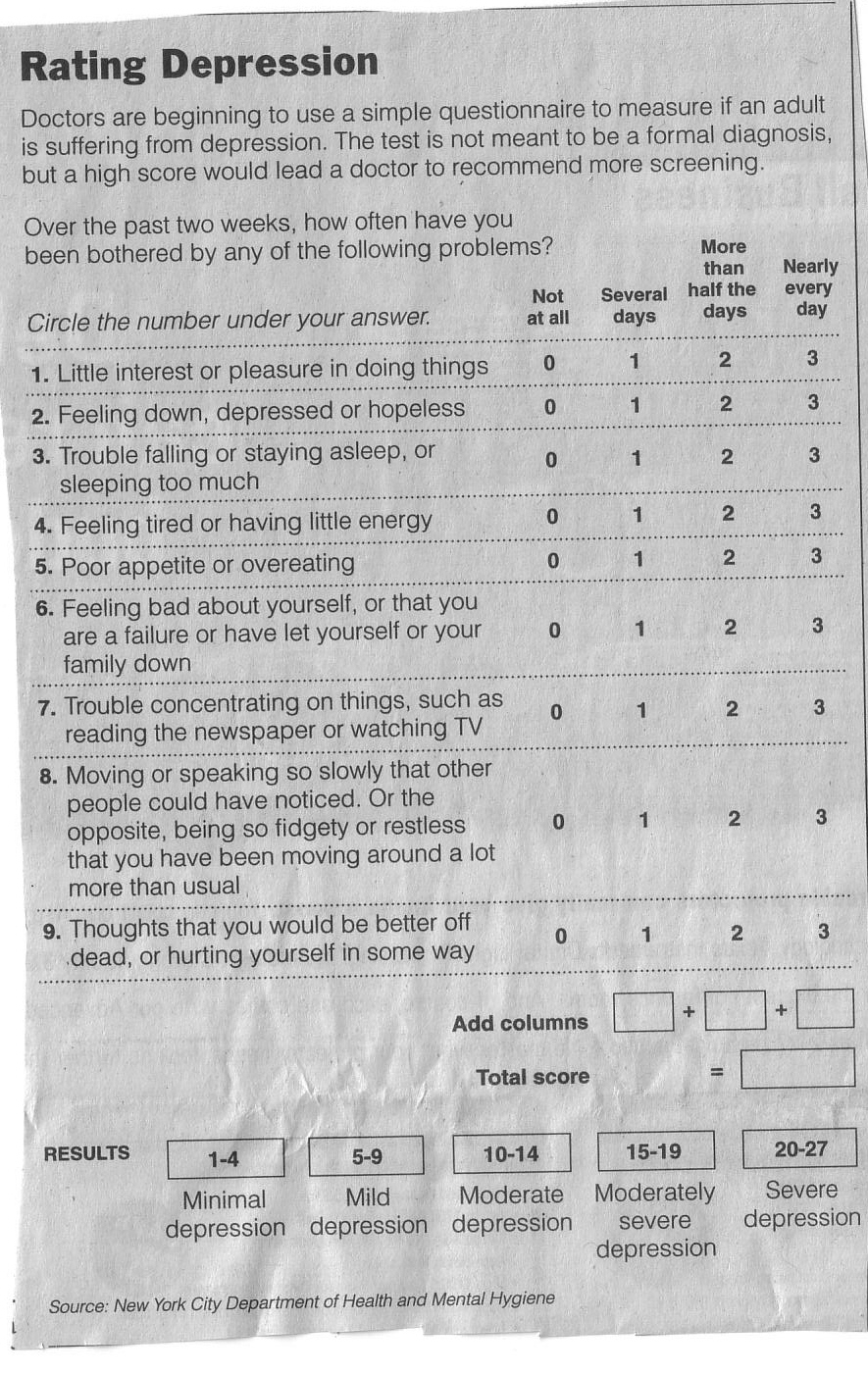 reading.
The new program is the first to carry out depression screening using a
scored test on a wide scale. It comes amid a spirited national debate
among psychiatrists, policy makers and patient-advocacy groups on the
wisdom of screening for mental disorders, especially in children.
In 2003, an expert panel convened by President Bush recommended
expanding mental health screening, and Congress budgeted $20 million in
supporting money for state pilot programs for this year. Several
states, including populous states like Florida and Illinois, have begun
to investigate large-scale screening plans, and scores of schools and
other youth centers throughout the country have used instruments to
test youngsters for suicide risk.
But some politicians and advocates for patients argue that testing
people broadly for mental conditions is an invitation to overdiagnosis,
unnecessary treatment and lifelong stigmatization.
In New York, no federal money is being used for the program, which is
under way in hospitals run by the city. The test, which is being given
to adults only, derives a depression score from the answers to nine
questions. It is not meant to yield a formal diagnosis, but a high
score would lead a doctor to recommend a more thorough clinical
screening.
The test includes questions about mood and behavior.
For instance, patients are asked if over the past two weeks they have
felt "down, depressed or hopeless." They can answer by checking one of
four categories: not at all, several days, more than half the days or
nearly every day. Dr. Lloyd I. Sederer, who heads the mental health
division of the Department of Health and Mental Hygiene, which is
leading the New York effort, said he hoped the screening would set an
example for other doctors in New York and around the country.
"It is our hope to have this become a standard practice," Dr. Sederer
said.
Health officials in New York City are working with the Health and
Hospitals Corporation to put their screening program into effect. So
far, only about a dozen primary-care physicians are using the test,
which was developed using research from the RAND Corporation. The goal
is to have every primary-care physician in the city hospital system
using the test within the next two or three years. One in every four
New Yorkers uses city hospitals for basic health-care treatment,
meaning the program could soon involve millions of patients.
Dr. Sederer said that a similar screening test could be developed for
adolescents and that if the testing of adults gained acceptance, it
would be easier for doctors to use a screening procedure for patients
of any age.
Psychiatrists and other proponents say mental health screening is long
overdue. They argue that millions of people with serious mental
disorders never get help, and that heightened vigilance would not only
allow doctors to head off much worse mental problems later, but would
also reduce the tremendous costs of untreated illness.
Surveys have found that about 16 percent of Americans - or as many as
46 million people - suffer from depression at some point. And by some
estimates, depression costs the nation $44 billion a year in lost work
and disability - more than any other illness, including heart disease.
But opponents say that depression is not always easy for primary-care
doctors to recognize, even in people who seek help, and they argue that
a screening score of any kind could needlessly confuse or worry
patients.
"When you label people as having a mental problem, such a label stays
with them for their entire lives, whether or not it's accurate," said
Vera Hassner Sharav, president of the Alliance for Human Research
Protection, a patient-advocacy group that has been campaigning to block
screening for mental health.
Critics like Ms. Sharav contend that screening tests will also increase
the use of psychiatric drugs, including antidepressants like Zoloft and
Prozac, whose use in children and adolescents has recently come under
scrutiny by regulators.
Representative Ron Paul, a Texas Republican and a gynecologist,
introduced an amendment last fall to block federal financing for
screening programs, in part because of worries about overmedicating
schoolchildren. The plan was rejected.
"We already have a tremendous number of kids being put on drugs like
Ritalin and Prozac," Dr. Paul said, "and I think if these screening
programs grow, you're going to see a lot of people pushed into
medication programs for behavioral problems."
Dr. Sederer and psychiatrists, psychologists and administrators around
the country who favor screening say these concerns are overblown and
obscure a much larger problem: a dismissive public attitude toward
mental illness.
Bill Emmet, coordinator for the Campaign for Mental Health Reform, a
coalition of organizations working to build support for screening and
other mental health programs, said: "Are people sometimes misdiagnosed?
Of course. But the fact is that there are whole segments of the
population that for a variety of reasons are not being diagnosed with
problems they do have, and that is the far greater problem."
Dr. Sederer said that once doctors were convinced that a quantitative
score worked in recognizing depression, they would be more open to
using similar measures for other areas of mental health.
Still, he acknowledged that "nobody likes to be measured" and said that
there had been some resistance from doctors who worried that this would
take away from already limited time with patients and add to their
workload. The science behind screening is mixed. In studies of patients
who belong to health maintenance organizations in California and
Washington, researchers have found that screening, when combined with
programs that coordinate treatment, does help many adults who are
struggling with depression and who would otherwise receive little or no
care.
But in May, the Preventive Services Task Force, a federal panel of
experts that advises doctors and the government on screening
guidelines, concluded that there was not enough evidence to recommend a
similar kind of screening for suicide risk. The controversy is not
likely to be settled soon.
"I have been getting a lot of attention on this, and it runs across the
political spectrum, from civil libertarians on the left to Christians
on the right," Representative Paul said. "I think the idea of screening
people, of asking these kinds of questions, rubs people the wrong way,
and particularly when it's their children."
Officials in New York, however, defend their initiative.
"Depression is a leading illness in New York City, but it can be
effectively treated," said Dr. Thomas R. Frieden, the city's health
commissioner. "Our surveys show that there are an estimated 400,000 New
Yorkers with depression; many have not been accurately diagnosed or
effectively treated."