Lecture 1
Units and dimensions
Three fundamental dimensions, of length [L], of mass [M], and of time [T].
Speed or velocity is a distance divided by a time. Its dimensions are therefore
[v] = [L]/[T]
An acceleration is a velocity divided by a time, or a distance divided by a time squared. Either way its dimensions are
[a] = [v]/[T] = [L]/[T]2
Problem 1-8. The variables x, v, and a have the dimensions [L], [L]/[T], and [L]/[T]2 respectively. These variables are related by an equation that has the form vn = 2ax, where n is an integer constant (1, 2, 3, etc) without dimensions. What must be the value of n, so that both sides of the equation have the same dimensions? Explain your reasoning.
The dimensions of the right side are
[2ax] = [2]×[a]×[x] = 1×[L]/[T]2×[L] = [L]2/[T]2
Left side has dimensions
[vn] = {[L]/[T]}n = [L]n/[T]n
Clearly the two are the same if n = 2
SI and British units
SI system. Basic units of length, mass, and time are the meter, kilogram, and second.
British system of units, the foot and mile, for distance, and the pound and ton for weight.
The pound is a unit of weight, and the proper corresponding unit for mass is the slug.
Conversion of units
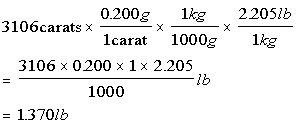
Problem 1-5. The largest diamond ever found had a size of 3106 carats. One carat is equivalent to a mass of 0.200 g. Use the fact that 1 kg (1000 g) has a weight of 2.205 lb under certain conditions, and determine the weight of this diamond.
Set out the conversion factors as fractions, and cancel the corresponding terms
Trigonometry
Sines, Cosines, and Tangents
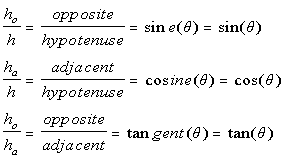
Long side of the triangle is the hypotenuse (h). Choose one of the angles other than the right angle, and call it (theta). The side opposite to is labeled ho and the side adjacent, or next, to is labeled ha. The most important ratios are then
Scalars and Vectors
Scalar quantities have no direction (e.g. time, mass)
Vector quantities (or vectors) have direction (e.g. velocity, acceleration, force)
Speed (a scalar) is the magnitude of the velocity (a vector).
Prototype vector is a displacement.
Draw an arrow, pointing in the direction of the displacement and with a length equal to the magnitude of the displacement.
A is the magnitude of A
Adding vectors - Head-to-tail
Draw the vectors head-to-tail so that the second vector starts where the first one ended and so on. You can add any number of vectors this way.
If A is a vector with magnitude A,
and B is a vector with magnitude B,
and C is a vector with magnitude C,
and
A + B = C
Does A + B = C?
If A and B are parallel, then
|A + B| = |A| + |B| (Parallel vectors)
If A and B are anti-parallel, then
|A + B| = |A| - |B| (Antiparallel, with A > B)
A - B = A + (-B)
See figure 1.14
Components of a vector
Any vector in two dimensions (i.e. in the x-y plane) can be written as the sum of a vector in the x-direction plus a vector in the y-direction. These two vectors are called the x- and y-components of the original vector. (See figs 1.16, 1.17, 1.19)
If
A = Ax + Ay
and
B = Bx + By
then
A + B = Ax + Ay + Bx + By
= (Ax + Bx) + (Ay + By)
The components of the sum of two (or more) vectors are the sums of the separate components.
(See fig 1.21)
Problem 1-62. A displacement vector A has a magnitude of 636 m and points 40.0o above the -x-axis. Another displacement vector B is added to A. The resultant has the same magnitude as A, but the opposite direction. Find (a) the x component and (b) the y component of B.
DRAW A PICTURE!
In fact, B = -2A
Bx = -2 × -636 cos(40) = 974 m
By = -2 × 636 sin(40) = -818 m
Problems from chapter 1 (solutions will be posted on web page): 1-7, 1-10, 1-18, 1-26, 1-52
The solution to 1-26 is to be handed in tomorrow. Instead of the value 7.41 km, use (6 + n / 10) km.
Kinematics in One Dimension (Chapter 2)
The displacement x of an object is the (vector) difference between its final and initial positions.

When finding a change in a quantity, such as x, we always write it as the final value minus the initial value, never the other way round.
If the object was at position x0 at a time t0 and at position x at time t, then the
time interval = elapsed time = t = t - t0
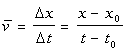
The average velocity over this time interval is defined as
Speed and Velocity
Speed is a scalar and velocity is a vector. The average speed is equal to the magnitude of the average velocity only if the motion is all in the same direction.
Instantaneous velocity

Acceleration
Average acceleration = Change in velocity / Elapsed time
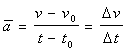
Define the instantaneous acceleration by

If the velocity is increasing, the acceleration is positive. If the velocity is decreasing, the acceleration is negative. Viewed as a vector, this means that the acceleration is in the opposite direction to the velocity. In everyday speech, we use the work "deceleration" to describe this.
Graphical Interpretation of Velocity and Acceleration
Plot the position x of an object as a function of the time t, then
If the velocity (or speed in this case) is constant, the graph is a straight line, and the velocity is the slope of the graph.(See fig. 2.23)
If the velocity is not constant, the line is curved. To find the instantaneous velocity at any time, draw a tangent to the curve at that time, and the instantaneous velocity is the slope of the tangent. (Fig. 2.25)
If the acceleration is constant, the graph of velocity against time is a straight line, and the acceleration is the slope of the line.
Problem 2-8 is assigned with 26 m replaced with (20 + n) m.