Memory Machines, Information Design, Economics of Media Systems
Some Features of Oral Cultural Transmission:
Oral Tradition as Memory Machine
- Beowulf and Homer's epics: manuscript/scribal culture represents an oral poet:
- The oral poet keeps "deep history" in memory: Beowulf (original Old English)
- The voice of the oral poet as oracle: poet authenticated by divine inspiration:
- The Bible as memory machine: basic oral memory features: parallelism and repetition: see online versions of the Bible (Genesis, Psalms).
- Oral culture meets literate, manuscript culture: the Beowulf manuscript: folio 129r, the first leaf of the manuscript. Copied c.1000 in England. In Old English.
Homer's Iliad I and Odyssey I (Greek: "andra moi ennepe musa...").

Plato, Writing, Memory, and Computers: After Ong, Chapter 4
- Speech, voice, writing, and technological interventions: alphabetic writing systems.
- Plato already in literate, scribal culture: see Phaedrus.
- Privileging speech--the present, real-time speech of dialogue--as underlying model of communication, thought, culture, politics.
- Are writing systems, and technological extensions of writing like computer text--extensions of speech or voice?
Problems in "Oral Culture" Theory
- Romantic nostalgia for pre-literate, pre-technological cultures: fantasies of organic societies cohering with bond of the present voice.
- Models for social transitions and cultural hybrids are needed rather than binary oppositions (oral vs. literate culture).
- In Western cultures since around 800 A.D., illiterate people have been expected to participate in literate culture (laws, scripture, literature read aloud to them).
- Literacy has thus become the norm through which culture, history, religion, and law are known (even for illiterate people in literate societies).
- Literate culture knows, subsumes, and can represent (in writing) oral culture and oral communication practices, but oral culture has no analogous knowledge or representational power for literate culture.
- Writing (handwritten or print) is a technology, part of the built human world through tools.
The First Information Age:
Manuscript Culture, c.400-c.1500
The technologies of manuscript production
and the culture of the manuscript book
The Rise of the Codex Book
- Form of the book adopted almost universally in the West by 400 AD, replacing the book as "volume" (roll).
- Materiality of the book: each manuscript was a unique object.
- Information in the medium: cultural/social information in the material form of the codex book, its use and reception throughout history.
- "Writing" in the Western world from c.100-1500 A.D. usually meant dictating aloud to a secretary, who wrote a draft on wax tablets, then a scribe copied the tablets onto parchment.
- Book production and use formed an economic and social system. The written languages were always the "official culture" (Latin, Greek), not the commonly spoken languages.
- Book production tied to a specific kind of literacy. Books in different genres had different formats, look and feel. Continues to today.
The Page as information system: Format and layout of the page
- Semiotics of the page: center and margins, columns, hierarchies of script.
Manuscript culture and early "hypertext": the page as system of meaning
- Text and glosses or commentary, Bible with gloss. Text with illustration. Text embedding and linking before hypertext.
- Example 1: Donatus, Ars grammatica, copied at Rheims, c.875.
- Example 2: Virgil, Aeneid, copied in Italy, c. 990.


Desire to extend the physical/material limits of a text, combining script, decoration, and images.
Case Study: The Copying System for University Student's Books, 1175-1400 (the pecia system)
- What was the economic system of the early university book? Interesting model of production and labor in the hands of the customer.
- Most non-university copying houses did book copying for hire. Most books from 1200 on were commissioned.
- [T]he nascent universities created a new
reading public. New texts, reference works, and commentaries were required
for scholastic study, and these works were not the kind produced in monastic
scriptoria. The new secular book trade became a licensed appendage of the
university, consisting of stationers, scribes, parchment makers, paper
makers, bookbinders, and all those associated with making books. They enjoyed
certain rights such as an exemption from taxes and the right to be tried
in university courts. A stationer was appointed only after an inquiry to
confirm his good standing and professional ability. He had to provide guarantees
and take an oath. Books tended to be sold and resold through many generations
and it was the stationer's responsibility to sell a book and buy it back
and sell it again, and so forth. He could buy and sell only under certain
conditions: he had to advertise the titles he had in stock, prices were
fixed, and students and professors received discounts. In order to produce
the large numbers of textbooks required by students and maintain their
textual accuracy, the pecia system of copying was instituted. The system
began in about 1200 and ended in about 1350 in the North, and about 1425-50
in the South. It existed in at least eleven universities (seven in Italy,
two in France, and one each in Spain and England) and probably many others.
The stationer held one or more exact copies (the exemplar) of a text in pieces (hence pecia), usually a gathering of four folios (sixteen columns) or perhaps six folios. Each column had to have a certain number of lines (usually sixty), and each line a certain number of letters (usually thirty). Each exemplar was examined to ensure it was correct, and any exemplar found to be incorrect resulted in a fine for the stationer. Each part was rented out for a specific time (a week at Bologna) so that students, or scribes, could copy them. This way a number of students could be copying parts of the same book at the same time. Stationers were required to rent pieces to anyone who requested them, and the charges were fixed (e.g., at Treviso in 1318 the charges were six pence for copying, and two pence for correcting). The size of books began to decline, and script became more compact and the number of abbreviations increased. The two-column format became the norm, and ornament was almost abandoned on all books with the exception of the luxury trade. Soft cover bindings tended to replace wooden boards, and parchment became progressively thinner as the number of folios per gathering increased. [From Richard Clement, Medieval and Renaissance Book Production: I. Manuscript Books]
Further sources:
Medieval and Renaissance Book Production: I. Manuscript Books and II. Printed Books (Richard Clement, University of Kansas)
The Making of Print Culture:
Better Memory Machines, or
Expanding the Centrality of the Codex Book
- 14th-15th centuries: though literacy remained class and institution-based, a growing urban--and secular--literate class began to emerge in European cities by the end of the 14th century.
- Latin textual culture already established through "grammatical culture" and the trivium (grammar, rhetoric, logic).
- Emergence of the "private reader" and silent reading. Demand for books.
- Converging industries: paper, metals, pressing devices.
- Church's book culture expanding to secular society.
- Diffusion of the textual ideology of "humanism" through standardized Latin books.
- Diffusion of continental Reformation: Luther's and Calvin's theological and political ideas depended on printed books.
- What were the earliest printed books? Bibles, liturgical (church) books like Psalters, private devotional books (Books of Hours), classical authors (Homer, Virgil), school textbooks (especially grammar; Gutenburg published several editions of Donatus's Ars grammatica, the standard Latin grammar book).
- Printing and language standarization: variations of manuscript culture regularized.
- Spread of vernacular, national languages through print and standardization. Other effect: solidifying nationalisms and ideologies through broad dissemination of standardized texts.
Richard de Bury's, Philobiblon (written 1345) (Richard was Chancellor of England under Richard III and Bishop of Durham):
In books I find the dead as if they were alive; in books I foresee things to come; in books warlike affairs are set forth; from books come forth the laws of peace. All things are corrupted and decay in time; Saturn ceases not to devour the children that he generates; all the glory of the world would be buried in oblivion, unless God had provided mortals with the remedy of books.
....
For the meaning of the voice perishes with the sound; truth latent in the mind is wisdom that is hid and treasure that is not seen; but truth which shines forth in books desires to manifest itself to every impressionable sense. It commends itself to the sight when it is read, to the hearing when it is heard, and moreover in a manner to the touch, when it suffers itself to be transcribed, bound, corrected, and preserved. The undisclosed truth of the mind, although it is the possession of the noble soul, yet because it lacks a companion, is not certainly known to be delightful, while neither sight nor hearing takes account of it. Further the truth of the voice is patent only to the ear and eludes the sight, which reveals to us more of the qualities of things, and linked with the subtlest of motions begins and perishes as it were in a breath. But the written truth of books, not transient but permanent, plainly offers itself to be observed, and by means of the pervious spherules of the eyes, passing through the vestibule of perception and the courts of imagination, enters the chamber of intellect, taking its place in the couch of memory, where it engenders the eternal truth of the mind. (Philobiblon, Chap. 1)
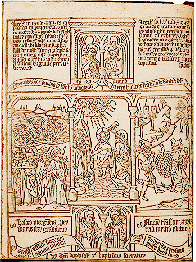
The Block Book: Printing before movable type.
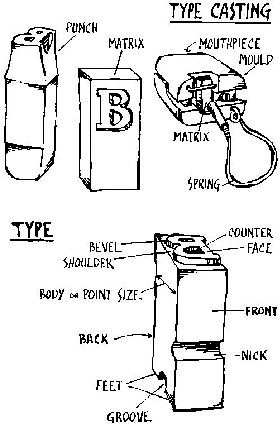
Johann Gutenberg's innovation: printing from hand-cast metal alloy type (probably lead, tin, and antinomy, which had a low melting point and quick solidification) in large quantities, on hand presses with oil-based ink.
Gutenberg's hand press. (From the Gutenberg Museum, Mainz.)
Gutenberg's famous 42-line (double column)
Bible printed in 1456 on six presses simultaneously, Mainz, Germany. (See
a close-up of the opening to St.
Paul's Epistle to the Romans.)
The first printed Psalter (Psalms):
Mainz, 1457. As You can see, the first printed books imitated manuscripts,
a fact that exemplifies McLuhan's theory that the content of a new medium
is an immediately prior medium.
-
Standardization of typography and page design:
regional variations gave way to "roman" type font, from prestige of the
humanist
movement in Italy and early classical Latin printed books: example
1; example
2.
- The continuing authority of the page: page layout, type design; personal portable object.
- Continued economic system of publishing, literacy, social experience and value of the book.
- Deconstruct a Web "page": continuities from early books, expectations of literate culture. Print publishing and multimedia convergence, new ecosystem of media types. Significance of print book metaphors for digital media.
Martin Irvine, 1999