"Go tell the Spartans, thou
who passest by,
That here, obedient to their laws, we
lie." (Trans. W. L. Bowles)
Die bekannteste deutsche Übersetzung ist Schillers, aus seinem Gedicht "Der Spaziergang":
"Wanderer, kommst du nach Sparta,
so sage
Du habest uns liegen gesehen, wie das
Gesetz es befahl."
During the Persian wars, a Spartan
army under King Leonidas helped hold Thermopylae pass against the much larger
Persian invasion force, but was eventually trapped and chose to fight to
the death rather than fleeing.
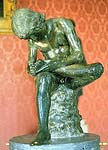 "Bild des Dornausziehers": the "Spinario"
or "Thornpuller," Roman bronze statue of the first century BC, after a Greek
model, showing a young man pulling a thorn from his foot. Much admired and
copied by Renaissance artists, used by Heinrich von Kleist (1777-1811) in
his essay "Über das Marionettentheater" as a symbol of youthful grace not
yet destroyed by conscious thought.
"Bild des Dornausziehers": the "Spinario"
or "Thornpuller," Roman bronze statue of the first century BC, after a Greek
model, showing a young man pulling a thorn from his foot. Much admired and
copied by Renaissance artists, used by Heinrich von Kleist (1777-1811) in
his essay "Über das Marionettentheater" as a symbol of youthful grace not
yet destroyed by conscious thought. 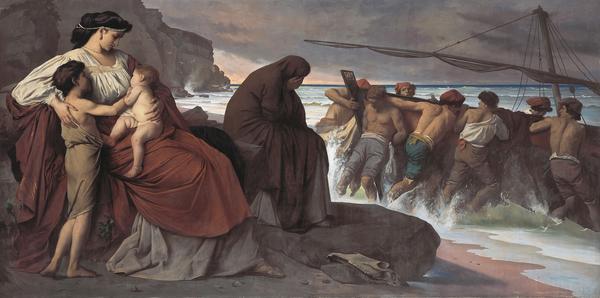
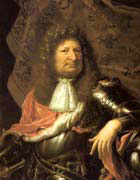 The "Großer Kurfürst" ("Great Elector") war Friedrich Wilhelm (1620-88),
Kurfürst von Brandenburg (1640-88), who greatly increased the territory, prestige,
and power of the Haus Hohenzollern, among other
things through the military defeat of Sweden at Fehrbellin (1675).
The "Großer Kurfürst" ("Great Elector") war Friedrich Wilhelm (1620-88),
Kurfürst von Brandenburg (1640-88), who greatly increased the territory, prestige,
and power of the Haus Hohenzollern, among other
things through the military defeat of Sweden at Fehrbellin (1675).