Alok Baveja and Michael Redmond
Police departments across the nation strive, often unsuccessfully, to
keep pace with growing crime in their neighborhoods by acquiring new technology,
using better problem-solving methodologies and building relationships with
the communities they serve. Available resources and manpower being limited,
this growth in crime has presented police administrators with myriad management
problems. At the same time, community residents and federal/state justice
departments are demanding that police departments adopt a more pro-active
outlook to controlling crime. But, a senior police officer in upstate New
York laments, "We’re drowning in a blitz of day-to-day problems and we
are being asked to look beyond. What is that? How is that done?
I have no clue!" Whereas this extreme skepticism may not be typical, it
underlines the need to explore whether police departments can indeed adopt
a strategic or pro-active outlook.
Don’t Businesses Have Similar Problems?
Yes, they do! Businesses too have limited access to resources. They
also have to contend with short-term (daily/weekly/monthly/quarterly) targets
and goals. But there is a difference. These short-term goals are deliberately
defined to meet the strategic or long-term objectives of the business.
Benchmarking is done to identify superior practices, and auditing to study
reasons for failures. Then, this information and the relevant learning
are shared among sister-divisions within the business, often on a global
scale. As the CEO of the successful Dell Computer Corp. remarked, "It’s
not that we have not made mistakes – we’ve made lots of them. But we are
really good at learning, and avoid repeating them. That’s just common sense
and being otherwise would be dumb." Unfortunately, this concept of shared
learning is alien to police departments across the country.
Is Communication Among Police Departments that Simple?
No, it is inherently difficult! Even if police departments made efforts
to document and share information, it may not be useful unless this is
done on a selective basis. First, each police department deals with circumstances
and problems unique to its community. Learning generated from the experiences
of a community that is vastly different from one’s own community may not
be easily transferable. Indeed, such learning may even be counterproductive.
Therefore, it may not be useful for police departments that serve vastly
different communities to talk to one another. Second, communities that
are good candidates for cooperation and shared learning, may be geographically
dispersed and unknown to one another.
These difficulties may be overcome by using Information Technology.
In the next section, we describe a computer-based decision-tool that will
make it easier for police departments across the nation to cooperate and
learn from their respective experiences, thereby fostering a strategic
outlook to controlling crime.
Artificial Intelligence, Information Sharing (A.I.I.S.) Software
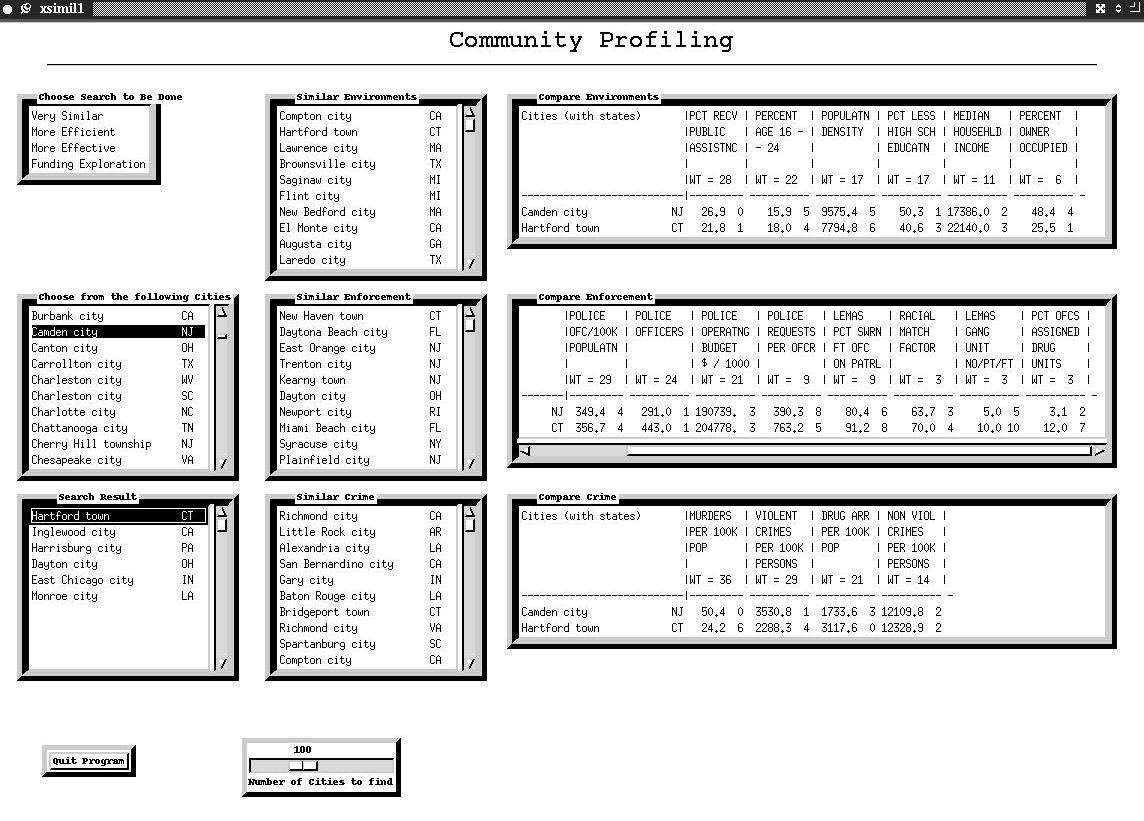
In partnership with the Camden and Philadelphia Police Departments, we have developed a computer software tool that enhances the potential for communication among police departments. This artificial intelligence based software tool uses on-line data sources – US Census, Law Enforcement Management and Administrative Survey, Uniform Crime Report and the FBI – and matches communities based on a tested and sophisticated analytical technique. To facilitate comparison and matching of communities, a number of individual factors are clustered into three dimensions:
The A.I.I.S. software is a user-friendly, easy-to-use, interactive tool
that yields matching communities based on target inputs provided by the
user police department. This software aims not to replace decision
makers, but to assist decision makers in making informed and strategic
decisions. Based on our extensive interviews with officials in the two
partner police departments, we have designed the software to address the
following questions:
What communities should we talk with? The software has a "find
very similar" feature which lists communities that are similar to one
another on the environment, enforcement and crime dimensions. Dialog with
such similar communities will help the user department to identify successful
and failed strategies. Additionally, such dialog may also alert the user
department to crime-related trends that are not yet manifest in its community.
For instance, if the Camden, NJ, police department were to use this feature,
it will identify Hartford, CT, as a top matching community (see Figure).
Further analysis, however, reveals that Hartford has a higher drug arrests
rate than Camden; additionally, it has a lower murder and violent crime
rate than Camden. Perhaps, Hartford is using a more effective drug enforcement
strategy that Camden can learn from.
Are there communities that are doing better than us? The software
has "find more effective" and "find more efficient" features
that identifies communities that are similar to the user department on
the environment dimension, but utilize their resources more effectively.
In other words, these communities have achieved lower crime levels with
the same enforcement resources as the user department, or they have same
crime levels with less enforcement resources. Dialog with such communities
will help the user department to identify and adopt policing strategies
that are more effective in combating crime. For example, if the Harrisburg,
PA, police department were to use the "find more effective" feature,
it will identify that New Bedford, MA, is more effective in utilizing its
enforcement resources. Closer scrutiny also reveals that New Bedford has
also been at the forefront of the move towards Community-oriented Policing.
Having adopted the community policing philosophy as early as 1993, it apparently
is reaping benefits through more effective resource utilization. Potentially,
Harrisburg can benefit by focusing its effort on community policing.
Figure: An Actual Screen Output from the A.I.I.S. Software Program
For an enlarged version of the Community Profiling
graphic, click
here.
Can we make a case for additional State/Federal funding? Often,
stringent State/Federal criteria for funding puts police departments in
the unenviable position of justifying requests for additional funding meticulously.
The software has a "funding match" feature that identifies communities
with similar environments, but enjoy access to greater enforcement resources
and
lower crime levels. The user police department can cite the examples of
such communities to argue for additional resources, "Since Community X
is similar to ours, we can reduce our crime level to match theirs, if we
had access to comparable enforcement resources." For instance, if the Hawthorne,
CA, police department used this feature, it will identify Yonkers, NY,
as a potential community to use as justification for additional enforcement
resources. Yonkers has almost twice the number of police officers and per
capital operating budget than Hawthorne, even though their environments
are similar. Perhaps, this is the reason why Yonkers enjoys a 50% lower
murder rate and 60% lower violent crime rate than Hawthorne. Hawthorne
can make a compelling case for additional resources citing the example
of Yonkers.
In addition to the above features, A.I.I.S. also allows user police
departments to calculate an environment-adjusted performance index. This
index uses the crime level as the output measure and enforcement resources
as the input measure.
Clearly, this software tool has the potential to be a useful learning
and decision-support resource for police departments.
Concluding Remarks
Our software development effort aims to make Information Technology
accessible to police departments across the nation, thereby promoting shared
learning and strategic decision-making. Since learning results in the dissemination
of relevant policing techniques across the nation, there is great potential
for police departments to conserve time, effort and scarce resources. Additionally,
communication among police departments, community groups and voluntary
agencies will enhance the potential for synergistic partnerships to control
crime.
We are planning to make the software available on the Internet to promote easy accessibility by police departments around the nation.