 |
 |
 |
 |
 |
 |
 |
 |
July 31, 2000 NY Times
THE PROTESTERS: Updated Refrains of the '60's as Dissenters Hit the Streets
By FRANCIS X. CLINES
PHILADELPHIA, July 30 --
Devotees of lively political protest, a fading art in recent decades, had
something to cheer
for and against
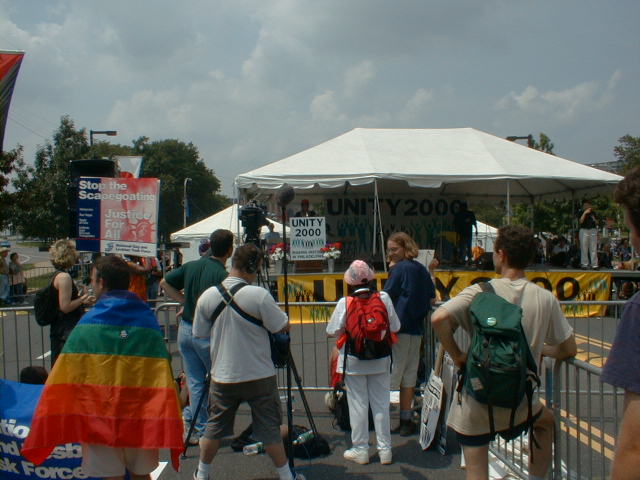
today as an eclectic, ragtag assortment of causes snaked and howled
through the
heart of this city, giving pause to Republican conventioneers intent
on decorum.
A rich assortment
of several thousand dissenters -- all of them
orderly, many rambunctious --
dominated
the eve of the convention as marchers consciously sought to
revive some old-time 60's rhythms and
jingles, but
with strategic updating.
"Hey, hey!
Ho, ho!" began one group, a generation removed from the old
"L.B.J." punch line,
who bellowed
a coda edited for current events: "H.M.O. has got
to go!"
"What do we
want?" came one marching question. And the answer ("Freedom!" in
the old days) came back:
"Health care!"
For all the
altered stakes, veteran witnesses of the antiwar demonstrations of
the 60's felt a pang of
nostalgia.
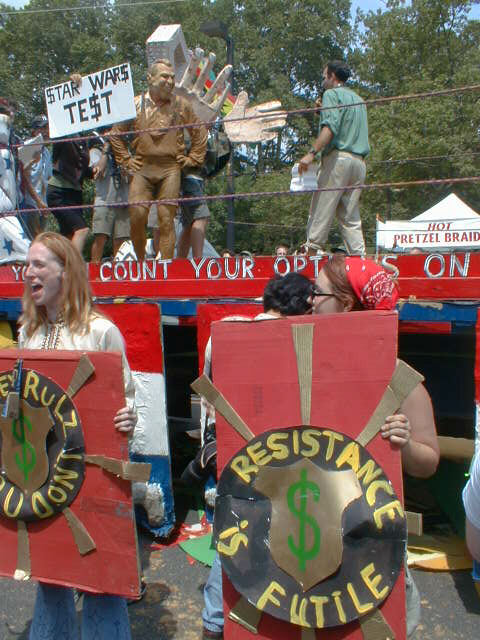
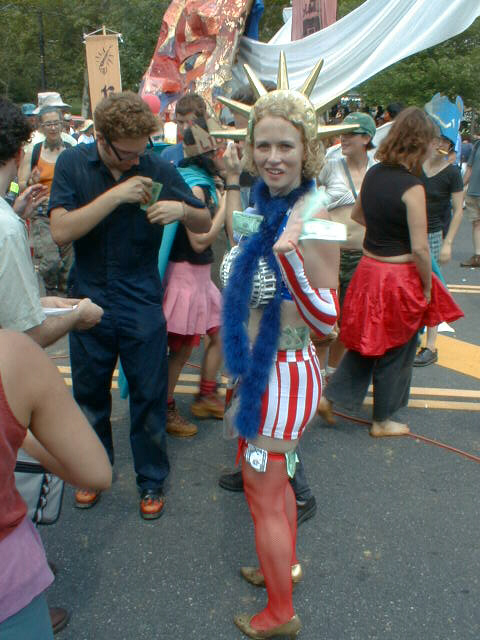
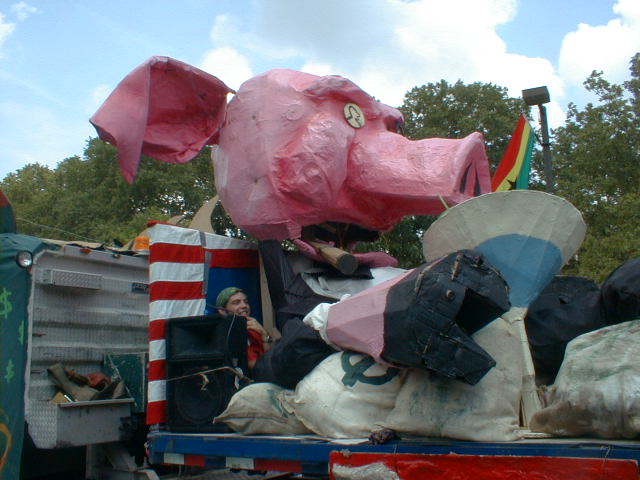
Particularly when guerrilla-theater demonstrators capered past
with large papier-mâché
heads of piggish
plutocrats and Darth Vader caricatures of politicians.
Chanting denunciations of corporate
wealth and
the two-party system, they happily rose to
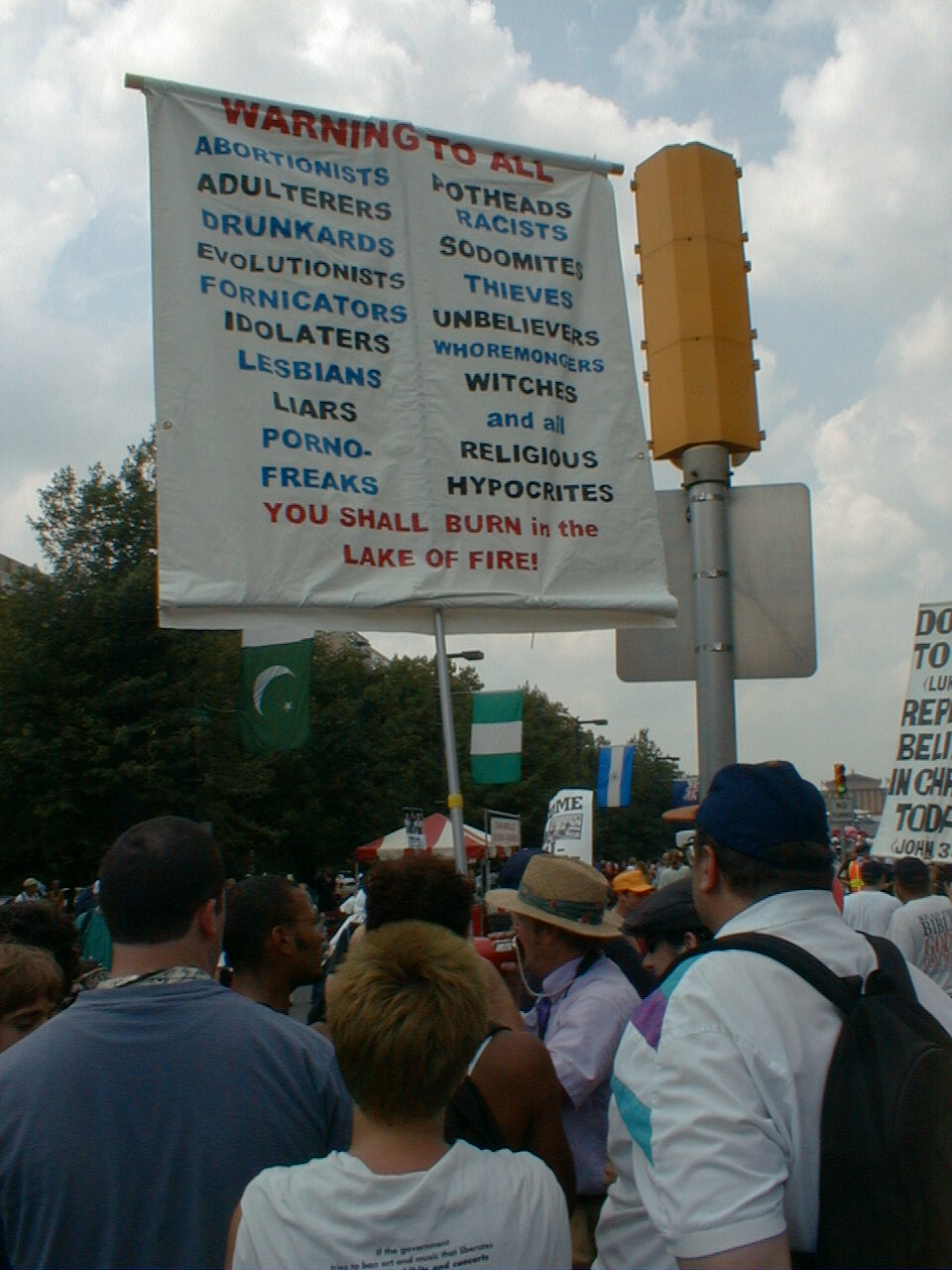
the bait of a few fundamentalist Christian
counterdemonstrators
lobbing bullhorn taunts from the
sideline.
"Hey, environmentalists,
get a life!" boomed John Franklin, wielding a printed billboard
that judgment
day was near.
"God will take care of the trees, then he'll take care of you
on the Last Day, for all the
clear-cutting
of babies," he said, mixing the abortion issue
in for good measure.
The marchers
offered as good as they got, several offering an obscene blend of
gesture and advice. Mr.
Franklin, a 58-year-old
veteran of varied protests of the 60's, admitted later in an interview:
"At least the kids
are trying,
scratching away, although they don't quite have
it. It's like watching a cartoon, but it's nostalgic.
They're trying."
Arms outstretched,
Michelle Christedes intervened as a peaceful parade monitor
between the caustic Mr.
Franklin and
an unshaven young man in a sundress who drew tension-tinged
laughter in impishly shouting
contentions
about the sexuality of Jesus.
But the peace
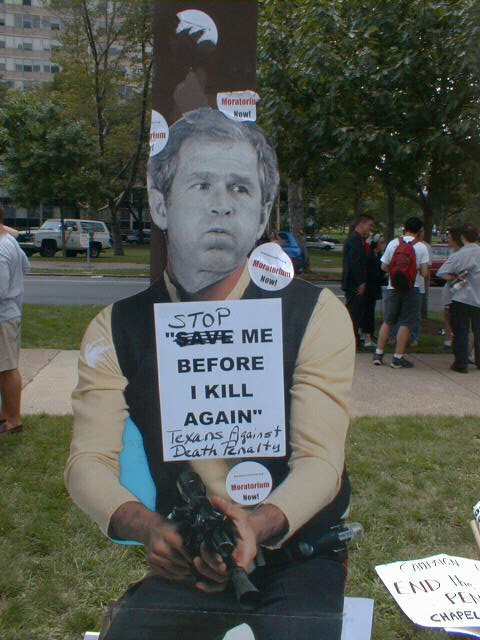
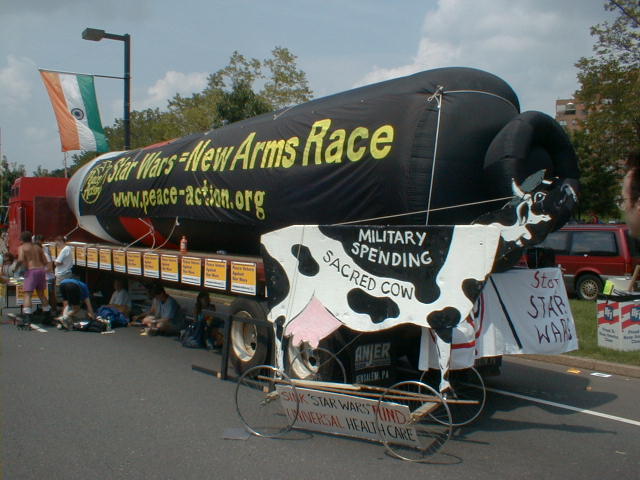
was maintained. Other causes strutted by: opposition to the
death penalty, to sweatshops, to the
antimissile
defense movement and a score more, many of them clearly pressed by
crowds of galvanized young
people.
"I've been
waiting for them a long time," said Ms. Christedes, a 53-year-old
psychology consultant who
said she felt
some of the fury and swagger of her youth when she marched
against the war in Vietnam as a
Ph.D. candidate
at the University of California at
Berkeley.
"The old me
generation sold out," she said, hoping for better. Not all the evidence
was encouraging. One
young man,
dressed melodramatically in the black garb and red bandanna of the
self-styled anarchists,
brandished
a bottle of Gatorade and a cell phone on his way to the rhetorical
ramparts.
Safely beyond
all sight and sound of the demonstrators, Rand S. Larson, a convention
delegate, sipped a rum
and diet cola
at a new oasis in town, the Ritz-Carlton
bar, which just opened in a palatial six-story marble
bank building
on Broad Street.
"I've not seen
any of the protest," said Mr. Larson, a first-time delegate from
Richmond, Vt., who sported a
bright "V.I.P."
tag atop his necklace of credentials. "I don't really fear
any trouble from the demonstrators,
although my
wife and 11-year-old son are coming down and I hope they have a good,
safe time," he said.
Mr. Larson
savored his drink after working for days to tamp down dissension as a member
of the party
platform committee.
"We dealt with all the right issues in a climate of respect,"
he insisted of a platform
smooth as
a runway for the candidates' landing.
As a man strolled
past the bar with one of the day's least contentious
T-shirts ("Dartmouth Fall Foliage
Squash Tournament"),
the Ritz's Sunday brunchers seemed all gentled out and ready
to convene, far
removed from
the dissenting crowd on the other side of City Hall.
Once outside,
however, Joe Bramante, a freelance Democrat from Derry,
N.H., bearded delegates with a
big, bluff
hello, then asked, "So, how's the economy?"
Before Republicans could answer, Mr. Bramante spun
a hand-printed
sign on its stanchion: "I am Bill Clinton's Number One Fan!"
And he told each of them
about the
booming economy as they sought escape.
Farther east
in the city, tourists approaching the Liberty Bell
were distracted by a display of hundreds of pairs
of shoes lined
up as part of the Silent March demonstration, the empty
shoes representing the
thousands
killed annually with handguns. A barefoot, grandmotherly
woman walked stolidly past, bearing her
own printed
protest: "Too angry, too female to vote
Republican."
The day's larger
march of dissenters presented a gathering of various
causes, from NOW to the
N.A.A.C.P.,
from folk-singing unionists to animal rights demonstrators,
under an umbrella label called Unity
2000. Some
self-proclaimed student anarchists marched amiably with
the larger parade, but they have
hinted they
may try to act up by midweek with some hit-and-run street
initiatives.
"So far so
good," said Police Commissioner John F.
Timoney, who has been darting between
demonstrations
as a member of the police bike patrol in helmet,
shorts and monogrammed "P.C." shirt. "But it's
early and
you never get cocky," he said, noting that other
marches potentially more troublesome begin on
Monday. "We
can work out deals, even if we don't quite like the deals,"
the commissioner said in
emphasizing
flexibility as his chief weapon for getting through
convention week.
This was demonstrated
on Saturday evening as the police quickly put aside
confrontation and became
escorts of
an ad hoc march of 200 teenagers who showed up on Chestnut
Street loudly devoted to the
cause of virginity.
"Free sex kills!" they warned. "Honk if you're a virgin!" they
pleaded as restaurantgoers
stared from
sidewalk cafes for a passing moment
before turning back to their food.
-----------------------
|
|
|
|
|
|
|
|
The Philadelphia Inquirer story Thousands protest; no one gets in trouble has three additional photos.
A few days later the demonstration got disruptive:
----------------------
Philadelphia Inquirer August 2, 2000
Sparking turmoil in downtown Philadelphia for several hours, hundreds of protesters launched a flurry of surprise blockades and protests yesterday, scuffling with police and creating the havoc that city officials had hoped to avoid during the Republican National Convention.
In the end, the convention was not affected and the disruptions
were limited to Center City.
For most of the afternoon and into the night, a cacophony of wailing sirens and thumping helicopters pervaded Center City as small but aggressive bands of protesters rushed into streets and blocked traffic in a well-orchestrated assault that began about 2:30 p.m.
Police said as many as 285 people were taken into custody, including 75 people who were detained after a police raid on a West Philadelphia warehouse where they had been building protest props.
Most of those arrested were charged with misdemeanor offenses. Ten people were charged with felony assault on a police officer.
Protest organizers claimed last night that the number of people arrested was higher. Julie Davids of the R2K Network, the organizing committee for various protest groups, said more than 400 people were in custody. Most were being held at Holmesburg prison, where they were practicing "jail solidarity" and refusing to be released unless all protesters were released, she said.
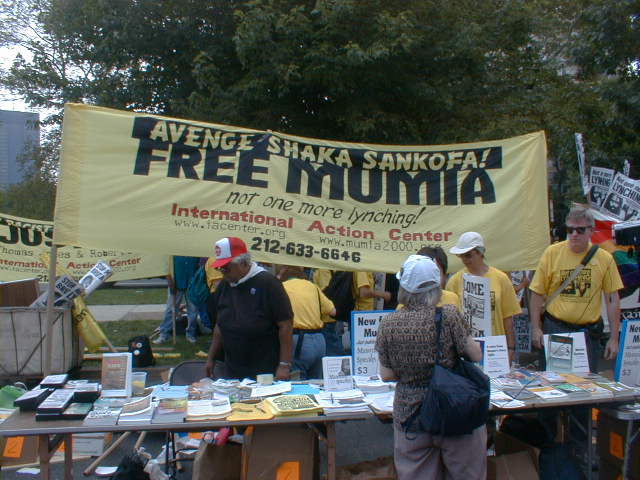
Earlier, protest flyers fluttered along streets and onlookers watched in surprise as protesters created near-gridlock in Center City for most of the late afternoon. Thousands of police officers, many wearing riot helmets and some on horseback, fanned out to seal city blocks and redirect traffic around the protesters, who chanted for causes ranging from globalization to a new trial for death-row inmate Mumia Abu-Jamal.
Mayor Street, in a 9:45 p.m. press conference at City Hall, praised police officers' handling of the protests and said: "We will be open for business tomorrow, believe me."
He said "the overwhelming majority of activity" by protesters was conducted by outsiders "with no ties to Philadelphia."
"There never was a question about the readiness of the city and the Police Department," he added.
That readiness will be tested today, as protesters have vowed to continue the disruptive actions.
Yesterday's scattered skirmishes between police and protesters at one point even involved Police Commissioner John F. Timoney, who last night rammed his bicycle into protesters who were stomping on a car near Rittenhouse Square.
"I got banged up," Timoney said. "That's OK. I'll live."
Officer Raymond Felder was taken to Hahnemann University Hospital with a head injury he suffered when he was hit with the commissioner's bicycle during the fight, Timoney said.
Deputy Police Commissioner Sylvester Johnson said protesters who were detained at the West Philadelphia warehouse had amassed pipes and chains and other materials to be used for blockades, a charge the protesters denied.
Johnson said the groups were "trying to lock down Center City . . . They're implementing their plan right now and we're implementing ours."
Police said they had infiltrated the group, but declined to elaborate.
There were only a few reports of serious injuries, including four police officers briefly hospitalized after a toxic substance was thrown in their faces.
Scars on city streets from the melee were obvious by evening. The steps in front of the District Attorney's Office were covered in red paint and the Municipal Services Building was spray-painted on every side with anarchy signs and "Free Mumia" slogans. By 7 p.m., clean-up crews were at work.
On the Benjamin Franklin Parkway, several city cars had been spray-painted and doused with orange paint, and their tires had been slashed. Many Dumpsters had been overturned, windows of at least 20 police cars had been smashed, and tires had been slashed on five police cars.
The outburst was far from spontaneous. Activists have said for weeks they were planning what they called "nonviolent direct action" somewhere in the city on the second and third days of the convention. They promised to continue their actions today.
Late yesterday, protesters said they would mount an illegal demonstration against the World Bank today at One Liberty Place, followed by demonstrations at the Federal Building and at a "major chemical corporation."
Eric Laursen of the R2K Network issued a statement about the protests. "Our lives are disrupted every day by the workings of the system that the Democratic and Republican parties represent," he said. ". . . This is our day to turn the tables on them and to disrupt the delegates' lives in somewhat the same way that our lives are disrupted."
With the ultimate aim being some disruption of the convention,
activists have said they would not target the highly secure First Union
Center, but would target the Center City hotels and restaurants where delegates
are staying, eating and socializing this week.
One of the first encounters yesterday came about 2 p.m., when at least 50 police officers surrounded the West Philadelphia warehouse that activists have used to prepare puppets, props and other materials for use in the protests.
Police said they had gone to the warehouse to search for weapons and materials that might be used in disruptive protests. They also brought a bomb squad.
Speaking from inside the warehouse, the activists said they did not have weapons and were only preparing cardboard puppets for impromptu protests. At least one vanload of props had departed the building and another was waiting to leave when police arrived.
"These people are getting ready to do street theater," said Matthew Hart, one of the 75 activists inside the building. "They have no reason to arrest us. . . . This is just total harassment and intimidation, there's nothing to base it on."
The raid on the warehouse appeared to enrage some activists already deployed into the city, said a lawyer for the group.
"We're seeing the removal of the velvet glove over the
iron hand," Stefan Presser, legal director of the American Civil Liberties
Union, said. "We're seeing an effort to bottle up (activists) before they
can get to the street."
Next, the blockades started appearing on city streets.
The multipronged protest started about 3 p.m. and seemed to shrink and grow in size during the afternoon, as isolated, roving groups ranging from about 50 to more than 1,000 surfaced without warning around Center City and blocked streets.
One of the largest appeared at the intersections of Broad and Spruce Streets, where up to 300 people marched into the street, with arms linked, and blocked the traffic while chanting: "Abolish the World Bank," and "More power to the people."
About the same time, at least 100 protesters from different groups blocked the 16th Street entrance to Interstate 676. At one point they stretched wire around the entrance to the ramp so that no car could get on the highway.
Hundreds of officers dashed from spot to spot around the city as they played a game of cat-and-mouse with protesters that at turns appeared both tense and cordial.
The running melee on the street included a group of black-clad
youths with black bandannas over their faces, who dashed around the Logan
Circle area, frightening delegates who were coming out of the Four Seasons
Hotel.
According to activists speaking on condition of anonymity, the actions were carried out by isolated cells of activists operating autonomously but under the coordination of a central, secretly located dispatch center, using a cobbled-together collection of mobile phones and walkie-talkies.
Protest organizers assessing the day's events last night conceded that police action was better than that at Washington in the spring and in Seattle last year, where police used tear gas.
Timoney said his officers were ready: "We knew this was going to happen. This is a game."
-------------------------------
Protesters With No Message Except, 'Let's Not Go Home'
By NEIL STRAUSS
LOS ANGELES,
Aug. 15 -- In the end, the confrontation
between young people and the police that took
place in the
parking lot outside the Democratic National Convention on
Monday night came
down to what
it often comes down to: a standoff between police
officers who want to go
home and young
people who don't want to go home.
Many of the
young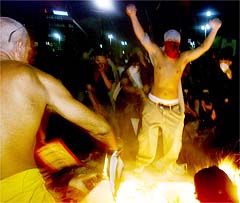
people who
don't want
to go home
-- a group of indeterminate size that mingled with the political
or anarchistic
groups outside
the Democratic convention -- are a special kind of
protest group in
themselves.
They don't have a formal
organization, membership, posters or agenda.
But they are
everywhere
these days, causing all kinds of problems, chiefly because
they don't want
to go home
and they want to be entertained.
They made headlines
at Woodstock '99 in Rome, N.Y., last summer, when
the festival ended
unexpectedly
early and the former Air Force base where it was held
erupted in arson and
vandalism.
Pundits pointed the finger at factors from the heat to the high cost
of bottled water to the lack of sanitation.
But lurking
behind it all was the restlessness of the young people who don't want to
go home.
In Los Angeles,
the designated protest area where the politically inflammatory rock
and rap band Rage
Against the Machine was setting up for a free concert on Monday
felt a lot like Woodstock '99. Before the
music started,
excitable rock fans were moshing and body-surfing. When the music
stopped at 7:24 p.m.
after a 40-minute
set, the audience simply turned its attention to another stage:
the fence separating the
protest area
from two rows of police officers in riot gear and, behind them, the convention
itself.
Soon at least
a dozen in the crowd -- from bored rock fans to self-proclaimed anarchists
-- were lobbing
glass bottles,
smoke bombs and even a No Parking sign at the police. Eventually the police
moved in with
rubber bullets
and pepper spray.
For Mike Bigge,
a 23-year-old Los Angeles resident, the show had just
begun when objects started flying. "I
came for a
good time, and now I'm having one," he said as mounted police
forced panicked protesters and rock
fans out of
the parking lot.
Among those
initially throwing projectiles was a teenager in a black T-shirt
who declined to give his
name for fear
of arrest. He lighted a firecracker and threw it over the fence.
Why? "Why not?" he said.
Was there anything in particular he was protesting? "No," he said.
Many of those
interviewed before, during and after the confrontation harbored not a single
political thought. "I
don't really
have an opinion on the convention," said Alberto Freire, a
13-year-old Rage fan from Torrance,
Calif., before
the disturbance began.
There were
as many video and still cameras held in the air during the Rage show as
protest posters. Several
camera-carrying
fans who showed up for the concert said they were not there to convey
a message to the
Democratic
Party but to gather content for their Internet sites.
If the convention
in the hall is mostly a political show for television, the message of the
medium applies to
controlling
crowds at concerts as well: put the police and a good rock band outside,
and the crowd will
watch the
band. But when the band wraps up early, the crowd's attention will turn
to whatever sideshow
remains: the
police. On Monday, it was between acts -- after Rage's performance and
before the following
group, a Latin
jam band called Ozomatli -- that audience members started provoking
the police.
When Ozomatli
started performing, the crowd at the fence started to drift over
to the stage to see which
show was more
entertaining. But it was too late. During Ozomatli's second song,
a police commander walked
on stage and
announced that the gathering had been declared unlawful and that the crowd
had 15 minutes to
disperse.
People lingered.
It was then
that the police commander tried something ingenious: he told Ozomatli
to make music and lead the
crowd out
of the parking lot Pied Piper-style, according to Bubba Cervantes,
the band's security guard. Band
members picked
up drums and started playing, and the crowd gathered in a circle around
them. Then, the band
began marching
the group, comprising almost all of the several hundred protesters who
remained, toward the
North exit
of the parking lot.
But before
they could reach the exit, as the time limit expired, mayhem broke out
and the police fired pepper
spray, beanbags,
and rubber bullets, turning the march into a stampede.
A Web Site on how music can communicate information to its listeners was prepared by Laura Miyoshi Rodan for last spring's Sociology of Communication class. It has links to many politically oriented musical groups.