A useful introduction to the study of the future is at futureswatch.org
For a Dutch
translation of this article by Johanne Teerink, click here.
For
a Spanish translation by Laura Mancini click here
This was downloaded and greatly abridged from the World
Futures Society at: http://www.wfs.org/newmeth.htm
TPlease consult the original for footnotes and additional
explanation and methods.
Methods and Approaches of Futures Studies
For all of human history people have tried to
develop methods for predicting the future, from reading palms to
gazing at the stars. But in recent years, primarily since World
War II, scientists, sociologists, operations researchers, and
others, many of whom began to call themselves futurists, have
developed quantitative and qualitative methods for rationally
anticipating the future. What separates futurists from the
soothsayers who came before is rationality, an awareness that
the future cannot be known with absolute certainty, and the
recognition that many different futures are possible, depending
on decisions people make in the present.
Generally, methods for studying the future do not
pretend to be able to predict the future, although assessing the
probabilities of alternative futures is an important aspect of
futures studies methods. Rather, futures studies methods are
generally designed to help people better understand future
possibilities in order to make better decisions today. Futurists
often say they use their methods to reduce uncertainty, although
it may be more accurate to say they are trying to manage
uncertainty. Many decisions must be made today in the face of
great uncertainty about what may happen in the future or even
what the effects of today's decision might be in the future.
Futures methods help people to deal with this uncertainty by
clarifying what is known, what can be known, what the likely
range of possibilities is, what the most desirable possibilities
are, and how today's decisions may play out in each of a variety
of possible futures.
Futures research methods are both descriptive and
prescriptive. Descriptive methods, sometimes also called
extrapolative, attempt to describe objectively what the future
will be or could be. Prescriptive methods, also called
normative, focus on what the future should be. Prescriptive
methods try to help people clarify their values and preferences
so they can develop visions of desirable futures. Once they
understand what they would like the future to be, they're better
able to take the appropriate steps to create that preferred
future.
Although much has been learned about futures
studies methods since most were developed in the 50s and 60s,
they remain somewhat amorphous. One can probably identify as
many futures studies methods as there are futurists, as each
futurist develops his or her own style for looking ahead. But
gradually, some consensus on methodologies is developing.
One principle upon which most futurists would
agree is the need to use multiple methods to address most
futures problems. One will gain much greater insight by
developing a futures research program that combines
environmental scanning, trend assessment, delphi, and scenarios,
for example, than one could achieve using any single method
alone. Thus, although several of the more popular methods are
described individually in the pages that follow, they are
ideally used in various combinations.
Another principle upon which some consensus is
developing is that futures research should be participatory: it
should involve stakeholders and decision-makers directly in the
process of developing forecasts or creating scenarios, because
that is the only way to enable people to fully appreciate and
perceive the range of possible futures.
Although many futurist strive for objectivity,
ultimately, most futures methods rely heavily on subjective
human judgment. But there are various tools one can use to
augment individual human judgment. A method's value often lies
in amalgamating the judgment of many people, enhancing
creativity, generating questions and ideas to produce different
judgments, and demonstrating consistencies and inconsistencies
among and within competing views of the future.
As discussed in Chapter 2, Principles of Futures
Studies, futurists often divide the purposes of futures studies
as imagining the possible, assessing the probable, and deciding
on the preferable. Most futures studies methods focus on one or
two of these goals, but not all three; thus one almost always
will need multiple methods if on is to work through the full
range of futures studies. For instance, analyzing a present
trend will give some information about the possible and the
probable, as we analyze what will happen if the trend continues
or what may cause the trend to change, but it tells us
relatively little about what we like to have happen. Visioning
techniques may tell us something about the possible, as we
brainstorm a range of alternatives, and the preferable, as we
use visioning to imagine preferred futures, but it may tell us
relatively little about the probabilities of our preferred
futures without the help of other techniques.
Futures studies can also be thought of as
encompassing five stages, although many individual projects will
focus on one or two stages and leave the rest to other projects.
The first stage is to identify and monitor change. The second
stage is to critique and analyze change. The third stage is to
imagine alternatives. The fourth stage is to envision the
preferred alternative. And the fifth and final stage is to plan
and implement steps to achieve the preferred vision.1
Trend Analysis: A
Method Everyone Uses
Trend analysis involves the use of any of a
variety of techniques based on historical data. Trend analysis
involves several processes. One process is spotting an emerging
trend, that is, identifying a change in the world around us. For
example, you may notice that more and more people seem to be
waiting until they are in their thirties to have children. You
may have spotted a trend-i.e., that people are delaying child
birth. Now you need to do some analysis to see what the nature
of the trend is and what its implications might be. You could
first look at historical data. What was the average age of women
having their first child in 1950? In 1955? and so on. Do you see
a pattern? Is the average age of women at the birth of their
first child increasing?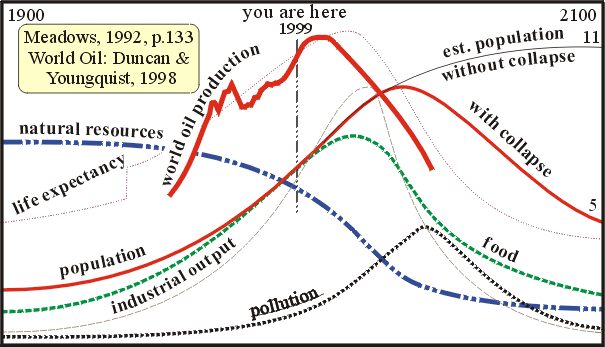
You might see the age at birth of the first child
is increasing by six months over each five-year interval. That
is, perhaps the average age was 21 in 1950, 21.5 in 1955, 22 in
1960, and so on until 1995 when the average age is 26. Then you
might extrapolate the trend into the future, to predict that the
average age would be 26.5 in 2000 and 27 in the year 2005 and so
on. But trend analysis requires that you do more than simply
extrapolate the trend forward. You have to ask, what is causing
this trend, and will those causes continue indefinitely? Are
there upper limits to the trend? What other forces may affect
the trend? At this point trend analysis relies more on
subjective judgment rather than objective extrapolation of
historical data.
Trend extrapolation is the most straight-forward
and objective component of trend analysis. Extrapolation
essentially consists of taking historical data, fitting a curve
to the data, and extending the curve into the future. Trend
extrapolation assumes that things will keep changing in the
future the way they have been changing in the past. One simply
extends the line or the curve forward to predict where things
will be at a certain future time.
If the population of a city is known to be
increasing at the rate of 2% a year, we assume that it will
continue to do so in the future, and we can use simple
arithmetic to calculate what the population will be in five
years. In other words, we can generate a forecast by observing a
change through time in the character of something and projecting
(extrapolating) that change into the future. In making a
forecast, we naturally disregard short-term changes or
fluctuations, such as the swelling of a city's population each
morning as people come to work. What is important is the
longer-term change, that is, the trend.
Trend extrapolation is one of the most commonly
used ways to generate a forecast. City planners, economists,
demographers, and many other specialists constantly extrapolate
trends -- consciously or unconsciously -- when they think about
the future. So, too, do ordinary people. Assuming that the
future will be like the past or that past changes will continue
in the same direction and rate is a perfectly sensible way to
begin trying to understand the future. It can not, however, be
the end of our endeavors, or we would end up with absurd
results. For example, we might estimate that a child aged four
has grown at the rate of five inches a year, and then calculate
that this rate of growth means he will be more than 13 feet tall
at the age of 34! We would not accept this forecast, because we
know that human beings never grow that tall. Long before he
reaches the age of 34, we forecast, his rate of growth will slow
and eventually halt at a height that will probably be somewhere
between five feet and six and a half feet.
Cyclical Pattern Analysis
Closely related to trend analysis is cyclical
pattern analysis, see theTrends
Timeline
Graph. Trends
Timeline
in Flash. Many phenomena appear to operate on
cycles, and cyclical pattern analysis uses cyclic or recurring
patterns (also referred to as waves, warps, bursts, surges,
epochs, and episodes) as templates for anticipating future
developments in various areas, such as public policy, the
economy, etc. The "business cycle" is probably the best known
example of this, in which a recession is followed by recovery,
which leads to over-expansion of capacity, which in turn leads
back to recession, and the cycle begins again. A similar, though
much longer-range cycle, was proposed by Russian economist N.D.
Kondratieff, who hypothesized that Western societies cycle
through a pattern of long waves, characterized by
recession-depression-revival-prosperity. The length of the
overall cycle averages 56 years, with peaks in the occurring in
1800, 1856, 1916, and 1969.4 The Kondratieff Wave attracted
great attention in the mid-1980s, when the cycle predicted
depression, but has attracted less attention recently.
Other cycles futurists have explored include
product life cycles, historical cycles, and generational
cycles. See my paper on Sept 11 as a turning
point in history.
Environmental Scanning
Environmental scanning refers to the process of
scanning the media (especially online media and media used
heavily by youth) to identify emerging issues to enable
organizations or individuals to anticipate and respond to
changes in the external environment.5 Scanning is meant to
provide strategic intelligence to the strategic planning process
by identifying changing trends and potential developments,
monitoring them, forecasting their future pattern and assessing
their impacts.6
"The objective of scanning is to look over the
widest range of possible factors and to identify connections
with the organization's function or business, and especially to
identify the significant positive or negative effects those
could have on the organization and its activities. In general,
the objectives in monitoring and scanning are to:
* detect scientific, technical, economic, social,
political and ecological events and other elements important to
the company;
* define the potential threats or opportunities or
major potential changes for the organization that are implied by
those events;
* provide continuous awareness and evaluation of
trends to guide planning and action choices;
* inform management and staff of the need for
anticipatory action; minimize reaction; stimulate proaction;
* alert management and staff to trends which are
converging, diverging, speeding up, slowing down, or
interacting.7
Scanning may be active or passive. "Passive
scanning is what most people do when they read journals or
newspapers," writes James Morrison, an expert in and proponent
of scanning.8 Active scanning is a more deliberate and conscious
effort to review information from a broad array sources and
subject areas.
The best known practitioner of
Environmental Scanning is probably Faith Popcorn.
Scenarios: Making Up
Stories About the Future
Scenario planning is the use of internally
consistent narrative descriptions of possible states of affairs
or development in the future. Usually, alternative scenarios are
developed in order to allow people to conceptualize alternative
futures and to clarify possible consequences of present
developments and decisions.
A scenario is simply a series of events that we
imagine happening in the future. Our everyday thinking is filled
with little ventures into the mysterious world of tomorrow, or
next week, or next year. And these ventures are scenarios,
though rarely as well developed as the elaborate scenarios
prepared by professional researchers working for government
agencies, the military, and commercial enterprises.
A scenario begins when we ask, "What would happen
if such-and-such occurred?" For example, "What would happen if
we went to the theater on Saturday night?" Once this question is
posed, we can begin to imagine the various consequences of the
event. First, certain preparations would be necessary for this
event to occur; for example, there would be the need for
transportation to the theater. In addition, if the event does
occur, there will be additional consequences, such as being
absent from home at a time when we anticipate that a relative
might come. In our minds, we may develop a large number of
scenarios in an effort to decide whether or not to go to the
theater on Saturday night. We develop these scenarios
intuitively and rarely bother to write them down. We may,
however, discuss them with each other and with friends.
What does a scenario do for us?
Fundamentally, scenarios are tools for ordering
our perceptions about alternative futures in which today's
decisions may play out. First, it makes us aware of potential
problems that might occur if we were to take the proposed
action. We can then (1) abandon the proposed action or (2)
prepare to take precautions that will minimize the problems that
might result.
Backcasting
A method closely related to scenarios is
backcasting. Backcasting is concerned with how desirable futures
can be created, rather than what futures are likely to occur. In
backcasting, one envisions a desired future endpoint, and then
works backward to determine what policy measures would be
required to achieve such a future. Backcasting involves six
steps: determine objective, specify goals and constraints,
describe the present system, specify exogenous variables,
undertake scenario analysis, and undertake impact analysis.12
The end result of a backcasting study is alternative images of
the future, thoroughly analyzed as their feasibility and
consequences.13
Visioning
Visioning has become one of the most popular and
important futures studies methods, and a wide range of futurists
have developed particularized techniques to help people develop
their vision of a desirable future for themselves, their
organization, or their community. (Visioning on larger scales,
such as national or global scales, remains relatively
undeveloped.) Generally, a visioning process will attempt to
identify sources of pleasure and dismay in the past and present,
will challenge people's current assumptions, will give people a
sense of current drivers of change so they can imagine a range
of alternative futures, and facilitates a process of achieving
some consensus of a preferred vision for the future. "Visioning
is a process of making images of the future sufficiently real
and compelling to act as 'magnets,' or goals to achieve, or
'spurs' to present action. Visioning can be done by an
individual, but it much more frequently takes place in futures
workshops,"14 writes Australian futurist Richard Slaughter.
For example, Clem Bezold, who has been developing
vision methods since the early 1980s, identifies five stages in
building a vision: 1) identification of problems, 2)
identification past successes 3) identification of future
desires; 4) identification of measurable goals; and 5)
identification of resources to achieve those goals.15
"If we can articulate what we want clearly enough,
we will be better able to invent and create the future we most
desire (our 'preferred' future)," says Bezold. "A preferred
future encompasses our ideals (usually in the form of a vision
statement or description) and our sense of the best outcome that
might be achievable. A vision is a compelling, inspiring
statement of the preferred future that the authors and those who
subscribe to the vision want to create."16
The visioning concept owes a heavy debt to the
future workshop developed by Robert Jungk. Jungk describes the
future workshop as follows:
Typically, a future workshop can be divided into a
preparatory phase and three workshop phases. The preparatory
phase involves deciding on the topic and making the practical
arrangements . . . The workshop itself begins with the critique
phase, during which all the grievances and negative experiences
related to the chosen topic are brought into the open. There
then follows the fantasy phase, in which the participants come
up with ideas in response to the problems, and with their
desires, fantasies and alternative views. A selection is made of
the most interesting notions and small working groups develop
them into solutions and outline projects. The workshop concludes
with the implementation phase, coming back down into the present
with its power structures and constraints. It is at this stage
that participants critically assess the chances of getting their
projects implemented; identifying the obstacles and
imaginatively seeking ways round them so as to draw up a plan of
action.17
Jim Dator, another long-time expert of the
visioning method, has modified Jungk's method in several ways,
most significantly in emphasizing the role of the futurist in
helping people think more broadly about alternative futures. "I
think it is a serious mistake to ask people to engage in any
kind of preferred futures envisioning exercise until they have
first been challenged to examine their own ideas about the
future," says Dator. "One part of the futurist's role is to
present, in a dramatic, engaging way, some of the elements,
forces or components in the past and present that might
significantly influence the future."18
Technological Forecasting
A technology forecaster generally makes forecasts
concerning how soon various types of technologies will be
possible and what characteristics they may have, rather than
what they will have, because the actual technology that will be
used in the future depends on economic, social, and political
considerations, which are normally beyond the province of the
technology forecaster. For example, a technology forecaster
might forecast that it will be possible by the year 2050 to
produce electricity from nuclear fusion, but whether
thermonuclear fusion will actually be used for that purpose may
depend on a variety of non-technological considerations.
Technology forecasting is differentiated from the
other methods described in this chapter by the subject area of
the forecasts rather than the methodology used. Technology
forecasting could, theoretically, employ almost any of the other
methods described here. However, technology forecasting has
developed as a distinct endeavor within futures studies, with
its own concepts, literature, and practitioners, so it is useful
to address it as an independent method.
An important concept used by technological
forecasters is "stages of innovation." Every technological
advance passes through certain stages, with each stage
representing a greater degree of practicality or use. According
to technological forecaster Joseph P. Martino, these stages are:
"scientific findings," when some basic scientific understanding
has been developed; "laboratory feasibility," when a specific
solution to a specific problem has been identifies and a
laboratory model has been created; "operating prototype," when a
device intended for a particular operational environment has
been built; "commercial introduction or operational use," at
which point the innovation at which point the innovation
technologically successful but is also economically feasible;
"widespread adoption," at which point the innovation has shown
itself to be in some way superior to whatever method was used
previously to perform its function and the innovation replaces a
some portion of those previous methods; "diffusion to other
areas," at which point the innovation becomes adopted for
purposes other than those originally intended; "social and
economic impact," at which point the innovation has changed the
behavior of society or has somehow involved a substantial
portion of the economy.32
Futures Research:
Because futures research relies heavily on human
judgment, it is often difficult to know which futures research
projects are well-executed and which should be largely ignored.
It is also important to realize the limitations of even the
best-executed futures research.
Experienced futurists have developed certain
caveats one must keep in mind whenever one engages in or uses
futures research, guideposts for telling good work from bad, and
rules of thumb for understanding why some futures research
fails.
First, some caveats:
1. Forecasts will be incomplete. As Herman Kahn
once said, "The most surprising future is one which contains no
surprises."
2. No forecast that depends on what humans will do
can be 100 percent accurate.
2. Futures depend on chance.
3. Accurate forecasts of some complex and
nonlinear systems may be impossible.
4. Extrapolation is bound to be wrong eventually.
5. Forecasting and planning must be dynamic and
able to respond to new information and insights.