Excerpts from The
Great Disruption by Francis Fukuyama
 OVER
the past half century the United States
OVER
the past half century the United States
and other economically
advanced countries have made the
shift into what has been called an information
society,
the information age, or the
post-industrial era.
The futurist Alvin Toffler has labeled
this
transition the "Third Wave," suggesting
that it will ultimately be
asconsequential as the two previous waves
in human history:
from hunter-gatherer to agricultural
societies, and from
agricultural to industrial ones.
A society
built around information tends to produce more of
the two things people value most in a modern democracy --
freedom and equality. Freedom of choice has exploded, in
everything from cable channels to low-cost shopping outlets to
friends met on the Internet. Hierarchies of all sorts, political and
corporate, have come under pressure and begun to crumble.
People associate the information age with the advent of the
Internet, in the 1990s, but the shift from the industrial era
started more than a generation earlier, with the
deindustrialization of the Rust Belt in the United States and
comparable movements away from manufacturing in other
industrialized countries. This period, roughly the mid-1960s to
the early 1990s, was also marked by seriously deteriorating
social conditions in most of the industrialized world. Crime and
social disorder began to rise, making inner-city areas of the
wealthiest societies on earth almost uninhabitable. The decline
of kinship as a social institution, which has been going on for
more than 200 years, accelerated sharply in the second half of
the twentieth century. Marriages and births declined and
divorce soared; and one out of every three children in the
United States and more than half of all children in Scandinavia
were born out of wedlock. Finally, trust and confidence in
institutions went into a forty-year decline. Although a majority
of people in the United States and Europe expressed
confidence in their governments and fellow citizens during the
late 1950s, only a small minority did so by the early 1990s.
The nature of people's involvement with one another changed
as well -- although there is no evidence that people associated
with one another less, their ties tended to be less permanent,
looser, and with smaller groups of people.
These changes were dramatic; they occurred over a wide
range of similar countries; and they all appeared at roughly the
same period in history. As such, they constituted a Great
Disruption in the social values that had prevailed in the
industrial-age society of the mid twentieth century. It is very
unusual for social indicators to move together so rapidly; even
without knowing why they did so, we have cause to suspect
that the reasons might be related. Although William J. Bennett
and other conservatives are often attacked for harping on the
theme of moral decline, they are essentially correct: the
perceived breakdown of social order is not a matter of
nostalgia, poor memory, or ignorance about the hypocrisies of
earlier ages. The decline is readily measurable in statistics on
crime, fatherless children, broken trust, reduced opportunities
for and outcomes from education, and the like.
Was it simply an accident that these negative social trends,
which together reflect a weakening of social bonds and
common values in Western societies, occurred just as the
economies of those societies were making the transition from
the industrial to the information era? The hypothesis of this
article is that the two were in fact intimately connected, and that
although many blessings have flowed from a more complex,
information-based economy, certain bad things also happened
to our social and moral life. The connections were
technological, economic, and cultural. The changing nature of
work tended to substitute mental for physical labor, propelling
millions of women into the workplace and undermining the
traditional understandings on which the family had been based.
Innovations in medical technology leading to the birth-control
pill and increasing longevity diminished the role of reproduction
and family in people's lives. And the culture of individualism,
which in the laboratory and the marketplace leads to innovation
and growth, spilled over into the realm of social norms, where
it corroded virtually all forms of authority and weakened the
bonds holding families, neighborhoods, and nations together.
The complete story is, of course, much more complex than this,
and differs from one country to another. But broadly speaking,
the technological change that brought about what the economist
Joseph Schumpeter called "creative destruction" in the
marketplace caused similar disruption in the world of social
relationships. Indeed, it would be surprising if this were not
true.
But there is a bright side, too: social order, once disrupted,
tends to get remade, and there are many indications that this is
happening today. We can expect a new social order for a
simple reason: human beings are by nature social creatures,
whose most basic drives and instincts lead them to create
moral rules that bind them together into communities. They are
also by nature rational, and their rationality allows them to
spontaneously create ways of cooperating with one another.
Religion, though often helpful to this process, is not the sine
qua non of social order, as many conservatives believe.
Neither is a strong and expansive state, as many on the left
argue. Man's natural condition is not the war of "every man
against every man"envisioned by Thomas Hobbes but rather a
civil society made orderly by the presence of a host of moral
rules. These assertions, moreover, are empirically supported by
a tremendous amount of research coming out of the life
sciences in recent years, in fields as diverse as
neurophysiology, behavioral genetics, evolutionary biology,
ethology, and biologically informed approaches to psychology
and anthropology. The study of how order arises -- not as the
result of a top-down mandate by hierarchical authority,
whether political or religious, but as the result of
self-organization on the part of decentralized individuals -- is
one of the most interesting and important intellectual
developments of our time.
The idea that social order has to come from a centralized,
rational, bureaucratic hierarchy was very much associated with
the industrial age. The sociologist Max Weber, observing
nineteenth-century industrial society, argued that rational
bureaucracy was, in fact, the very essence of modern life. We
know now, however, that in an information society neither
governments nor corporations will rely exclusively on formal
bureaucratic rules to organize people. Instead they will
decentralize and devolve power, and rely on the people over
whom they have nominal authority to be self-organizing. The
precondition for such self-organization is internalized rules and
norms of behavior, a fact that suggests that the world of the
twenty-first century will depend heavily on such informal
norms. Thus although the transition into an information society
has disrupted social norms, a modern, high-tech society cannot
get along without them and will face considerable incentives to
produce them.
 |
"The ENIAC, or the Electrical Numerical Integrator and Computer, was
a large digital electronic computer developed by the US. Army and University
of Pennsylvania late in World War II. This photograph shows only a small
section of a machine that stretched around the walls of a room 30' by 50.'
ENIAC was designed to compute ballistics tables, a task that required many
tedious electronic calculations. But the designers made it programmable,
so that it could also be set to perform many other calculation tasks. Because
of its speed and flexibility, ENIAC set the stage for the emergence
of the post-war computer industry." Text and photo from:
==Smithsonian Photo
#90-7164B by Laurie Minor-Penland. |
THE disruption of social order by the progress of
technology is not a new phenomenon. Particularly since
the beginning of the Industrial Revolution, human
societies have been subject to a relentless process of
modernization, as one new production process replaced
another. The social disorder of the late eighteenth and early
nineteenth centuries in America and Britain can be traced
directly to the disruptive effects of the so-called first Industrial
Revolution, when steam power and mechanization created new
industries in textiles, railroads, and the like. Agricultural
societies were transformed into urban industrial societies within
the space of perhaps a hundred years, and all the accumulated
social norms, habits, and customs that had characterized rural
or village life were replaced by the rhythms of the factory and
the city.
This shift in norms engendered what is
perhaps the most famous concept in modern
sociology -- the distinction drawn by
Ferdinand Tönnies between what he called
Gemeinschaft ("community") and Gesellschaft ("society").
According to Tönnies, the Gemeinschaft that
characterized a typical premodern European peasant society
consisted of a dense network of personal relationships based
heavily on kinship and on the direct, face-to-face contact that
occurs in a small, closed village. Norms were largely unwritten,
and individuals were bound to one another in a web of mutual
interdependence that touched all aspects of life, from family to
work to the few leisure activities that such societies enjoyed.
Gesellschaft, on the other hand, was the framework of laws
and other formal regulations that characterized large, urban
industrial societies. Social relationships were more formalized
and impersonal; individuals did not depend on one another for
support to nearly the same extent, and were therefore much
less morally obligated to one another.
Many of the standard sociological texts written in the middle of
the twentieth century treated the shift from Gemeinschaft to
Gesellschaft as if it were a one-shot affair: societies were
either "traditional" or "modern," and the modern ones somehow
constituted the end of the road for social development. But
social evolution did not culminate in middle-class American
society of the 1950s; industrial societies soon began
transforming themselves into what the sociologist Daniel Bell
has characterized as post-industrial societies, or what we know
as information societies. If this transformation is as momentous
as the previous one, we should hardly be surprised that the
impact on social values has proved equally great.
Whether information-age democracies can maintain social
order in the face of technological and economic change is
among their greatest challenges today. From the early 1970s to
the early 1990s there was a sudden surge of new democracies
in Latin America, Europe, Asia, and the former Communist
world. As I argued in The End of History and the Last Man
(1992), there is a strong logic behind the evolution of political
institutions in the direction of modern liberal democracy, based
on the correlation between economic development and stable
democracy. Political and economic institutions have converged
over time in the world's most economically advanced countries,
and there are no obvious alternatives to the ones we see before
us.
This progressive tendency is not necessarily evident in moral
and social development, however. The tendency of
contemporary liberal democracies to fall prey to excessive
individualism is perhaps their greatest long-term vulnerability,
and is particularly visible in the most individualistic of all
democracies, the United States. The modern liberal state was
premised on the notion that in the interests of political peace,
government would not take sides among the differing moral
claims made by religion and traditional culture. Church and
State were to be kept separate; there would be pluralism in
opinions about the most important moral and ethical questions,
concerning ultimate ends or the nature of the good. Tolerance
would become the cardinal virtue; in place of moral consensus
would be a transparent framework of law and institutions that
produced political order. Such a political system did not
require that people be particularly virtuous; they need only be
rational and follow the law in their own self-interest. Similarly,
the market-based capitalist economic system that went hand in
glove with political liberalism required only that people consult
their long-term self-interest to achieve a socially optimal
production and distribution of goods.
The societies created on these individualistic premises have
worked extraordinarily well, and as the twentieth century
comes to a close, there are few real alternatives to liberal
democracy and market capitalism as fundamental organizing
principles for modern societies. Individual self-interest is a
lower but more stable ground than virtue on which to base
society. The creation of a rule of law is among the proudest
accomplishments of Western civilization -- and its benefits
become all too obvious when one deals with countries that lack
one, such as Russia and China.
But although formal law and strong political and economic
institutions are critical, they are not in themselves sufficient to
guarantee a successful modern society. To work properly,
liberal democracy has always been dependent on certain
shared cultural values. This can be seen most clearly in the
contrast between the United States and the countries of Latin
America. When Argentina, Brazil, Chile, Mexico, and other
Latin American countries got their independence, in the
nineteenth century, many of them established formal democratic
constitutions and legal systems patterned on the presidential
system of the United States. Since then not one Latin American
country has experienced the political stability, economic
growth, or institutional efficacy enjoyed by the United States,
though most, fortunately, had returned to democratic
government by the end of the 1980s.
There are many complex historical reasons for this, but the
most important is a cultural one: the United States was settled
primarily by British people and inherited not just British law but
British culture as well, whereas Latin America inherited various
cultural traditions from the Iberian peninsula. Although the U.S.
Constitution enforces a separation between Church and State,
American culture was decisively shaped in its formative years
by sectarian Protestantism. Sectarian Protestantism reinforced
both American individualism and the tendency of the society to
be self-organizing in a myriad of voluntary associations and
communities. The vitality of American civil society was crucial
both for the stability of the country's democratic institutions and
for its vibrant economy. The imperial and Latin Catholic
traditions of Spain and Portugal, in contrast, reinforced
dependence on large, centralized institutions like the State and
the Church, weakening an independent civil society. Similarly,
the differing abilities of Northern and Southern Europe to make
modern institutions work were influenced by religious heritage
and cultural tradition.
The problem with most modern liberal democracies is that they
cannot take their cultural preconditions for granted. The most
successful among them, including the United States, were lucky
to have married strong formal institutions to a flexible and
supportive informal culture. But nothing in the formal institutions
themselves guarantees that the society in which they exist will
continue to enjoy the right sort of cultural values and norms
under the pressures of technological, economic, and social
change. Just the opposite: the individualism, pluralism, and
tolerance that are built into the formal institutions tend to
encourage cultural diversity, and therefore have the potential to
undermine moral values inherited from the past. And a
dynamic, technologically innovative economy will by its very
nature disrupt existing social relations.
It may be, then, that although large political and economic
institutions have long been evolving along a secular path, social
life is more cyclical. Social norms that work for one historical
period are disrupted by the advances of technology and the
economy, and society has to play catch-up in order to establish
new norms.
BEGINNING in about 1965 a large number of indicators
that can serve as negative measures of social capital all
started moving upward rapidly at the same time. These
could be put under three broad headings: crime, family, and
trust.
Americans are aware that crime rates began
sometime in the 1960s to climb very rapidly -- a
dramatic change from the early post-Second World
War period, when U.S. murder and robbery rates
actually declined. After declining slightly in the
mid-1980s, crime rates spurted upward again in the
late 1980s and peaked around 1991-1992. The rates for both
violent and property crimes have dropped substantially since
then. Indeed, they have fallen most dramatically in the areas
where they had risen most rapidly -- that is, in big cities like
New York, Chicago, Detroit, and Los Angeles.
Although the United States is exceptional among developed
countries for its high crime rates, crime rose significantly in
virtually all other non-Asian developed countries in
approximately the same time period. Violent crime rose rapidly
in Canada, Finland, Ireland, the Netherlands, New Zealand,
Sweden, and the United Kingdom. With regard to crimes
against property, a broader measure of disorder, the United
States is no longer exceptional: Canada, Denmark, the
Netherlands, New Zealand, and Sweden have ended up with
theft rates higher than those in the United States over the past
generation.
Of the shifts in social norms that constitute the Great
Disruption, some of the most dramatic concern those related to
reproduction, the family, and relations between the sexes.
Divorce rates moved up sharply across the developed world
(except in Italy, where divorce was illegal until 1970, and other
Catholic countries); by the 1980s half of all American
marriages could be expected to end in divorce, and the ratio of
divorced to married people had increased fourfold in just thirty
years. Births to unmarried women as a proportion of U.S. live
births climbed from under five percent to 32 percent from
1940 to 1995. The figure was close to 60 percent in many
Scandinavian countries; the United Kingdom, Canada, and
France reached levels comparable to that in the United States.
The combined probabilities of single-parent births, divorce, and
the dissolution of cohabiting relationships between parents (a
situation common in Europe) meant that in most developed
countries ever smaller minorities of children would reach the
age of eighteen with both parents remaining in the household.
The core reproductive function of the family was threatened as
well: fertility has dropped so dramatically in Italy, Spain, and
Germany that they stand to lose up to 30 percent of their
populations each generation, absent new net immigration.
Finally, anyone who has lived through the 1950s to the 1990s
in the United States or another Western country can scarcely
fail to recognize the widespread changes in values that have
taken place over this period in the direction of increasing
individualism. Survey data, along with commonsense
observation, indicate that people are much less likely to defer
to the authority of an ever-broader range of social institutions.
Trust in institutions has consequently decreased markedly. In
1958, 73 percent of Americans surveyed said they trusted the
federal government to do what is right either "most of the time"
or "just about always"; by 1994 the figure had fallen as low as
15 percent. Europeans, although less anti-statist than
Americans, have nonetheless seen similar declines in
confidence in such traditional institutions as the Church, the
police, and government. Americans trust one another less as
well: although 10 percent more Americans evinced more trust
than distrust in surveys done in the early 1960s, by the 1990s
the distrusters had an almost 30 percent margin over those
expressing trust. It is not clear that either the number of groups
or group memberships in civil society declined overall in this
period, as the political scientist Robert Putnam has suggested.
What is clear, however, is that what I call the radius of trust has
declined, and social ties have become less binding and
long-lasting. (Readers can obtain more detailed statistical
information on the Great Disruption at
http://mason.gmu.edu/~ffukuyam/.)
[Here I edited out a lengthy argument about
the reasons for the "Great Disruption" - basically he argues that the hierarchal
"industrial" order collapsed, and with it the traditional family system,
and nothing was ready to take its place. Society became too complex
for the traditional hierarchies, and there were insufficient informal networks
to take their place. We need to build new social norms fitting the
society's current technological base in the information industry.]
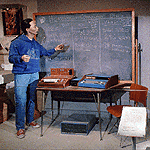 |
"Homebrew Computer Club. Many of pioneer developers of personal
computers prided themselves on being members of the "counter culture."
They met at places like the "homebrew
computer club" in Silicon Valley, California, and dreamed of giving
computer power to individuals. The interest of such hobbyists helped create
a viable market for personal
computers, even though their capabilities were far too limited for office
use." Picture and text from: Smithsonian
Photo #90-15065 by Jeff Tinsley. |
Reconstructing Social Order
HOW can we rebuild social capital in the future? The fact
that culture and public policy give societies some control
over the pace and degree of disruption is not in the long
run an answer to how social order will be established at the
beginning of the twenty-first century. Japan and some Catholic
countries have been able to hold on to traditional family values
longer than Scandinavia or the English-speaking world, and this
may have saved them some of the social costs experienced by
the latter. But it is hard to imagine that they will be able to hold
out over the coming generations, much less re-establish anything
like the nuclear family of the industrial era, with the father
working and the mother staying at home to raise children. Such
an outcome would not be desirable, even if it were possible.
We appear to be caught, then, in unpleasant circumstances:
going forward seems to promise ever-increasing levels of
disorder and social atomization, at the same time that our line of
retreat has been cut off. Does this mean that contemporary
liberal societies are fated to descend into increasing moral
decline and social anarchy, until they somehow implode? Were
Edmund Burke and other critics of the Enlightenment right that
anarchy was the inevitable product of the effort to replace
tradition and religion with reason?
The answer, in my view, is no, for the very simple reason that
we human beings are by nature designed to create moral rules
and social order for ourselves. The situation of normlessness --
what the sociologist Emile Durkheim labeled "anomie" -- is
intensely uncomfortable for us, and we will seek to create new
rules to replace the ones that have been undercut. If technology
makes certain old forms of community difficult to sustain, then
we will seek out new ones, and we will use our reason to
negotiate arrangements to suit our underlying interests, needs,
and passions.
To understand why the present situation isn't
as hopeless as it
may seem, we need to consider the origins of social order per
se, on a more abstract level. Many discussions of culture treat
social order as if it were a static set of rules handed down from
earlier generations. If one was stuck in a low-social-capital or
low-trust country, one could do nothing about it. It is true, of
course, that public policy is relatively limited in its ability to
manipulate culture, and that the best public policies are those
shaped by an awareness of cultural constraints. But culture is a
dynamic force, one that is constantly being remade -- if not by
governments then by the interactions of the thousands of
decentralized individuals who make up a society. Although
culture tends to evolve more slowly than formal social and
political institutions, it nonetheless adapts to changing
circumstances.
What we find is that order and social capital have two broad
bases of support. The first is biological, and emerges from
human nature itself. There is an increasing body of evidence
coming out of the life sciences that the standard social-science
model is inadequate, and that human beings are born with
pre-existing cognitive structures and age-specific capabilities for
learning that lead them naturally into society. There is, in other
words, such a thing as human nature. For the sociologists and
anthropologists, the existence of human nature means that
cultural relativism needs to be rethought, and that it is possible
to discern cultural and moral universals that, if used judiciously,
might help to evaluate particular cultural practices. Moreover,
human behavior is not nearly as plastic and therefore
manipulable as their disciplines have assumed for much of this
century. For the economists, human nature implies that the
sociological view of human beings as inherently social beings is
more accurate than their own individualistic model. And for
those who are neither sociologists nor economists, an essential
humanity confirms a number of commonsense understandings
about the way people think and act that have been resolutely
denied by earlier generations of social scientists -- for example,
that men and women are different by nature, that we are
political and social creatures with moral instincts, and the like.
This insight is extremely important, because it means that social
capital will tend to be generated by human beings as a matter of
instinct.
The biological revolution that has been under way in the second
half of the twentieth century has multiple sources. The most
startling advances have been made at the level of molecular
biology and biochemistry, where the discovery of the structure
of DNA has led to the emergence of an entire industry devoted
to genetic manipulation. In neurophysiology great advances
have been made in understanding the chemical and
physiological bases of psychological phenomena, including an
emerging view that the brain is not a general-purpose calculating
machine but a highly modular organ with specially adapted
capabilities. And finally, on the level of macro behavior, a
tremendous amount of new work has been done in animal
ethology, behavioral genetics, primatology, and evolutionary
psychology and anthropology, suggesting that certain behavioral
patterns are much more general than previously believed. For
instance, the generalization that females tend to be more
selective than males in their choice of mates proves to be true
not only across all known human cultures but across virtually all
known species that reproduce sexually. It would seem to be
only a matter of time before the micro and macro levels of
research are connected: with the mapping of complete gene
sequences for fruit flies, nematodes, rats, and eventually human
beings, it will be possible to turn individual gene sequences on
and off and directly observe their effects on behavior.
The second basis of support for social order is human reason,
and reason's ability to spontaneously generate solutions to
problems of social cooperation. Mankind's natural capabilities
for creating social capital do not explain how social capital
arises in specific circumstances. The creation of particular rules
of behavior is the province of culture rather than nature, and in
the cultural realm we find that order is frequently the result of a
process of horizontal negotiation, argument, and dialogue
among individuals. Order does not need to proceed from the
top down -- from a lawgiver (or, in contemporary terms, a
state) handing down laws or a priest promulgating the word of
God.
Neither natural nor spontaneous order is sufficient in itself to
produce the totality of rules that constitutes social order per se.
Either needs to be supplemented at crucial junctures by
hierarchical authority. But when we look back in human history,
we see that self-organizing individuals have continuously been
creating social capital for themselves, and have managed to
adapt to technological and economic changes greater than those
faced by Western societies over the past two generations.