By RAYMOND BONNER and FORD FESSENDEN - NY Times Sept 22, 2000.
The
dozen states that have chosen not to enact thedeath penalty since the Supreme
Court ruled in 1976 that
it was constitutionally permissible have
not had higher homicide
rates than states with the death penalty,
government statistics and
a new survey by The New York Times show.
- click on the clipping for a larger image of the graph at left -
Indeed, 10 of
the 12 states without capital punishment have homicide rates below
t
he national
average, Federal Bureau of Investigation data shows,
while half the
states with the death penalty have
homicide rates
above the national average. In a state-by- state analysis, The Times
found that
during the last
20 years, the homicide rate in states with the death
penalty has been
48 percent to
101 percent higher than in states without the death penalty.
The study by
The Times also found that homicide rates had risen and fallen along roughly
symmetrical
paths in the states with and without the death penalty,
suggesting to
many experts that the threat of the death penalty rarely deters
criminals.
"It is difficult
to make the case for any deterrent effect from these numbers,"
said Steven
Messner, a criminologist at the State University of New York at
Albany, who
reviewed the analysis by The Times.
"Whatever the
factors are that affect change in homicide rates, they don't seem
to
operate differently
based on the presence or absence of the death penalty in a state."
That is one of
the arguments most frequently made against capital punishment
in states
without the
death penalty — that and the assertion that it is difficult to mete
out fairly.
Opponents also maintain that it is too expensive to
prosecute and
that life without parole is a more efficient form of punishment.
Prosecutors and
officials in states that have the death penalty are as
passionate about
the issue as thei
counterparts in states that do not have capital punishment.
While they recognize
that it is difficult to make the case for deterrence,
they contend
that there are powerful reasons to carry out executions.
Rehabilitation
is ineffective, they argue, and capital punishment is often
the only penalty
that matches the horrific nature of some crimes.
Furthermore,
they say, society has a right to retribution and the finality
of an execution
can bring closure for victims' families.
Polls show that
these views are shared by a large number of Americans. And, certainly,
most
states have
death penalty statutes. Twelve states have chosen otherwise,
but their experiences
have been largely
overlooked in recent discussions about capital punishment.
"I think Michigan
made a wise decision 150 years ago," said the state's governor,
John Engler,
a Republican. Michigan abolished the death penalty in 1846
and has
resisted attempts to reinstate it. "We're pretty proud
of the
fact that we don't have the death penalty," Governor Engler said, adding
that he opposed
the death penalty
on moral and pragmatic grounds.
Governor Engler
said he was not swayed by polls that showed 60
percent of Michigan
residents favored the death penalty. He said 100
percent would
like not to pay taxes.
In addition to
Michigan, and its Midwestern neighbors Iowa, Minnesota,
North Dakota
and Wisconsin, the states without the death penalty are
Alaska, Hawaii,
West Virginia, Rhode Island, Vermont, Maine and
Massachusetts,
where an effort to reinstate it was defeated last year.
No single factor
explains why these states have chosen not to impose
capital punishment.
Culture and religion play a role, as well as political
vagaries in
each state. In West Virginia, for instance, the state's largest
newspaper, The
Charleston Gazette, supported a drive to abolish the
death penalty
there in 1965. Repeated efforts to reinstate the death
penalty have
been rebuffed by the legislature.
The arguments
for and against the death penalty have not changed much.
At Michigan's
constitutional convention in 1961, the delegates heard
arguments that
the death penalty was not a deterrent, that those executed
were usually
the poor and disadvantaged, and that innocent people had
been sentenced
to death.
"The same arguments
are being made today," said Eugene G. Wanger,
who had introduced
the language to enshrine a ban on capital punishment
in Michigan's
constitution at that convention. The delegates
overwhelmingly
adopted the ban, 141 to 3. Mr. Wanger said two- thirds
of the delegates
were Republicans, like himself, and most were
conservative.
Last year, a former state police officer introduced
legislation
to reinstate the death penalty. He did not even get the support
of the state
police association, and the legislation died.
In Minnesota,
which abolished capital punishment in 1911, 60 percent of
the residents
support the death penalty, said Susan Gaertner, a career
prosecutor in
St. Paul and the elected county attorney there since 1994.
But public sentiment
had not translated into legislative action, Ms.
Gaertner said.
"The public policy makers in Minnesota think the death
penalty is not
efficient, it is not a deterrent, it is a divisive form of
punishment that
we simply don't need," she said.
In Honolulu,
the prosecuting attorney, Peter Carlisle, said he had
changed his
views about capital punishment, becoming an opponent, after
looking at the
crime statistics and finding a correlation between declines
in general crimes
and in the homicide rates. "When the smaller crimes go
down — the quality
of life crimes — then the murder rate goes down,"
Mr. Carlisle
said.
Therefore, he
said, it was preferable to spend the resources available to
him prosecuting
these general crimes. Prosecuting a capital case is
"extremely expensive,"
he said.
By the very nature
of the gravity of the case, defense lawyers and
prosecutors
spend far more time on a capital case than a noncapital one.
It takes longer
to pick a jury, longer for the state to present its case and
longer for the
defense to put on its witnesses. There are also considerably
greater expenses
for expert witnesses, including psychologists and, these
days, DNA experts.
Then come the defendant's appeals, which can be
considerable,
but are not the biggest cost of the case, prosecutors say.
Mr. Carlisle
said his views on the death penalty had not been affected by
the case of
Bryan K. Uyesugi, a Xerox copy machine repairman who
gunned down
seven co-workers last November in the worst mass
murder in Hawaii's
history. Mr. Uyesugi was convicted in June and is
serving life
without chance of parole.
Mr. Carlisle
has doubts about whether the death penalty is a deterrent.
"We haven't
had the death penalty, but we have one of the lowest murder
rates in the
country," he said. The F.B.I.'s statistics for 1998, the last year
for which the
data is available, showed Hawaii's homicide rate was the
fifth-lowest.
The homicide
rate in North Dakota, which does not have the death
penalty, was
lower than the homicide rate in South Dakota, which does
have it, according
to F.B.I. statistics for 1998. Massachusetts, which
abolished capital
punishment in 1984, has a lower rate than Connecticut,
which has six
people on death row; the homicide rate in West Virginia is
30 percent below
that of Virginia, which has one of the highest execution
rates in the
country.
Other factors
affect homicide rates, of course, including unemployment
and demographics,
as well as the amount of money spent on police,
prosecutors
and prisons.
But the analysis
by The Times found that the demographic profile of
states with
the death penalty is not far different from that of states without
it. The poverty
rate in states with the death penalty, as a whole, was 13.4
percent in 1990,
compared with 11.4 percent in states without the death
penalty.
Mr. Carlisle's
predecessor in Honolulu, Keith M. Kaneshiro, agrees with
him about deterrence.
"I don't think there's a proven study that says it's a
deterrent,"
Mr. Kaneshiro said. Still, he said, he believed that execution
was warranted
for some crimes, like a contract killing or the slaying of a
police officer.
Twice while he was prosecuting attorney, Mr. Kaneshiro
got a legislator
to introduce a limited death penalty bill, but, he said, they
went nowhere.
In general, Mr.
Kaneshiro said, Hawaiians fear that the death penalty
would be given
disproportionately to racial minorities and the poor.
In Milwaukee,
the district attorney for the last 32 years, E. Michael
McCann, shares
the view that the death penalty is applied unfairly to
minorities.
"It is rare that a wealthy white man gets executed, if it happens
at all," Mr.
McCann said.
Those who "have
labored long in the criminal justice system know,
supported by
a variety of studies and extensive personal experience, that
blacks get the
harsher hand in criminal justice and particularly in capital
punishment cases,"
Mr. McCann wrote in "Opposing Capital Punishment:
A Prosecutor's
Perspective," published in the Marquette Law Review in
1996. Forty-three
percent of the people on death row across the country
are African-Americans,
according to the NAACP Legal Defense and
Educational
Fund.
The death penalty
also has been employed much more often when the
victim was white
— 82 percent of the victims of death row inmates were
white, while
only 50 percent of all homicide victims were white.
Supporters of
capital punishment who say that executions are justified by
the heinous
nature of some crimes often cite the case of Jeffrey L.
Dahmer, the
serial killer who murdered and dismembered at least 17
boys and men,
and ate flesh from at least one of his victims.
Mr. McCann prosecuted
Mr. Dahmer, but the case did not dissuade him
from his convictions
on the death penalty. "To participate in the killing of
another human
being, it diminishes the respect for life. Period," Mr.
McCann said.
He added, "Although I am a district attorney, I have a gut
suspicion of
the state wielding the power of the death over anybody."
In Detroit, John
O'Hair, the district attorney, similarly ponders the role of
the state when
looking at the death penalty.
Borrowing from
Justice Louis E. Brandeis, Mr. O'Hair said:
"Government
is a teacher, for good or for bad, but government should
set the example.
I do not believe that government engaging in violence or
retribution
is the right example. You don't solve violence by committing
violence."
Detroit has one
of the highest homicide rates in the United States — five
times more than
New York in 1998 — but Mr. O'Hair said bringing
back the death
penalty is not the answer.
"I do not think
the death penalty is a deterrent of any consequence in
preventing murders,"
said Mr. O'Hair, who has been a prosecutor and
judge for 30
years. Most homicides, he said, are "impulsive actions,
crimes of passion,"
in which the killers do not consider the consequences
of what they
are doing.
Nor, apparently,
do the people of Detroit see the death penalty as a way
of cutting crime.
Only 45 percent of Detroit residents favored capital
punishment,
a poll by EPIC/MRA, a polling organization in Lansing,
Mich., found
last year; in Michigan over all, 59 percent favored
executions,
which is roughly the level of support for the death penalty
nationally.
To illustrate
the point that killers rarely considered the consequences of
their actions,
a prosecutor in Des Moines, John Sarcone, described the
case of four
people who murdered two elderly women. They killed one
in Iowa, but
drove the other one across the border to Missouri, a state
that has the
death penalty.
Mr. Sarcone said
Iowa prosecutors were divided on the death penalty,
and legislation
to reinstate it was rejected by the Republican-controlled
legislature
in 1997. The big issue was cost, he said.
Last year in
Michigan, Larry Julian, a Republican from a rural district,
introduced legislation
that would put the death penalty option to a
referendum.
But Mr. Julian,
a retired state police officer, had almost no political
support for
the bill, not even from the Michigan State Troopers
Association,
he said, and the bill died without a full vote. The Catholic
Church lobbied
against it.
State officials
in Michigan are generally satisfied with the current law.
"Our policies
in Michigan have worked without the death penalty," said
Matthew Davis,
spokesman for the Michigan Department of Corrections.
"Instituting
it now may not be the most effective use of people's money."
Today in Michigan,
2,572 inmates are serving sentences of life without
parole, and
they tend to cause fewer problems than the general prison
population,
Mr. Davis said.
They are generally
quieter, not as insolent, more likely to obey the rules
and less likely
to try to escape, he said. Their motivation is quite clear, he
said: to get
into a lower security classification. When they come in, they
are locked up
23 hours a day, 7 days a week, and fed through a small
hole in the
door. After a long period of good behavior, they can live in a
larger cell,
which is part of a larger, brighter room, eat with 250 other
prisoners, and
watch television.
One thing they
cannot look forward to is getting out. In Michigan, life
without parole
means you stay in prison your entire natural life, not that
you get out
after 30 or 40 years, Mr. Davis said.
In many states,
when life without parole is an option the public's support
for the death
penalty drops sharply. "The fact that we have life without
parole takes
a lot of impetus from people who would like to see the
death penalty,"
said Ms. Gaertner, the chief prosecutor in St. Paul.
In most states
with the death penalty, life without parole is not an option
for juries.
In Texas, prosecutors have successfully lobbied against
legislation
that would give juries the option of life without parole instead
of the death
penalty.
Mr. Davis said
a desire "to extract a pound of flesh" was behind many of
the arguments
for capital punishment. "But that pound of flesh comes at a
higher price
than a lifetime of incarceration."
Mr. O'Hair, the
Detroit prosecutor said, "If you're after retribution,
vengeance, life
in prison without parole is about as punitive as you can
get."
--------------
Deadly
Statistics: A Survey of Crime and Punishment
By FORD FESSENDEN
In
its analysis, The New York Times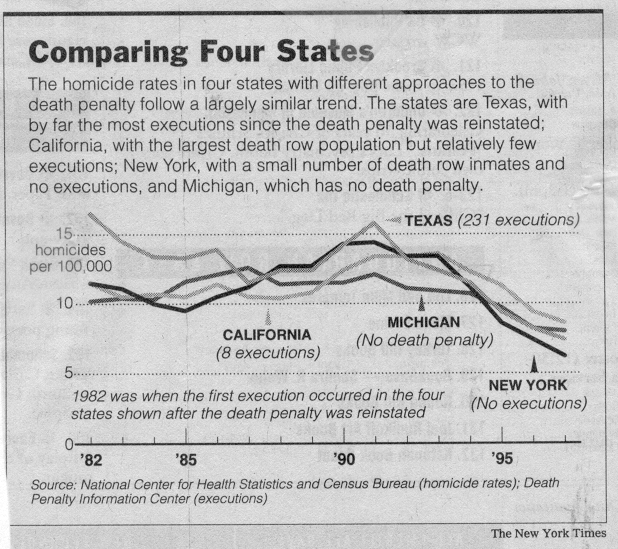
examined homicide rates in two groups of
states: the
12 states without the death penalty
and the 36 states
that passed laws within 10
years of the
Supreme Court's 1972 Furman v.
Georgia decision,
which overturned all existing
death penalty
statutes. (New York and
Kansas did not
adopt the death penalty until the 1990's.)
The analysis
found that homicide rates have not declined any more in the
states that
instituted the death penalty than in states that did not.
In fact, year
after year, homicide rates in states with death penalties
roughly mirrored
the rates in states without capital punishment, with death
penalty states
48 percent to 101 percent higher. That trend,
criminologists
say, provides evidence that something besides enactment
of capital punishment
laws drives homicides.
"It's clear that
the states with the death penalty may want it more because
they have more
homicides," said Alfred Blumstein, director of the
National Consortium
on Violence Research at Carnegie Mellon
University.
"But it's not clear that it does them any good in terms of
reducing homicide."
Even after executions
resumed, homicide rates appeared unaffected, the
analysis found.
In the 21 states that carried out their first executions by
1993, homicide
rates declined a collective 5 percent over the four years
after the execution.
But rates declined 12 percent in states that had not
had executions
in the same years.
The Times also
looked at contiguous and demographically similar states,
and found no
pattern that differentiated death penalty states from those
without capital
punishment. Massachusetts and Rhode Island, with no
death penalty,
had homicide rates of 3.7 per 100,000 and 4.2 per
100,000, respectively,
from 1977 to 1997, while Connecticut, a death
penalty state,
had a rate of 4.9 per 100,000.
The survey by
The Times is similar to the type of analysis criminologists
used in the
years before the Supreme Court's Furman decision to
conclude that
state homicide rates were not affected by death penalty
laws. The review
by The Times confirms that those patterns appear to
continue under
the new era of capital punishment statutes.
Some researchers
still contend that the death penalty has a measurable
deterrent effect.
"The statistics involved in such comparisons have long
been recognized
as devoid of scientific merit," Prof. Isaac Ehrlich, of the
State University
of New York at Buffalo, said of the analysis by The
Times. He said
that if variations like unemployment, income inequality,
likelihood of
apprehension and willingness to use the death penalty are
accounted for,
the death penalty shows a significant deterring effect.
Most criminologists,
however, discount Professor Ehrlich's work.
------------------
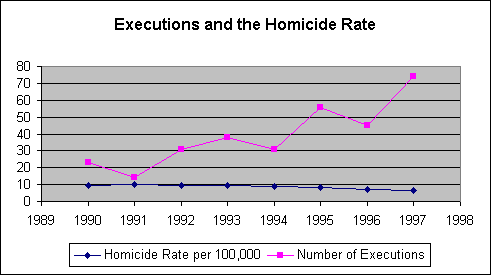
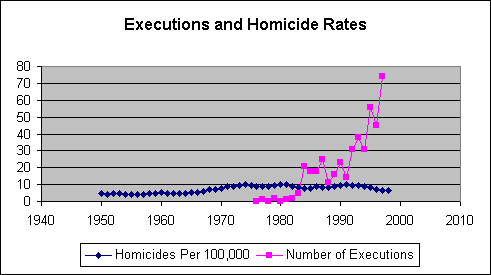
Some additional graphs that I prepared: