
Lecture 9
Simple Harmonic Motion
The Restoring Force
In order to stretch a spring that obeys Hooke's law, a stretching force F = kx must be applied. This creates a tension in the spring, so that the spring pulls backward on whatever it is attached to, which experiences a
Restoring force: F = -kx
A point mass m connected to a spring obeying Hooke's Law, experiences a force F = -kx, and it performs a motion called simple harmonic motion.
A graph of the displacement as a function of time has the shape of a sine or cosine function. The maximum value of the displacement is called the amplitude. It is fixed by the distance the mass is pulled down before it is let go.
The pattern of the displacement repeats itself after a characteristic time that is called the period T of the oscillation.
The frequency f is just one over the period
f = 1/T
The SI unit for frequency is the hertz.
E.g. a radio station has a frequency of 1060 kHz. The period of the oscillations of the radio waves is
T = 1/f = 1/(1060×103 Hz) = 0.943 × 10⁻⁶ s
or about 1 microsecond.
The angular frequency is
w = 2p/T = 2pf
(no separate SI unit)
The Reference Circle
Imagine a point mass performing uniform circular motion, with angular velocity w. Shine a light in the plane of the circle to project a shadow of the point mass on a flat screen. Then that shadow performs uniform circular motion.
Radius of the circle is A, angle turned through is q , then length of the shadow is A cos(q). But q = wt so
x = A cos(wt)
This is simple harmonic motion. The angular frequency of the simple harmonic oscillator has the same value as the angular velocity of the point on the reference circle.
The tangential velocity of the point performing uniform circular motion is
vT = wr = wA
The velocity of the harmonic oscillator is the projection of this. Since the tangential velocity is at right angles to the radius, there is a sine factor. Also, the horizontal component of the velocity points backwards, so
v = -vTsin(wt) = -wA sin(wt)
When the displacement is at its maximum positive or its maximum negative value, the mass instantaneously comes to rest, and the velocity is zero. The mass has its maximum speed when it is moving through the center of its swing, i.e. when the displacement is zero.
Acceleration of the harmonic oscillator is a projection of the acceleration of uniform circular motion, which is the centripetal acceleration
aC = v2/r = w2r = w2A
- always in the opposite direction to the displacement vector - cosine factor and a negative sign
for SHM: a = -w2 A cos(wt) = -w2x
Newton's second law:
F = ma
-kx = m × (-w2x) = -mw2x
so
and, from this
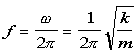
and
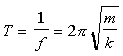
If m is increased, the object responds more slowly. If the spring constant is increased, the mass goes through its oscillation more rapidly.
Energy of Harmonic Oscillator
The work done in stretching a spring from its relaxed length through an extension x is ½kx2. And the elastic force is conservative.
The elastic potential energy of a spring with a force constant k that is stretched through an extension x is
PE(elastic)=½kx2
The mass that is performing simple harmonic motion also has kinetic energy, the usual ½ mv2.
Total energy of the oscillator is
E(total) =PE + KE = ½kx2 + ½mv2
with:
k = mw2
x = A cos(wt)
v = -wA sin(wt)
so
E(total) = ½mw2 A(cos2(wt) + sin2(wt))
From Pythagoras' theorem:
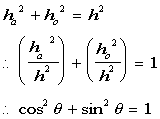
for any angle.
Hence
E(total) = ½mw2A2
The total energy is constant, independent of time. As the mass oscillates on the spring there is a continually switching of the energy between potential and kinetic energies, with the net amount of energy staying constant.
The Simple Pendulum
Mass on the end of a string - simple pendulum - not exactly a simple harmonic oscillator. Good approximation to one if the amplitude of the oscillations is small.
When the pendulum is turned through an angle q, the mass has traveled through a circular arc of length s = Lq. Forces acting on the mass are the tension T in the string, and the weight mg of the mass. The tension is perpendicular to the arc, so it has zero component along the path.
The weight is vertically downwards. Its component along the path is -mg sin(q). Equation of motion is
ma = -mg sin(q)
- does not have a simple solution. Make an approximation.
sin(q) » s/L
then
ma = -mgs/L
a = -(g/L)s
This has the same form as the equation for simple harmonic motion of
for SHM a = -w2x
with
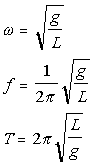
The period of a simple pendulum is not strictly independent of the amplitude.
Fluids
Use the word fluid to encompass both gases and liquids.
Mass density
The mass density is the mass m of a substance divided by its volume V:
r = m/V
The gram was chosen so that the density of water was 1.00 gm/cm3. In SI, the density of water is approximately 1000 kg/m3. (It depends slightly on temperature). Some densities are
Water (4oC) 1000 kg/m3
Blood (37oC) 1060
Wood (yellow pine) 550
Quartz 2660
Aluminum 2700
Iron 7860
Lead 11300
Gold 19300
Specific gravity = Density of substance/Density of water at 4oC
E.g. specific gravities of wood and lead are 0.55 and 11.3 respectively (no units).
The Earth, Moon, and Sun are all, near enough, spheres. The volume of a sphere is
V = (4p/3)R3
Astronomical from the inside front cover of the textbook (and an extra line for Jupiter)
Mass (kg) Radius (m) Density (kg/m3)
Earth 5.98×1024 6.38×10⁶ 5500
Moon 7.35×10²² 1.74×10⁶ 3330
Sun 1.99×1030 6.96×10⁸ 1410
Jupiter 1.90×1027 7.15×10⁷ 1240
Earth is part rock and part iron, the Moon is almost all rock. Sun is hydrogen gas, highly compressed. Jupiter is similar.
Pressure
Pressure increases with depth in a fluid, because the weight of the fluid that is above provides a downward force. The pressure at any depth in a fluid is the weight of all the fluid above it that is contained in a column of unit cross-sectional area.
SI unit for pressure is the newton per square meter, called a pascal
1 pascal (Pa) = 1 N/m2
Then
1 atmosphere = 1.013 × 10⁵ Pa
Increase of Pressure with Depth in a Fluid
Imagine a vertical column of liquid, with a height h and an area A. Pressure at the top of the column is P1. Downward force on the column corresponding to this pressure is P1A. Pressure at the bottom of the column is P2 and the upward force on the column at the bottom is P2A. Other downward force is the weight of the fluid in the column. Volume of the column is hA, mass of the column is the density times the volume, or rhA. The weight of this mass of fluid is rghA. Hence
P2A = P1A + rghA
P2 = P1 + rgh
For example, if P2 - P1 is one atmosphere
rgh = 1.013 × 10⁵ N/m2
h = 1.013 × 10⁵/(9.8 × r)
If r = 1000, for fresh water, h = 10.3 m, about 34 feet. If is the density of mercury, 13600 kg/m3 h is 0.760 m, or 760 mm.
Pascal's Principle
The pressure is the same at all points in the fluid that are at the same depth. Used in hydraulic lift. (see fig. 11.16)
Pascal's Principle
Any change in the pressure applied to a completely enclosed fluid is transmitted undiminished to all parts of the fluid and the enclosing walls.
Archimedes' Principle and Buoyancy
Think about an object that is completely submerged in a fluid. It has a height h and a cross-sectional area A. The pressure at the top of the cylinder is P1, the pressure at the bottom is P2. The downward force on the upper surface is P1A, the upward force on the lower surface is P2A. The net upward force exerted by the fluid on the object is
P2A - P1A = (P2 - P1)A
but P2 - P1 = rgh
so the net buoyant force is rghA upwards.
Archimedes Principle
Any fluid exerts a buoyant force on an object that is partially or completely immersed in it; the magnitude of the buoyant force equals the weight of the fluid that the object displaces.
Problem 11-50 (**) One kilogram of glass (r = 2.60 × 10³ kg/m3) is shaped into a hollow spherical shell that just barely floats in water. What are the inner and outer radii of the shell? Do not assume the shell is thin.
The weight of the glass is 1 kg×9.8 m/s2 = 9.8 N
Since it just floats, it displaces a weight of water of 9.8 N, which is a mass of water of 1 kg.
The volume of 1 kg of water is
V = m/(water) = (1 kg)/(1000 kg/m3) = 0.001 m3
The volume of a sphere is
V = (4p/3)R3
Radius of a sphere with a volume of 0.001 m3 is

(surprisingly small!)
The actual volume of 1 kg of glass is
V(glass) = m/(glass) = (1 kg)/(2.60×103 kg/m3) = 0.000385 m3
so there must be a hollow space with volume 0.001 - 0.000385 = 0.000615 m3 at the center of the sphere. A sphere with this volume has a radius of

This gives the outer and inner radii.
Fluids in Motion
We distinguish between streamline, or steady, flow, and turbulent flow. In streamline flow, the fluid particles move along smooth trajectories. In turbulent flow, the particles follow unpredictable complicated paths, full of changes in direction and velocity. Turbulent flow is an example of chaos.
Equation of Continuity
Imagine an liquid moving along a tube with a cross-sectional area A, at a speed v. In a time t, each particle of the fluid moves a distance vt along the tube. In this time t, a volume Avt of the liquid goes by. If the density of the liquid at that point is r, then the mass of liquid passing in time t is rAvt.
If the cross-sectional area is changing from point to point, the mass of liquid entering the tube must equal the mass leaving the tube. Put subscript 1 on the values at the beginning of the tube and subscript 2 on the values at the end of the tube, then
r1A1v1t = r2A2v2t
r1A1v1 = r2A2v2
equation of continuity.
If the fluid is incompressible, as the tube narrows, the fluid must speed up.
Bernoulli's Equation
In a time t, the fluid at the left end travels a distance s2 = v2t, and a volume of fluid V = A2v2t enters the tube
The force exerted on this bit of the fluid from the fluid pushing it along is F = P2A2, and the work done by this force is W2 = Fs2 = P2A2s2 = P2V.
When the bit of fluid leaves the tube at the right end, it does work pushing the fluid ahead of it along the tube, and the work it does is W1 = P1V. The net work done on the fluid as it moves through the tube is W2 - W1.
As the bit of fluid enters the tube, it has kinetic energy ½mv22 and it has potential energy mgy2, where m = rV.
As it leaves the tube it has kinetic energy ½mv12 and potential energy mgy1.
For energy to be conserved
W2 - W1 = ½r Vv12 + rVgy1 - ½rVv22 - rVgy2
P2V - P1V = ½r Vv12 + rVgy1 - ½rVv22 - rVgy2
The factor of V cancels
P2 + ½r v22 + rgy2 = P1 + ½rv12 + rgy1
As the velocity of a fluid increases, its pressure falls.
- airplane's wing, wind can blow the roof off a building.