Lecture 6
Principle of Conservation of Momentum
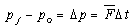
Change in momentum is equal to impulse of net force
If there is no net force acting on a system, the impulse is zero and
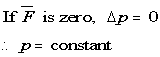
Law of conservation of momentum.
The momentum P of a system consisting of several pieces is the sum of mv for all of the pieces, i.e. it is the sum of the separate momenta.
Divide the forces into external forces and internal forces. Then for each piece of the system
p = impulse of external forces + impulse of internal forces
P = {impulses of external forces} +
{impulses of internal forces}
From Newton's third law, the internal forces occur in pairs, with
FBA = -FAB
It follows that
{impulses of internal forces} = 0
and hence
P = impulse of net external force.
The total linear momentum of an isolated system remains constant (is conserved). An isolated system is one for which the vector sum of the external forces acting on the system is zero. This principle applies to a system containing any numer of objects.
Problem 7-18. An astronaut is motionless in space. Upon command, the propulsion unit strapped to his back ejects some gas with a velocity of +32 m/s, and the astronaut recoils with a velocity of -0.30 m/s. After the mass is ejected, the mass of the astronaut is 160 kg. What is the mass of the gas?
Initial momentum = Final momentum,
but Initial momentum = 0
so (Net) final momentum = 0
Final momentum of astronaut + final momentum of gas = 0
mAvA + mGvG = 0
(160 kg)(-0.30 m/s) + mG (+32 m/s) = 0
mG = 160 × 0.30 / 32
= 1.50 kg
Collisions
If mechanical energy is conserved in a collision, the collision is said to be elastic. A collision in which this is not the case is inelastic.
Elastic collisions in one dimension
Ball 1 has mass m1 and an initial velocity v01
Ball 2 has mass m2 and initial velocity v02
They collide, and, after the collision, ball 1 has a final velocity vf1, and ball 2 has final velocity vf2
Initial total momemtum = final total momentum
m1v01 + m2v02 = m1vf1 + m2vf2
If the collision is elastic
Initial total kinetic energy = final total kinetic energy
½m1v012 + ½m2v022 = ½m1vf12 + ½m2vf22
(complicated, but enough information to solve the problem)
Suppose ball 2 is initially at rest, i.e. v02 = 0
Then the solutions for the two final velocities are
(eqns 7.8a and 7.8b)
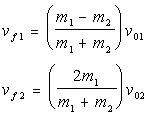
If m1 > m2, vf1 is positive i.e. ball 1 keeps going
If m1 < m2, vf1 is negative i.e. ball 2 bounces backwarads
If m1 = m2, vf1 = 0 Ball 1 stops, exactly.
A sticking-together-collision is never elastic.
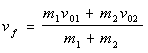
If two objects collide, and stick together, so that they have the same final velocity vf, momentum conservation gives
Collisions in two dimensions
If P is the sum of the momenta of all the particles, then
P0x = Pfx
and P0y = Pfy
Center of Mass
The center of mass is an average position for the mass in a system composed of several parts. Suppose we have two objects sitting on a line, one has mass m1 and is located at position x1, the other has mass m2 and is located at x2.
The center of mass is an average position in which the position of each object is weighted by the mass of that object
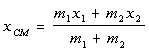
The external forces acting on a composite system cause the center of mass to move exactly as if all the mass of the system was at that point.
Velocity of the Center of Mass
If, in a time t, the two objects move distances x1 and x2, the center of mass moves a distance
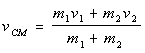
The velocity of the center of mass is exactly the same form of weighted average as the its position.
In a collision, the velocity of the center of mass is the same after the collision as it was before the collision.
Chapter 7 problems: 2, 10, 19, 30, 41
7-19 is assigned with 1550-kg replaced with (1200 + 10 n) kg.
Rotational Kinematics
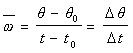
Draw a line drawn along a radius of the rotating disk, and a fixed reference mark next to the disk. Initially, the radius line makes an angle 0 with the reference mark, at a later time it makes an angle with the reference mark, and in between it has turned through an angle .
Angular velocity
The average angular velocity for the time interval t is
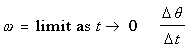
The instantaneous value is got by taking the limit as t shrinks to zero
Angular acceleration
If the angular velocity changes during some time interval, the average angular acceleration in that interval is
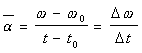
is the angular acceleration.
Any relationships that held for the linear variables also hold for the angular variables.
Each of the equations used to describe motion at constant acceleration has a counterpart describing rotational motion at constant angular acceleration. See table 8.1
The kinematic rotational equations are valid for any consistent set of rotational units. (This will not be the case for some of the dynamical equations.)
Radians
Draw a circle and two radii, separated by the angle . What is the length s of the circular arc between the radii?

Choose the unit for so that this proportionality is an equality. Define the angle by
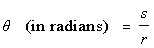
For an entire circle the arc length is 2 times the radius
1 revolution = 2 radians
and, since one revolution is 360o,
1 radian = 360 / 2 = 57.3o
Problem 8-8. An automatic spin drier spins wet clothes at an angular speed of 5.2 rad/s. Starting from rest, the drier reaches its operating speed with an average angular acceleration of 4.0 rad/s2. How long does it take the drier to come to up to speed?
Compare v = v0 + at.
= 0 + t
5.2 rad/s = 0 + (4.0 rad/s2)t
t = (5.2 rad/s) / (4.0 rad/s2)
= 1.3 s
We could have used any units for this.
Problem 8-23. The angular speed of the rotor in a centrifuge increases from 420 to 1420 rad/s in a time of 5.00 s. (a) Obtain the angle through which the rotor turns. (b) What is the angular acceleration?
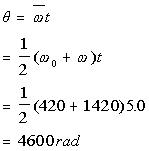
The angular acceleration is found from
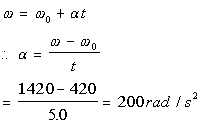
Angular Variables and Tangential Variables
If a point mass travels in a circular arc through a distance s in time t, s is related to t through the linear velocity
s = vt
The angle turned through is related to t and to the angular velocity
= t
but = s/r
t = vt/r
= v/r or v = r
Similarly, if the point mass is accelerating, the linear acceleration and the angular acceleration are related by
= a/r or a = r
Problem 8-35. The take-up reel of a cassette tape has a radius of 0.025 m. Find the length of tape that passes around the reel in 7.1 s when the reel rotates at an average angular speed of 1.9 rad/s.
The linear speed of the perimeter of the take-up reel is
v = r = (1.9 rad/s)(0.025 m) = 0.0475 m/s.
The length of tape that passes around the reel in 7.1 s is then
s = vt = (0.0475 m/s)(7.1 s) = 0.337 m = 34 cm.
Centripetal and Tangential Acceleration
If a point mass moving in a circle to change its speed, the acceleration has two components.
If a point is moving in a circle of radius r, and, at one instant of time, it has speed v, then the centripetal acceleration is

just as for uniform motion. If the speed is also changing, there is a second component to the acceleration, a tangential component, given by

where is the angular acceleration. It is also equal to the rate of change of the speed.
If the speed increases by v in a time interval t,

Rolling
If an object is to roll without slipping, the wheel must advance a distance equal to its perimeter, 2r, while it completes one revolution. If there is to be no slipping

This looks like the same formula as before, but the significance of the symbols is different.
Chapter 8 problems: 12, 19, 24, 31, 42
8-19 is assigned with 1800 rad/s replaced with (1500 + 10 n) rad/s.