Problem 12-7. On the Rankine temperature, which is sometimes used in engineering applications, the ice point is at 491.67oR and the steam point is at 671.67oR. Determine a relationship between the Rankine and Fahrenheit scales.
For the ice point, TR - TF = 491.67 - 32 = 459.67, and for the steam point, TR - TF = 671.67 - 212 = 459.67 also. So
TR = TF + 459.67
The Rankine scale is a scale with the same zero point as the Kelvin scale, but the size of a degree is the same as the Fahrenheit degree. Note that 491.67 is (9/5)(273.15).
Problem 12-20. The brass bar and the aluminum bar in the drawing are each attached to an immovable wall. At 28oC the air gap between the rods is 1.3 × 10⁻³ m. At what temperature will the gap be closed?
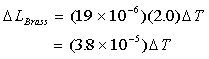
If the final temperature is T, the increase in length of the brass bar is
The increase in length of the aluminum bar is
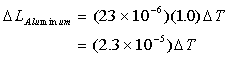
The sum of the two increases is (6.1×10⁻⁵)(T-28). This equals 1.3×10⁻³ m when (T-28) = 21, so T = 49oC.
Problem 12-37. The bulk modulus of water is B = 2.2 × 10⁹ N/m2. What change in pressure P (in atmospheres) is required to keep water from expanding when it is heated from 15 to 25oC?
The change in temperature would produce a change in the volume, at constant pressure of

The pressure must produce a change of the same magnitude but of the opposite sign. So

Since 1 atmosphere is 1.01×10⁵ Pa, this is 45 atm.