Problem 11-7. A gold prospector finds a solid rock that is composed solely of quartz and gold. The rock has a mass of 12.0 kg and a volume of 4.00 × 10⁻³ m3. What mass of gold is contained in the rock?
Call the mass of gold MG. Then, using the density of gold, the volume of gold is MG/(19300) = (5.18×10⁻⁵)MG.
The mass of quartz is (12.00 - MG), and the volume of quartz is (12.00-MG)/(2660) = (3.76×10⁻⁴)(12.00-MG)
The sum of these is the total volume. This gives a condition
(5.18×10⁻⁵)MG + 4.51×10⁻³ - 3.76×10⁻⁴ MG = 4.00×10⁻³
or
3.24×10⁻⁴ MG = 5.1×10⁻⁴
MG = 1.57 kg.
Problem 11-13. High-heeled shoes can cause tremendous pressure to be applied to a floor. Suppose the radius of a heel is 6.00 × 10⁻³ m. At times during a normal walking motion, nearly the entire body weight acts perpendicular to the surface of such a heel. Find the pressure that is applied to the floor under the heel because of the weight of a 50.0-kg woman.
The weight of the woman is 50.0 kg × 9.8 m/s2 = 490 N.
The area of the heel (assuming it is a circle) is 1.15 × 10⁻⁵ m2.
The pressure is the force divided by the area, P = 490 N/1.15 × 10-5 m2 = 4.33 × 10⁷ Pa. (About 420 atmospheres, or about 3 tons per square inch.)
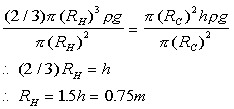
Problem 11-17. A cylinder (with circular ends) and a hemisphere are solid throughout and made from the same material. They are resting on the ground, the cylinder on one of its ends and the hemisphere on its flat side. The weight of each causes the same pressure to act on the ground. The cylinder is 0.500 m high. What is the radius of the hemisphere?
The pressure exerted by each is its weight divided by the area that is in contact with the ground. The weight of each is its volume multiplied by its density. If the cylinder has radius RC and height h, and the hemisphere has radius RH, this gives
Problem 11-42. A solid object floats on ethyl alcohol, with 68.2% of the object's volume submerged. Using table 11.1, identify the substance from which the object
is made.
Suppose the volume of the object is V. Then the volume of ethyl alcohol that it displaces when it floats is 0.682 V. From table 11.1, the density of ethyl alcohol is 806 kg/m3, so the mass of the alcohol displaced is (806 kg/m3)(0.682 V). This must equal the mass of the object. Hence the density of the object, its mass divided by its volume, is (0.682)(806 kg/m3) = 550 kg/m3. The entry in table 11.1 with this density is wood (yellow pine).
Problem 11-55. Suppose that blood flows through the aorta with a speed of 0.35 m/s. The cross-sectional area of the aorta is 2.0 × 10⁻⁴ m2. (a) Find the volume flow rate of the blood. (b) The aorta branches into tens of thousands of capillaries whose total cross-sectional area is about 0.28 m2. What is the average blood speed through them?
(a) In a time t, the blood travels through the aorta a distance of 0.35 m/s × t. The volume of a column of blood of this length is 0.35 m/s × t × 2.0×10⁻⁴ m2 = (7.0 × 10⁻⁵ m3)t. The flow rate is the volume divided by the time, or, equivalently, it is the volume for a time of 1 second. It is 7.0 × 10⁻⁵ m3/s.
(b) From the equation of continuity, and assuming the density of blood is constant, when the cross-sectional area changes from A1 to A2, the speed changes from v1 to v2 so that A1v1 = A2v2. Hence
v2 = (2.0×10⁻⁴ m2)(0.35 m/s)/(0.28 m2) = 0.0025 m/s.