
Problem 8-12. Two people start at the same place and walk around a circular lake in opposite directions. One has an angular speed of 1.7 × 10⁻³ rad/s, while the other has an angular speed of 3.4 × 10⁻³ rad/s. How long will it be before they meet?
You could use a relative angular velocity idea to solve this, but it is not necessary. Suppose they meet after a time t. Then the first person has walked through an angle of (1.7 × 10⁻³ rad/s)t, and the second person has walked through an angle of (3.4 × 10⁻³ rad/s)t. Together, they must have completed a circuit of the lake, which is 2×3.142 radians (i.e. 2 pi). But the total angle they have covered is (1.7×10⁻³ + 3.4×10⁻³)t radians = 5.1×10⁻³ rad, so t = 2×3.142 ÷ 5.1×10-3 = 1.23×10³ s.
Problem 8-19. An airliner arrives at the terminal, and the pilot shuts off the engines. The initial angular velocity of the fan blades is 1800 rad/s, and it takes 120 s for them to come to rest. What is the angular displacement of the blades?
Use the equation that is the rotational analog of x = ½(v0+v)t.
Problem 8-24. After 10.0 s, a spinning roulette wheel has slowed down to an angular speed of 1.88 rad/s. During this time, the wheel rotates through an angle of 44.0 rad. Determine the angular acceleration.
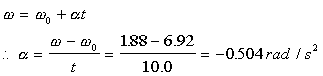
This is an asterisked problem, because you can't solve it in a one-shot application of the standard equations. But there are several ways to go at it. One is first to say that the average angular velocity is (44.0 rad)/(10.0 s) = 4.40 rad/s. This is the average of the initial and final angular velocities. From this you can find that the initial angular velocity must be (2 × 4.40 - 1.88) = 6.92 rad/s. Then the angular acceleration is found from
Problem 8-31. An auto race is held on a circular track. A car completes one lap in a time of 18.9 s, with an average tangential speed of 42.6 m/s. Find (a) the average angular speed and (b) the radius of the track.
(a) Since one lap is 2 pi radians, from the time to complete a lap, the average angular speed is (2×3.142 rad)/18.9 s = 0.332 rad/s. (b) Now you can use
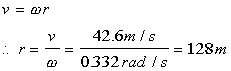
(This is a short track, but not impossibly so. The circumference is about half a mile.)
Problem 8-42. Two Formula-one racing cars are negotiating a circular turn with the same angular speed. However, the path of car A has a radius of 24 m, while that of car B has a radius of 18 m. Determine the ratio of the centripetal acceleration of car A to that of car B.
(I seem to have a fixation on racing cars.)
A formula that I have not written down, but which is useful, is got by writing the centripetal acceleration in terms of the angular velocity
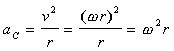
Since the cars have the same angular velocity, their centripetal accelerations are in the same ratio as the radii of their paths, or acA/acB = 24/18 = 1.33.
<A href="solution.htm">back to main solution menu</A>