Problem 4-6. During a circus performance, a 72-kg human cannonball is shot out of an 18-m-long cannon. If the human cannonball spends 0.95 s in the cannon, determine the average net force exerted on him in the barrel of the cannon.
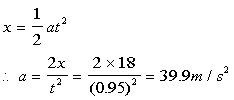
If the human cannonball starts from rest and travels 18 m in 0.95 s, his average acceleration is given by
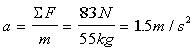
The average net force is then

Problem 4-16. A space probe has two engines. Each generates the same amount of force when fired, and the directions of these forces can be independently adjusted. When the engines are fired simultaneously and each applies its force in the same direction, the probe, starting from rest, takes 28 s to travel a certain distance. How long does it take to travel the same distance, again starting from rest, if the engines are fired simultaneously and the forces that they apply to the probe are perpendicular?
Suppose that each engine generates a force F. Then the net force when the two engines are fired in the same direction is 2F. When the engines are fired perpendicularly to each other, the direction of travel is half way in between them. The component of the force provided by each engine, in the direction of travel, is F cos(45o), or 0.707 F. The total force is therefore twice this, or 1.414 F. This is smaller than the previous value by a factor of 2/1.414, which is also 1.414. The acceleration is therefore reduced by this factor. The time taken to travel a given distance is

If the acceleration is reduced by a factor of 1.414, the time is increased by a factor of the square root of this, or 1.189. The time is therefore
28s × 1.189 = 33.3s.
Problem 4-28. A space traveler weighs 580 N on earth. What will the traveler weigh on another planet whose radius is three times that of the earth and whose mass is twice that of the earth?
If the traveler weights 580 N on earth, his or her mass is
580 N / 9.8 m/s2 = 59.18 kg. The acceleration due to gravity on the surface of a planet is

so g on the surface of the planet is

The weight of the person on the planet is therefore
59.18 kg ×2.18 m/s2 = 129 N.
Problem 4-38. A 55-kg person crouches on a scale and jumps straight up. As the person springs up, the reading on the scale suddenly rises to 622 N. What is the acceleration of the person at this instant?
The reading on the scale is the force exerted on the scale by the person, and, from Newton's third law, this is equal to the force exerted on the person by the scale. This is an upward force on the person. There is also the downward force of the person's weight, which is 55 kg × 9.8m/s2 = 539 N. The net upward force is then (622 - 539) = 83 N, and the acceleration this generates is
Problem 4-52. A wire is stretched between the tops of two identical buildings. When a tightrope walker is at the middle of the wire, the tension in the wire is 2220 N. Each half of the wire makes an angle of 8.00o with respect to the horizontal. Find the weight of the performer.
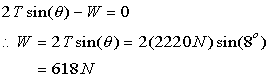
The tension in each half of the wire has a vertical component of T sin(), where is 8.00o. The net upward force on the person consists of the tensions in the two sides of the wire, and the downward weight, and this total must be zero. Therefore