Instructor: Dr. Cowley
Syllabus
The text book is "An Introduction to Computer Simulation Methods" by Harvey Gould and Jan Tobochnik. This book does an excellent job of emphasizing the physics rather than the computer science or numerical analysis. A peculiarity is that it uses the language TrueBasic. The reason given is that this is the only language that has a rich set of graphics commands and that is available to run on DOS, Mac, and Unix machines. A student version of TrueBasic can be purchased for $19.95 from TrueBasic Inc., or the Windows-based Bronze version is $39.95. Their web site is at http://www.truebasic.com. The TrueBasic listings in the textbook can be downloaded from http://sip.clarku.edu/.The format of most chapters of the book is that a method is discussed, and then a program listing is given, in TrueBasic. There is then a series of problems. The first mainly requires running the program as listed. Others will require you to write some additional code. I shall try to run the course in a laboratory format. You will be able to work at individual computers in the lab., and work at your own pace through the material. Each assignment should be submitted in the form of a lab report. Read the section on the format of reports in Chapter 1 of the textbook. |
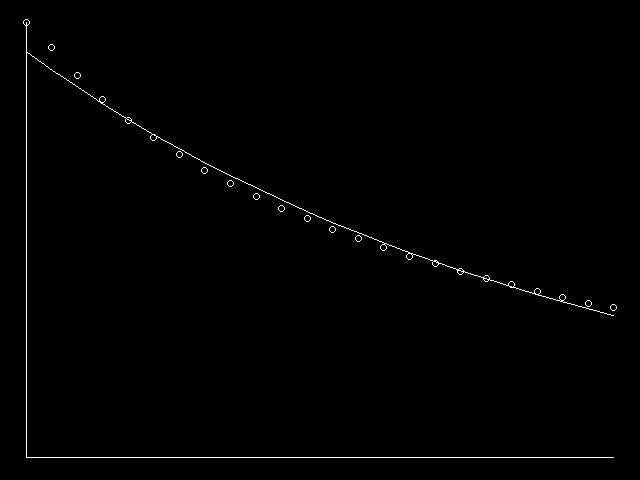
Programs and problems assigned are Chapter 2: The Coffee Cooling Problem page 14 - redo Table 2.01 using x = 0.05
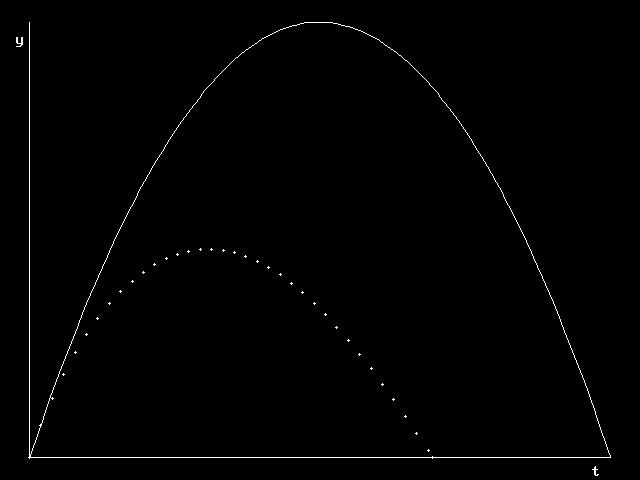
Program coolChapter 3: The Motion of Falling Objects Program free_fall, problem 3.1,
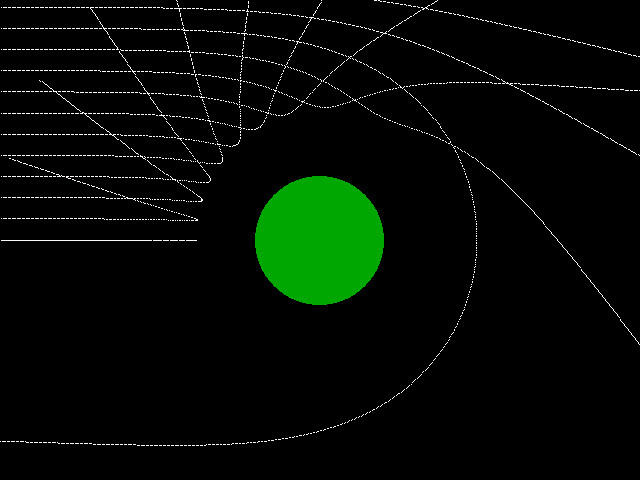
Problem 3.2 (b)Chapter 4: The Two-Body Problem Problem 4.1 (doesn't involve a program)
Problem 4.14 (c)Chapter 5: Simple Linear and Nonlinear Systems Program sho, problem 5.1, problem 5.2, problem 5.3, problem 5.5
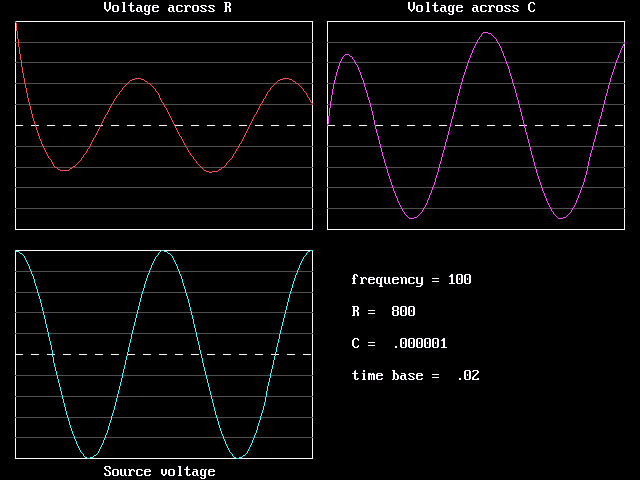
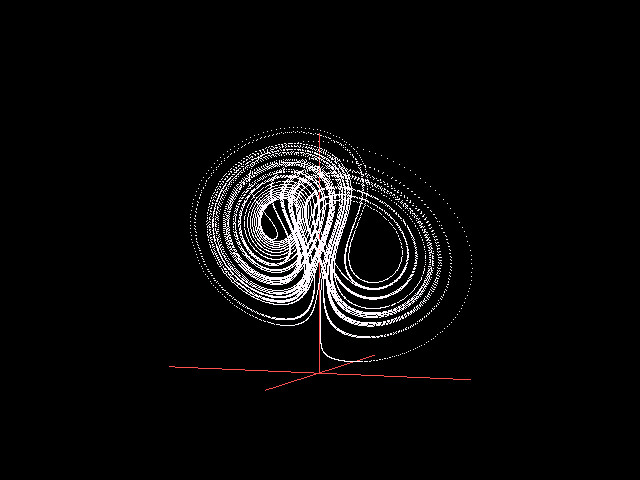
Program rcChapter 6: The Chaotic Motion of Dynamical Systems Program iterate_map, problem 6.1 |
Chapter 7: Random Processes
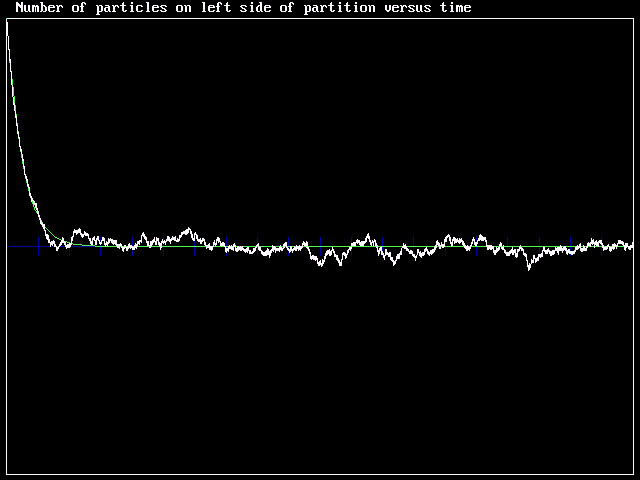
Program box, problem 7.1, problem 7.2 Program random_walk, problem 7.6, problem 7.7
Output from program "box" with 1000 particles.
Each chapter has additional program listings and problems. I shall discuss and illustrate many of these in class. For this to work, it is essential that you keep up with the material. I depend on your having become familiar with ideas that are used in additional applications. Most of the grade is based on the reports that you will write on the problems. In addition to the problems, you will be required to carry out one of the projects given at the ends of chapters 4, 5, and 6. This will carry the weight of three problems. The final exam will consist of an additional problem, requiring you to write a program, to be carried out with a three hour time limit. This will carry the weight of two problems. (Computational Physics I begins with chapter 8, and two long programs md and hd. You might want to make an early start on whichever of these you are assigned.)