Ethics and Policy in Criminal Justice - Class Notes - Section
Three of the course
The Criminology of Terrorism
What is terrorism? The definition is controversial since "one
man's terrorist is another's freedom fighter." All military action
can be terrifying, yet we distinguish between terrorism and legitimate
military action. This gets back to the ethics
of war which we looked at earlier. This can be viewed from the
perspective of intentions (deontological) or consequences, eg., in the
Arab/Israeli conflict the Israelis kill more Palestinians than vice versa,
but they do not intentionally target civilians. Suicide bombers do.
Which
is more ethical?
Or is the key question whether a campaign is conducted by a government
or by irregular forces? Whether the forces wear uniforms or not?
This is a legal issue with regard to the prisoners the U.S. is holding
in Guantanamo, are they entitled to be treated as prisoners of war or are
they terrorists?
Can we use the justice of the cause as a criterion for deciding which
behavior is terrorist?
In The Lessons of Terror, Caleb Carr defines terrorism as "warfare deliberately
waged against civilians with the purpose of destroying their will to support
either leaders or policies that the agents of such violence find objectinable."
This applies to Al Qaeda but also to the Allied bombing of Dresden, Tokyo,
Hiroshima, Nagasaki.
There are many other
definitions.
Why do people commit terrorist acts?
A good summary is psychiatrist Jerrold Post's testimony to Congress
on Terrorist
Organizations and Motivations. This document should be considered
as part of the lecture notes for this course. Also see
my paper Terrorist Beliefs and Terrorist Lives which is on our WEBCT site
(click on Documents) because it is in the process of publication.
The material in this paper, also, will be included in the lectures for
this course.
March 27
Key points in White's book for discussion:
Chapter 1: Page 3 gives goals for the chapter. It focuses
on contexts, definitions, typologies and tactics. Much of this is
muddled because the word "terrorism" is used in different ways by different
people in different historical circumstances. People on the left
such as Ed Herman and
Noam
Chomsky tend to define "terrorism" as repression by the state, based
on the fact that this causes more misery for people. They argue that
the U.S. is a terrorist state. Governments tend to define terror
as action by non-governmental, clandestine groups. There is
no need to memorize all the different people's definitions. You should
know the U.S. government's official
definition (p. 12 in the book) and understand the basic ethical issues
that are implicit in the definitions (intent vs consequences; good
cause vs. fighting by the rules; government vs. independent actor).
There are also issues separating criminal and political terrorism.
The scale of terrorism also varies, from single individuals to very large
groups. The responses vary according to the scale. this is
summarized in the typology on page 15.
Terrorists use different tactics: bombing, hijacking, arson, assault,
kidnapping, taking hostages. Factors that amplify their power are
use of technology, transnational support, media coverage and religious
fanaticism. The author refers to these as a "typology" but I can't
find a real typology here, just a list of tactics without any logical organization.
Chapter 2 - This chapter raises the important issue of how "terrorists"
differ from "ciminals" - the difference is motivation, terrorists have
a political, religious or ideological motivation. This can become
fuzzy, and groups may shift, becoming pure criminals after starting as
terrorists (the FARC in Colombia is an example, they are now without political
support but powerful because of drug money). Some organized criminal
groups, e.g., in Sicily, began historically as part of a resistance against
foreign occupation. Terrorists are likely to be well organized and
to plan their actions carefully; they are more similar to organized
crime than to oppportunistic crime and investigation of terrorism has much
in common with investigation of organized crime. Terrorists are more
difficult to apprehend than organized criminals because they have no ongoing
relationship with their victims.
Terrorists believe in their own moral righteousness, support from a
wider community is likely to be important to them. Often they have
a legal "front" group, groups that propagate their ideology without taking
responsibility for the armed actions. Links to these support groups
can provide information to investigators.
Profiles of terrorists: Psychologically, they are people with
an absolutist ideology, who cannot accept an imperfect world (says H.H.A.
Cooper). In specific situations, they may be of certain ethnic or
religious groups, although these may be difficult to identify physically,
e.g, Palestinians and Israeli Jews look the same physically.
There tends to be a charismatic leader in a terrorist group, catching this
person can greatly weaken the group. He can't carry out his role
entirely underground. Sender Luminoso pretty much died when Guzman
was apprehended.
Chapter 3: Group Structures. Terrorists need to organize
to be effective, and often this is difficult. They tend to find it
difficult to obtain adequate support. Most are small and short-lived.
This presents a paradox for law enforcement. If they work too
hard at repressing groups, this may elevate their martyr or victim status
among their potential supporters. Many groups may just fade away
if ignored. On the other hand, some may be well enough managed to
grow without getting a lot of publicity. This tactical issue is a
major debate among terrorism specialists, as discussed in the article What
Terrorists Want by Nicholas Lemann. The difference between a
"narrow" and a "wide" approach - retail or wholesale. Do we zero
in on the organizations themselves, or do we go after the countries or
populations that support them. How can we discourage the passive
supporters?
Organizationally, terrorists need hierarchal structures similar to other
groups, but they also need survivability under state suppression.
This leads to cell structures, decentralized command. Support and
training are needed. Anti-terrorist efforts can go after these supports.
They also require financing, and can be approached through the financial
networks. This raises questions of civil rights, how can we cut off
funding to terrorists without compromising the rights of legitimate groups?
If there is a lot of oppression, terrorists may evolve a "leaderless
resistance" strategy, e.g., Carlos Marighella's ideas in Brazil, propaganda
didn't work, so dramatic actions might. As it turned out, these failed
also and the police broke the groups through torture. Some movements
depend on "lone wolf" terrorists who act on their own, following rhetoric
from leaders. He calls them "beserkers". The man at the beginning
of the video, Faces of the Enemy, is an example.
Chapter Four: Religion and Terror. Marvin Harris says there
are two types of religions: those based on killing and those expusing
nonkilling. Sacrifices are made to get the Gods to do things.
Religious or spiritual language is taken literally. Religion can
also reflect ethnic differences, e.g., the Jews are both a religion and
an ethnic group, as are the Sikhs and most religions in tribal groups.
Or they may reflect social class differences, e.g, Protestant and Catholic
in Ireland.
Huntington's Class of Civilizations Thesis. Eight primary cultural
paradigms or civilizations: Western, Confucian, Japanese, Islamic,
Hindu, Slavic-Orthodox, Latin American, African. Some of these are
more coherent than others, e.g., Latin American doesn't work well, but
Islamic may. This is the primary theme of Osama bin Laden's movement.
A difference between political and "holy" terror is that for the religious
terrorist the killing may be an end in itself, not a means to an end.
Holy terrorism relies on beliefs about the end of the world, eschatology.
This leads to irrational acts since the world is going to end anyway.
Death doesn't matter since it is a sure route to heaven. How much
does this differ from political terrorism, Marxist terrorism? Was
Marxism a form of "secular religion"?
Is religion simply a veneer or justification for hostility rooted in
deeper psychological forces, or does the religious ideology itself make
a difference? Hinduism and Christianity are pacifist in doctrine,
yet there have been highly violent Hindu and Christian movements.
Chapters 5, 6, 7, and 8 of the White book give Historical Background
to Terrorism in five areas: European history, Ireland, the Middle
East and Latin America. I don't expect you to remember all the details,
but you should get the main points and give some thought to the "lessons"
we can draw from this history. As a guide to doing this, we will
do an in-class
exercise on these chapters. Those missing class have until April
1 at 13:20 to submit it to WEBCT.
April 1 - International Terrorism other than the Middle East, chapters
11 and 12.
Chapter 11 begins with a review of Western European left-wing terrorism.
This was part of the generational culture of the 1960s and 1970s, the Vietnam
War era, and the Europeans were inspired by movements in the United States
- SDS and the Weathermen - discussed briefly in Chapter 13. These
groups began as non-violent protests, but the non-violent protests failed
to achieve the desired results, at least as quickly as desired. Small
factions turned to violence, including the Weathermen in the United States,
the Red Brigades in Italy and the Red  Army
Faction or Bader-Meinhof Gang in West Germany. What do all these
movements have in common? They see themselves as part of a left-wing,
socialist, anti-capitalist tradition dating back to Karl Marx, Friedrich
Engels, Vladimir Lenin, Leon Trotsky and others. Characteristics
of this ideology:
Army
Faction or Bader-Meinhof Gang in West Germany. What do all these
movements have in common? They see themselves as part of a left-wing,
socialist, anti-capitalist tradition dating back to Karl Marx, Friedrich
Engels, Vladimir Lenin, Leon Trotsky and others. Characteristics
of this ideology:
-
stresses economic equality and the welfare of the poor and oppressed over
political, religious, or civil rights
-
has revolutionary and reformist wings
-
the revolutionaries seek to overthrow the capitalist order through mass
uprisings, military action, modeled on the Russian Revolution of 1917
-
the reformists seek gradual, democratic reform following the British or
Scandinavian examples
-
the revolutionary "communist" left was powerful in the U.S. and Western
Europe in early part of the 20th century, especially in the 1930s, when
it seemed that capitalism was in collapse. The Soviet Union was idealized
as a vision of the future. See the movie Reds
-
by the 1960s, it seemed apparent to most people that the reformist approach
was working better. Some people in the Western democracies, however,
idealized one or another of the Communist regimes that were following the
revolutionary model, especially China and Cuba
But why did it become popular among youth in the United States and West
Germany, countries that were doing well under capitalism? Many people
argue that there is a deeper, psychological cause. This can be seen
as an example of Nihilism.
Nihilism is defined on the Nihilism
Home Page as follows:
A
common unofficial description of nihilism is the 'belief in nothing'. But
a far more useful one would substitute 'faith' for 'belief' where faith
is
defined as the "firm belief in something for which there is no proof."
A
universal definition of nihilism could then well be the rejection of that
which requires faith for salvation or actualization and would span to
include anything from theology to secular ideology. Within nihilism faith
and similar values are discarded because they've no absolute,
objective substance, they are invalid serving only as yet another
exploitable lie never producing any strategically beneficial outcome.
Faith is an imperative hazard to group and individual because it
compels suspension of reason, critical analysis and common sense.
Faith is "don't let those pesky facts get in the way of our political plan
or
our mystically ordained path to heaven"; faith is "do what I tell you
because I said so". All things that can't be disproved need faith, utopia
needs faith, idealism needs faith, spiritual salvation needs faith. F**k
faith.
Nihilism:
-
A Nineteenth Century Russian Philosophical Movement, although they drew
on the ideas of earlier thinkers
-
Believed that religion, nationalism and traditional family values were
at the root of ignorance
-
No vision for a future society, only that the existing society was intolerable
-
A negative, critical philosophy - overturn the existing order and something
better will have to take its place
-
Anarchists such as Petr Kropotkin and Sergei Nechayev adopted thi basic
nighilist philosophy to anarchist activism and then to terrorism
-
Groups such as the Red
Army Faction or Baader-Meinhof Gang, the Red
Brigades in Italy, and the Weather Underground in the United States
follow this philosophy. Offshoots of these groups continue
to be active.
-
One could argue that al Qaeda is nihilist in that it has no specific model
for what the post revolutionary world will look like
-
The Japanese Red Army was another group that arouse out of the leftist
culture of the 60s and 70s. They focused mostly on struggles outside
Japan, traveling to Palestine to train with George Habash's Popular Front
for the Liberation of Palestine. Shot passengers in Lod Airport in
Israel in 1972. One of their agents was apprehended by a New Jersey
State Trooper in a traffic stop (p 182) in or about 1988 .
-
A key defining trait of Nihilist movements is a focus on destroying the
existing order without any concern about what
 takes
its place.
takes
its place.
-
They often believe that their success is inevitable because the existing
reality is so terrible
-
Carlos
Marighella, the Brazilian theorist of urban terrorism, wrote The
Minimanual of the Urban Guerilla which is still used as a training
manual by nihilist terrorist groups.
-
Critics accuse them of "jumping from the frying pan into the fire" - of
replacing an imperfect reality with an awful one.
The psychology of people whgo support extremist movements can be judged
from autobiographical accounts, as well as from studies using psychological
tests. An excerpt from my paper on our WEBCT site:
Rothman and Lichter (1982) used projective tests to probe
the unconscious minds of New Left activists in the United States.
They found them to be characterized by weakened self-esteem, injured narcissism
and paranoid tendencies. The tests showed that many activists were
motivated by a preoccupation with power which attracted them to ideologies
that answered their doubts and offered clear and unambiguous answers to
their problems. Similar traits were found in studies of West German
terrorists (Kellen, 1998), Italian radical youth (Ferracuti and Bruno,
1981), and members of the Shining Path movement in Peru (Cáceres,
1989). The findings of these and similar studies are summarized well
by Post (2001):
terrorists as individuals for the most part do
not demonstrate serious psychopathology. While there is no one personality
type, it is the impression that there is a disproportionate representation
among terrorists of individuals who are aggressive and action-oriented
and place greater than normal reliance on the psychological mechanisms
of externalization and splitting. There is suggestive data indicating
that many terrorists come from the margins of society and have not been
particularly successful in their personal, educational and vocational lives.
The combination of the personal feelings of inadequacy with the reliance
on the psychological mechanisms of externalization and splitting make especially
attractive a group of like-minded individuals whose credo is "Its not us;
its them. They are the cause of our problems."
Bommi Bauman wrote an interesting auto-biographical account of his
involvement in the RAF. Here is a summary:
Bommi Baumann. Not all terrorists are shy, reclusive
young men who have trouble meeting women. West German terrorist Michael
"Bommi" Baumann was a fun loving, long haired young man who (Baumann, 1979,
p. 23) "preferred running after a girl over running after work, naturally,
you get more out of it and she does too!" He found working as an
apprentice construction worker tedious, and gravitated to Berlin's counterculture
where he enjoyed rock music, drugs and plenty of liberated sex. He
and his friends looked down on the conventional working class neighborhoods
where "cars are more important than places for children to play."
In his autobiography, he recalls that one day he was visiting just such
a neighborhood, where a lot of policemen lived, and (Baumann, 1979, p.
31) "my whole disgust toward these object relationships just went through
me, and I started slashing tires. I did them to the tune of about
a hundred. In other words, I slashed the tires of about a hundred
cars with a knife, a kind of stiletto." He kept doing this until
he was caught and served jail time.
Baumann says that he came from a working class
environment where fighting was common and that for him (Baumann, 1979,
p. 27) "violence was a perfectly adequate means, I've never had any hang-ups
about it." Indeed, he was fascinated by it. He and his friends
took pleasure in the actions of Charles Manson and his "family" in California,
who tortured and
murdered the actress Sharon Tate and her friends.
He remembers (Baumann, 1979, p. 65) "at that time we didn't think Charles
Manson was so bad. Somehow we found him quite funny." Baumann's
fascination with Manson was shared by Bernardine Dohrn, one of the leaders
of the Weathermen in the United States, who remarked (Sprinzak, 1998, p.
70): "Dig it, first they killed those pigs, then they ate dinner in the
same room with them, then they even shoved a fork in the victim's stomach!
Wild!"
Baumann rose above petty hooliganism by reading
radical literature - Robert Williams, Regis Debray, Eldridge Cleaver -
and dedicated himself to the struggle against the Vietnam war. Was
this a rational decision? Certainly more so than McVeigh's or Kaczynski's.
Baumann had no illusions that the left would win the struggle against capitalism
in Germany. Focusing on Vietnam allied him with a cause that had
a chance of succeeding, and in fact did succeed. The only problem
is that, when the war ended, the rationale for his terrorist career ended.
So he and his friends looked around for another cause they could identify
with and settled on Palestine. This provided a sufficient rationalization
for continuing his terrorist bombings.
Eventually Baumann tired of terrorism as a life
style, although he did not completely abandon the belief system.
He simply became bored with living in safe houses and being isolated from
the fun loving counterculture community. Life underground made it
difficult to sustain meaningful relationships with women, and he came to
feel that a stable relationship was more important to him than the cause.
He concluded that (Baumann, 1977, p. 115) "making a decision for terrorism
is something already psychologically programmed. Today, I can see
that - for myself - it was only the fear of love, from which one flees
into absolute violence. If I had checked out the dimension of love
for myself before hand, I wouldn't have done it."
Baumann is an example of the militant activist
for whom the excitement of violent struggle was the chief motivator.
He saw the parallel between his life and that of Stalin, observing that
(Baumann, 1977, p. 116) "Stalin was actually a type like us: he made it,
one of the few who made it. But then it got heavy."
The Italian government developed a "penitente" program to appeal to
terrorists who repented of their views. They get reduced prison terms
in exchange for publicly renouncing violence and providing information
to the police. Other countries have copied this program.
Often they renounce the methods of terrorism but not the ideology itself.
An interesting example is the book Empire
by Michael Hardt and Antonio Negri. Hart spoke at our Law School
last semester and was well received. Negri doesn't do speaking tours
because, as the back
cover of the book says, he "an independent researcher and writer and
an inmate at Rebibbia Prison, Rome." This is an example of the phenomenon
of "radical chic" - the espousal of radical ideas by priviliged, intellectual
people who use them to assert their cultural superiority to crass, commercial
capitalism.
What happened to these movements? They always fail in their supposed
political objectives, because their theory as expressed in the Mini-Manual
of the Urban Guerilla "was
fatally flawed -- it assumed that the "oppressed" populace would rise up
in joy after seeing terrorist acts against the state" They
didn't, in West Germany or in Brazil or anywhere else. The police
eventually track down the activists and arrest or killed them. Meinhoff
committed suicide by hanging herself, Baader shot himself in 1977.
Marighella was killed in a police ambush. The RAF formally ceased
operations on May 28, 1998 (p. 178).
However, they can be hard to find because they become highly skilled
in underground tactics, and new cells may emerge to replace the ones that
failed. There are always new generations of Nihilists because it
seems to speak to a deep psychological need in some people, particularly
young people who have difficulty adjusting to adult life. They can
find
a cause to espouse, sometimes a left-wing cause, sometimes a right-wing
one. Today, the "skin heads" and other right-wing, anti-immigrant
extremists are more powerful in Germany.
Nationalistic and Ethnic Terrorism (chapter 12) has a stronger base
of support. Many people support their goals, if not their methods.
The more moderate, reformist political forces may feel that the extremists
help them by making their opponents negotiate with them as an alternative
to terrorist actions by the extremists. Yassir Arafat is often thought
to play this game.
An example is the Liberation Tigers of Tamil Eelam. They are active
in Sri Lanka, a an island nation off the southeast coast of Indian.
The population of Sri Lanka is composed mainly (about 75%) of Sinhalese,
who are Theravada Buddhists; Hindu Tamils make up a large minority
(some 18%). [Your book refers to Hindus and Muslims, but it is actually
Hindus and Buddhists]. Here is a summary of the history of the conflict,
from encyclopedia.com:
Full independence was finally granted to the island on
Feb. 4, 1948, with dominion status in the Commonwealth of Nations. In
1950 delegates of eight countries of the Commonwealth
met in Colombo and adopted the Colombo Plan for economic aid to S
and SE Asia. Riots in 1958 between Sinhalese and
the Tamil minority over demands by the Tamils for official recognition
of
their language and the establishment of a separate
Tamil state under a federal system resulted in severe loss of life. In
Sept.,
1959, Prime Minister S. W. R. D. Bandaranaike
was assassinated, and in 1960 his widow, Sirimavo Bandaranaike , became
prime minister. The Federal party of the Tamils
was outlawed in 1961, following new disorders.Certain Western business
facilities were nationalized (1962), and the country
became involved in disputes with the United States and Great Britain over
compensation. The radical policies of Mrs. Bandaranaike
aroused opposition, and the elections in 1965 gave a parliamentary
plurality once more to the moderate socialist
United National party (UNP) of Dudley Senanayake, who became prime minister
with a multiparty coalition. Under Senanayake,
closer relations with the West were established and compromise arrangements
were made for recompensing nationalized companies.
However, economic problems and severe inflation continued,
aggravated by a burgeoning population (between
1946 and 1970 the population almost doubled).In 1970, Mrs. Bandaranaike
and her three-party anticapitalist coalition won
a landslide victory, following considerable preelection violence. She launched
social welfare programs, including rice subsidies
and free hospitalization, but failed to satisfy the extreme left, which,
under
the Marxist People's Liberation Front, attempted
to overthrow the government in an armed rebellion in 1971. With Soviet,
British, and Indian aid, the rebellion was quelled
after heavy fighting. In 1972 the country adopted a new constitution,
declared itself a republic while retaining membership
in the Commonwealth of Nations, and changed its name to Sri Lanka. In
the early 1970s the government was confronted
with a severe economic crisis as the country's food supplies and foreign
exchange reserves dwindled in the face of rising
inflation, high unemployment, a huge trade deficit, and the traditional
policy
of extensive social-welfare programs.
Civil War
Repression of the Tamil language fueled demands
by the Tamil minority for an independent state. Election of a new UNP
government under J. R. Jayawardene in 1977 and
the implementation of economic reforms geared toward growth did little
to
restrain an upsurge of terrorist violence. In
the 1980s the Liberation Tigers of Tamil Eelam initiated a full-scale guerrilla
war
against the army in the north and east; at the
same time, radical Sinhalese students assassinated government officials
whom
they believed were too soft on the Tamils. In
response to a request from Jayawardene's government, India sent (1987)
42,000 troops to NE Sri Lanka. The Indian troops
fought an inconclusive war with the Tigers and were asked to withdraw by
Jayawardene's successor, Ramasinghe Premadasa,
who was elected in 1988.The Indian troops withdrew in late 1989, and
fighting resumed in 1990. In 1993, Premadasa was
assassinated in a suicide bombing; he was succeeded as president by
prime minister and UNP leader Dingiri Banda Wijetunga.
A year later, the opposition People's Alliance party (PA) came to
power, and Chandrika Kumaratunga , the daughter
of Sirimavo Bandaranaike, became prime minister and then president.
Her government negotiated a cease-fire with the
Tamil Tigers, but it collapsed after three months as violence resumed.
In late
1995 the government, in a large-scale offensive,
captured the Tamil stronghold of Jaffna ; heavy casualties were reported
there, while terrorist bombs caused civilian deaths
in the capital city of Colombo. The war continued throughout the 1990s,
as
government troops attacked rebel bases and terrorists
carried out political assassinations (including those of several
moderate Tamil politicians) and suicide bombings.
By end of the century, more than 60,000 people had been killed in the
ethnic conflict.President Kumaratunga was injured
when a suicide bomber detonated explosives at an election rally in Dec.,
1999; a few days later, she narrowly won reelection.
Subsequent attempts by Kumaratunga to negotiate a new constitution
that would grant Tamils some autonomy proved unsuccessful,
and fighting continued. In Oct., 2000, the PA remained the
largest party after parliamentary elections, but
it was six seats shy of an absolute majority, leading it form a coalition
with a
Muslim party. When that party withdrew, Kumaratunga
suspended parliament (July-Sept., 2001) until she could form a
coalition with the leftist People's Liberation
Front. Defections by members of her own party, however, ultimately forced
her to
dissolve parliament and call for new elections
in December. Following an opposition victory at the polls, the UNP's Ranil
Wickremesinghe became prime minister, creating
a politically divided government. He pledged to work with the president,
and
agreed to a truce and mediated negotiations with
the Tamil guerrillas.
 The
Liberation
Tigers of Tamil Eelam grew up after the failure of a nonviolent, Gandhian
reformist movement, largely in protest of the government's efforts to ban
the use of the Tamil language in government positions. The English
gave some priority to Tamil intellectuals. The Tamil population also
includes many low paid laborers in plantations.
The
Liberation
Tigers of Tamil Eelam grew up after the failure of a nonviolent, Gandhian
reformist movement, largely in protest of the government's efforts to ban
the use of the Tamil language in government positions. The English
gave some priority to Tamil intellectuals. The Tamil population also
includes many low paid laborers in plantations.
Their leader is Velupillai
Prabhakaran. Here is a summary of his life (from my paper on
our WEBCT site):
Baumann's love of violence pales in comparison to that
of Velupillai Prabhakaran, the founder of the Liberation Tigers of Tamil
Eelam. Prabhakaran's mother was (Swamy, 1994, p. 49) "deeply religious
and very fond of him," but "his thin-lipped father was a strict and upright
man who demanded absolute discipline." His father is also described
as "doting" and as a man who took very close interest in his children's
education. But the young Velupillai found his father's attentions
stifling. He was bored with school, and was inspired by exciting
tales of Indian struggles against the British.
He also had a taste for killing animals.
Swamy (1994, p. 51) reports that "his love for the catapult, while the
other boys were more interested in sports, was legendary and took him to
the world of marksmanship. His earliest victims were chameleons,
squirrels and birds which he felled or killed with pebbles." His
early associates remember him as "a shy and quiet young man with big piercing
eyes who always appeared to be itching for action."
He quickly became famous by murdering Alfred Duriappah,
the Tamil mayor of Jaffna and the leader of a moderate Tamil political
party. After this killing, he lived underground with a group of young
men who were inspired by his daring. One of these young men recalled
that (Swamy, 1994, p. 59) "Prabhakaran would take slow steps with a revolver
tucked into his shirt, take a sudden u-turn, whip out the revolver in a
flash and fire at the imaginary enemy. He never got tired of it.
He thought it was fascinating." He was particularly proud of a pistol
he took from a police official he murdered.
Prabhakaran had a (Swamy, 1994, p. 69) "near total
disinterest in Marxist politics and ideology." When an interviewer
suggested that it was important to politicize people before beginning armed
struggle, he responded "What people, people, you talk about? We have
to do some actions first. People will follow us. You arm chair
intellectuals are afraid of blood. No struggle will take place without
killings." He conceded, however, that every movement needs ideological
manifestos, so he recruited a journalist, Anton Balasingham, to write them
(Balasingham, 1983).
The Liberation Tigers are still active, under Prabhakaran's leadership.
The Kurdish Workers'
Party is a long standing movement, reflecting the desire of the Kurdish
people to have their own nation, or at least recognition within Turkey
(and Iraq and Syria). In Turkey, their existence as a people was
denied by the government, they were called "Mountain Turks" and not allowed
to have schools or publications in their own language. This is similar
to this history of the Basques under Franco in Spain. More enlightened
governments recognize the rights of linguistic minorities to their own
institutions, as the spanish government does now. Abdullah Ocalan
was recently captured  by
the Turkish security forces while under the protection of Greek security
forces in Kenya in 1999. He was executed, although he volunteered
to call off the armed struggle if he was freed. The Kurds have
many more legitimate complaints than the Basques, who are treated well
in modern spain.
by
the Turkish security forces while under the protection of Greek security
forces in Kenya in 1999. He was executed, although he volunteered
to call off the armed struggle if he was freed. The Kurds have
many more legitimate complaints than the Basques, who are treated well
in modern spain.
The Irish Republican
Army is another example of a nationalist movement, the basic dispute
being whether the Catholics should be a minority in Ulster or the Protestants
a minority in Ireland.
The British have alternated between being highly repressive and making
more concessions. Certainly the Catholics have equal rights under
British law, but in practice they are often not treated equally by the
Royal Ulster Contabulary or other government institutions. An article
by Pockgrass, cited in the text p 198, argues that "Irish violence is a
kind of antional expression..glorified in poetry, literature and
song..."
April 3 - Middle Eastern Terrorism- "Rainbow over Jerusalem " by Robert
Heppard of our class:
Chapter 7 covers the origins of Middle Eastern Terrorism. The
Moslem religion, Islam, is based on the principle of submission to the
will of God, and most Moslems emphasize love and compassion. However,
Mohammed also declared holy war, jihad, on all nonbelievers. Sometimes
the word jihad is translated simply as struggle, implying nothing mroe
than a recruitment drive. Others describe it as a war. Extremists
like Osama bin Laden argue that Moslems should kill all non-Moslems because
of the awful things they have done to Moslems.
The Moslem world has been in a general state of decline for centuries,
relative to the west, as discussed in the book What
Went Wrong? by Bernard Lewis. Some Moslems believe that this
is because of a failure to modernize, to accept science, to be open to
the modern world. Others argue that it is due to a failure to stick
to the true word of God. This is a major split, between modernists
and fundamentalists, in the Arab world, with "moderates" trying to steer
a course between them. A major issue is whether to apply Islamic
religious law as national law. Turkey, under Ataturk, became a modern
secular state, Saudi Arabia is much more traditional. The Shah
of Iran was a modernizer, although also an authoritarian, whereas Ayatollah
Khomeini, the leader of the revolution against him, is a fundamentalist.
The current leader is trying to modernize but without alienating the Ayatollahs.
There is a similar split within Israel, between the Orthodox religious
Jews and the Zionists who tend to be secular. There is also a left/right
political division. The Israel/Palestine conflict is only one of
the issues in the Middle East that generates terrorism.
Israel: In 1947, the UN General Assembly voted the partition of
Palestine into Jewish and Arab states. In 1948, the armies of Lebanon,
Syria, Jordan, Egypt, and Iraq invaded Israel, and many or most Palestinian
Arabs fled from Jewish territory. Some of them were drive out by
Jewish terrorists, many left at the suggestion of the invading Arab armies.
The Israeli army was small and inexperienced, but it succeeded in holding
off the Arabs. Israel has won a series of wars since then.
In 1956 it invaded Egypt, after Nasser nationalized the Suez Canal, and
conquered the Gaza Strip and the Sinai, but it removed its troops from
the Sinai and UN border guards were sent. In 1967, Nasser closed
the port of Elat, and had the Un troops pulled out and in 6 days Israel
occupied the Gaza Strip and the Sinai peninsula of Egypt, the Golan Heights
of Syria, and the West
Bank and Arab sector of E Jerusalem (both under Jordanian rule),
thereby giving the conflict the name of the Six-Day War. In 1973,
Egypt and Syria attacked on Yom Kippur, and were initially successful,
but the Israelis mobilized and drove them out, crossing the Suez canal
and encircling the Egyptian Third Army, clearing a path to Cairo.
The Soviets threatened to intervene and Israel pulled back. I think
the account on page 103 of our book gives too much credit to the Egyptian
army, in fact it was defeated. After that Sadat made peace with Israel
and Israel gave back the Sinai.
Since this time, Israel has occupied all of Palestine, and the Palestinians
have turned to demonstrations, stonings and terrorism - the Intifada -
making the struggle one of Israel vs. the Palestinians rather than Israel
vs the Arab Nations. The US had consistently tried to mediate.
There are moderates or doves on both sides who try to find a peaceful solution
and extremists on both sides who want to drive the other side out by force.
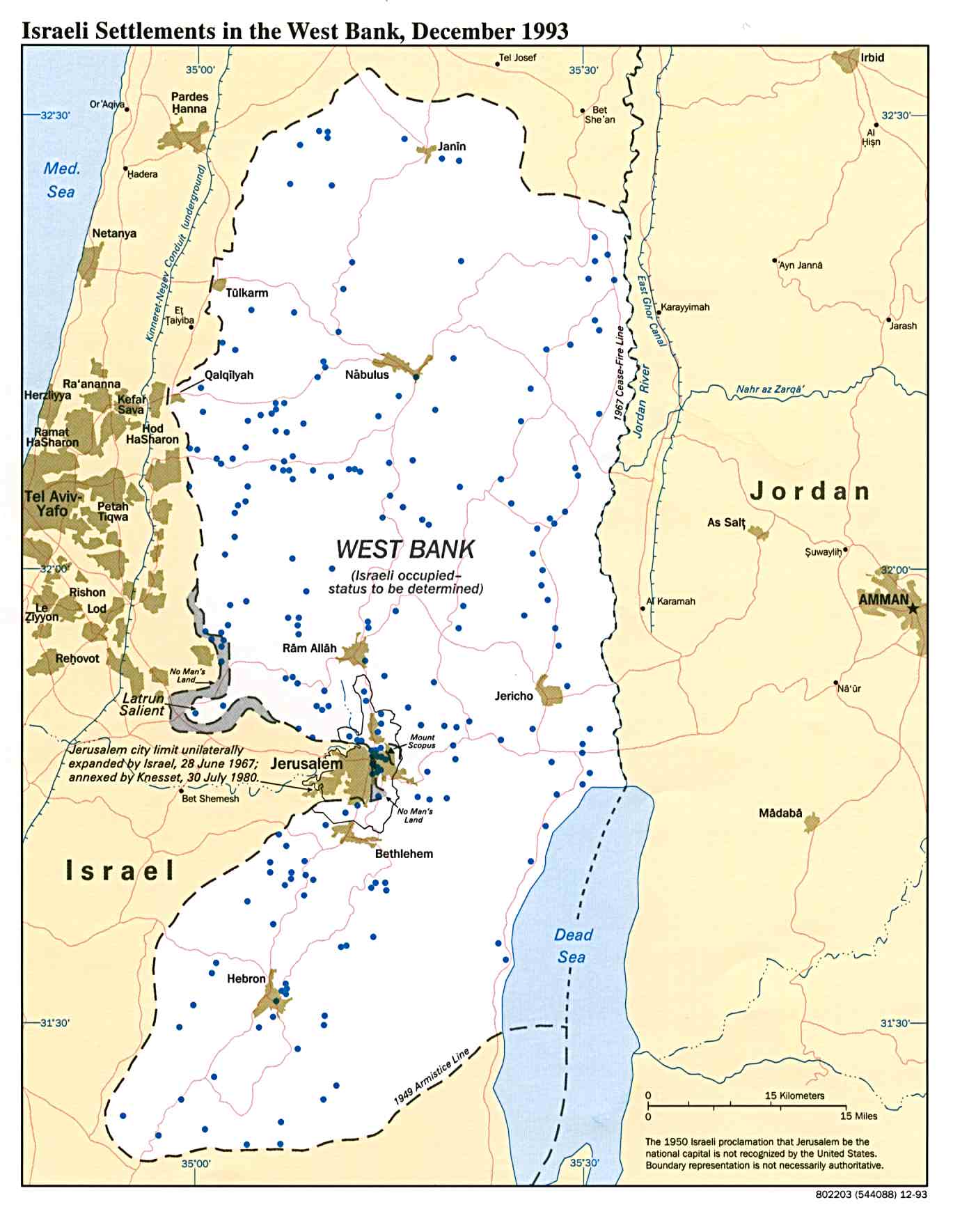
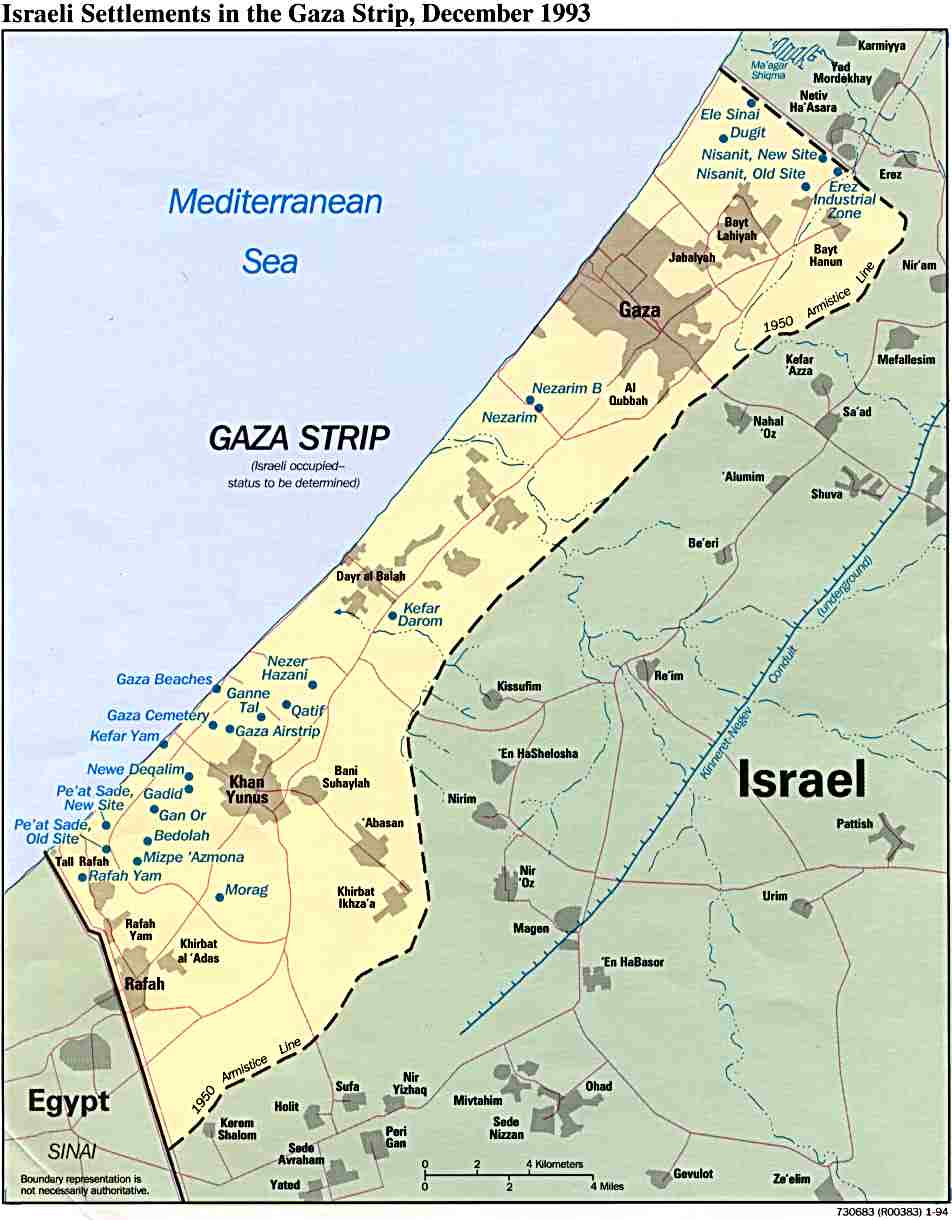
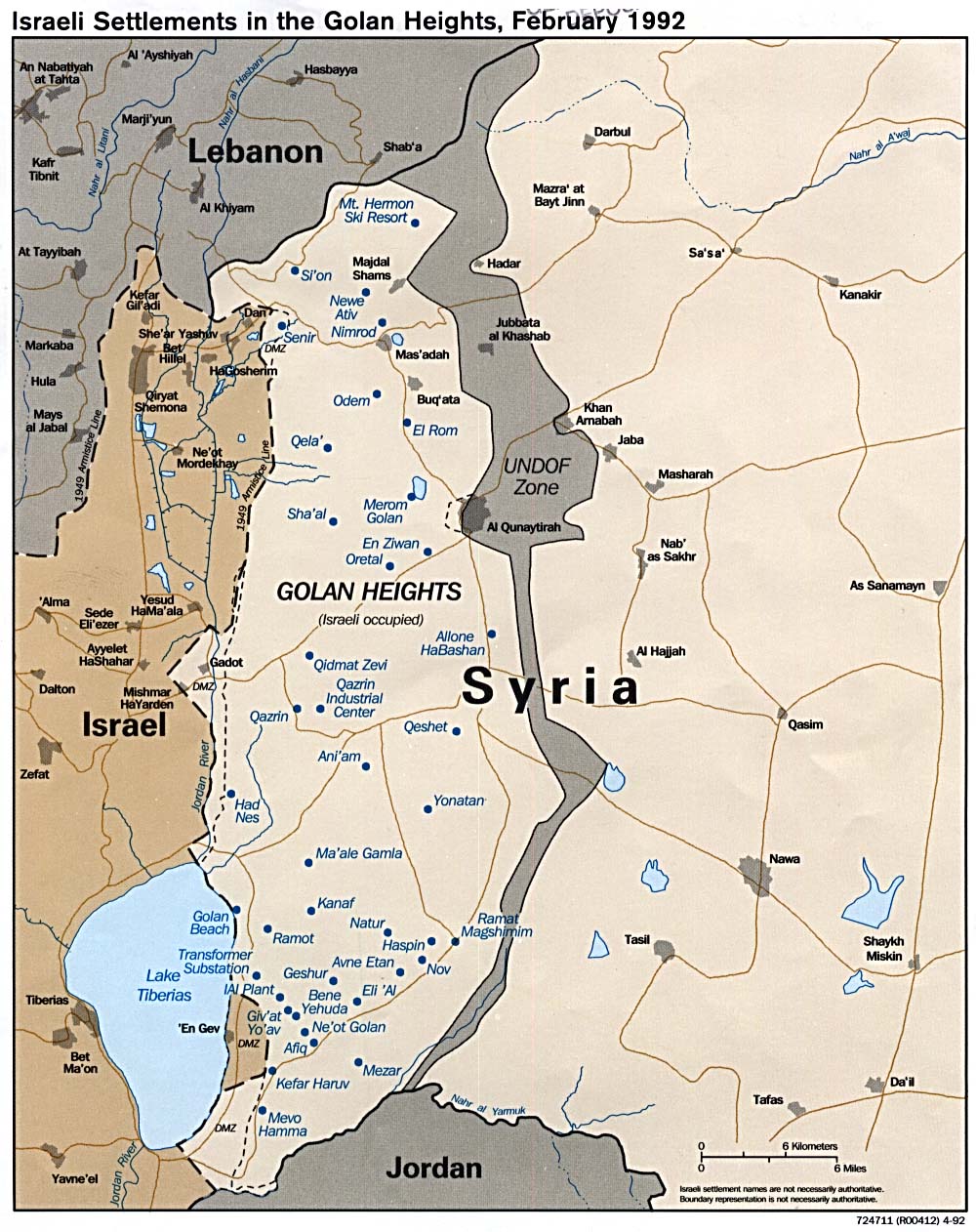
The Israeli extremists keep building settlements throughout the West Bank
and Gaza in an effort to "establish facts on the ground." Maps
of settlements in the West
Bank, Gaza
Strip, and Golan
Heights in 1993 show why Palestinians believe the Israelis are
trying to take over the whole country. New
settlements continue to be built. See UN Site on the Question
of Palestine. Many Israelis argue that Israel should have all
the land between the Jordan river and the Mediterranean, Palestinian
extremists seek it all for themselves. Moderates seek a compromise,
a division. The Israeli government under Barak last year offered
unmprecedented concessoins, but the Palestinians felt they were not enough
and mobilized for more. The Israelis had occupied the south of Lebanon,
but they pulled out, giving the Arabs their first "victory" over Israel.
Hizbollah claims responsibility for this. The PLO under Yasir Arafat
claims not to condone terrorist acts, at least against civilians within
Israel, but the Israelis accuse it of tolerating them in fact.
In the last year or so suicide
bombings have become the most effective tactic used by the Palestinians
to terrorize the Israeli population. This has destroyed tourism to
Israel and cut back on immigration. The Israelis have no way to stop
all these people and usually respond with retaliatory strikes against Palestinian
institutions, often against the Palestinian security forces. These
stir up more resentment and hostility and we have an escalation of "tit
for tat" violence. Each side can give an extensive litany of the
abuses of the other, justifying its behavior by the abuses it has suffered.
Psychology, suicide bombing involves a love/hate relationship, similar
to murder/suicides in marital or workplace conflicts. It is rooted
in feelings of powerlessness,
when people feel they have no way to get what they desperately want.
The Arabs both hate and admire the Israelis, want to be more like them.
This is sometimes revealed in remarks that slip out. For example,
Gen. Rashid Qureshi, the public relations chief for President Pervez Musharraf
of Pakistan told Newsweek (April 1, 2002, p. 26) that the attacks on the
World Trade Center and Pentagon were so well coordinated, so brilliantly
executed, that it was inconceivable an Arab organization could have carried
them out. "Who else [but Israel] coudl have done it?" he asked.
He since moderated his views, but in September he repeated a rumor that
has been heard repeatedly throughout the Pakistan, and reported in newspapers
there, that the Jewish employees in the World Trade Center had all mysteriously
called in sick on the 11th. One Palestinian
legislator said "If you don't choose your type of death yourself, Sharon
will do it for you. All of Tulkarm is proud [of Abdel-Basset Odeh,
a local suicide bomber]. None of us wants to kill civilians, but
we are obliged to defend ourselves. We have nothing else with which
to fight this huge machine of israel's. They have everything;
they have all the power. We have nothing but our bodies." His
older brother said "Everyone's proud of him. this is a war.
Yes, he's the one who changed everything."
American Muslims Intent on Learning and Activism say:
Many Muslims both here and abroad have chosen to deal with feelings of
powerlessness and
inferiority by indulging in violent rhetoric or actual violence against
noncombatants, stretching
Islamic justifications to cover up any moral misgivings. This can only
be possible when emotions
rule over common sense, when the world is cleanly and artificially divided
into good and evil, and
when non-Muslims are so dehumanized as to make even the most innocent among
them guilty of
the death penalty.
Unfortunately, many Muslims in America take the simplistic "West is always
bad, Muslims are
always good" line to heart and begin acting like the stereotypes that we
hate so much. Many
Muslims are strangely schizophrenic; on one hand they condemn the portrayal
of Islam in the
media as a violent religion, but at the same time they engage in inflammatory
violent rhetoric
against real or perceived enemies. We rightfully decry the terrorism of
sanctions against Iraq or the
Israeli bombing of Lebanon, but we are studiously silent about - or worse,
supportive of - Muslim
terrorist bombings of Western targets
In an impromptu statement in 1991 to students at Cairo University, Egyptian
President Hosni Mubarak is reported (by Ephraim
Dowek, an Egyptian Jew serving as Israel's ambassador to Egypt;
Commentary, April 2002, p. 26):
Against us stood the most intelligent people on earth--a people
that controls the international press, the world economy, and world finances.
We succeeded in compelling the Jews to do what we wanted; we received
all our land back, up to the last grain of sand! We have outwitted
them, and what have we given them in return? A piece of paper!...We
were shrewder than the shrewdest people on earth! We managed to hamper
their steps in every direction. We have established sophisticated
machinery to control and limit to the minimum contacts with the Jews.
We have proven that making peace with Israel does not entail Jewish domination
and that there is no obligation to develop relations with Israel beyond
those we desire.
Of course, Mubarak is a politician, and his remarks were intended to persuade
the students, so they may not reflect his own most careful thinking.
If this is so, they are all the more important, as reflecting his understanding
of Egyptian mass psychology.
Israel has a percapita GDP of $18,900 - the Palestinians have a per
capita GDP of $1680. The Israelis have an infant mortality rate of
.08%; for the Palestinians it is 2.6%. Of all Arab populations,
the best off in terms of objective social and economic indicators are the
Arab citizens of Israel (with the possible exception of citizens of some
small oil rich enclaves on the Persian gulf, if one looks only at statistics
for citizens).
Solutions. To many the final solution is obvious: a partition
along approximately the 1967 border lines, with some adjustments and generous
financial compensation for Palestinians not able to return to their ancestral
lands in Israel proper. Barak offered much of this in 1999, but it
was either not enough (he offered 90% of the land in the occupied territories,
but kept 70% of the settlements) or the Arabs were not ready to accept
it. Right now, Israel is attempting to root terrorism out with military
action against the whole population of the occupied territories.
This seems unlikely to succeed, unless it goes so far as ethnic cleansing,
which is probably impossible in the international conflict. As Prof
Ariel Merari of Tel Aviv University says, "What Israel is doing now
is not helpful, it is not enough to deter the Palestinians but it
is more than enough to provoke them. And that is quite a serious
mistake."
Osama bin Laden is a Saudi, and was never focused on the Israel/Palestine
dispute. His major goal was to rid Saudi Arabia of all non-Moslems.
Biographical informan on bin Laden:
In his exultation about the World Trade Center bombing
(bin Laden, 2001) identified himself and his agents with "God Almighty,"
and proclaimed that "what the United States tastes today is a very
small thing compared to what we have tasted for tens of years.
Our nation has been tasting this humiliation and contempt for more than
80 years. Its sons are being killed, its blood is being shed,
its holy places are being attacked, and it is not being ruled according
to what God has decreed. Despite this, nobody cares."
Bin Laden's rhetoric follows the terrorist ideological
script, as described above by Post (2001) perfectly. It is polarizing
and absolutist, a rhetoric of us versus them, with no shades of grey.
Most revealing, however, is his plaint that "nobody cares." The terrorist
attacks forced the whole world to pay attention to his complaints.
Bin Laden and his organization are quite sophisticated in their use of
mass media, so it is impossible to know how sincere he is in his rhetoric.
But many of his followers are sincere enough to sacrifice their lives to
make sure their agonies are heard.
Biographical information (Robinson, 2002; Frontline,
2001) about bin Laden is limited and open to different interpretations.
His father was dedicated to his family, but as one of 54 children, Osama's
time with his father was unavoidably limited. His father, a wealthy
construction entrepreneur, had three "permanent" wives and filled the fourth
slot permitted under Moslem law with rotating incumbents. Discarded
wives were kept in the family compound and continued to be supported financially.
Osama's mother was one of these, an attractive young Syrian woman who quickly
lost favor with Osama's father. Osama was not close to his mother,
but was raised mostly by servants.
This kind of family life is not abnormal in Saudi
Arabia, however, and most of Osama's brothers have had conventional lives.
He seems always to have been an outsider within the family. He swung
from one lifestyle to another, at times being a bookworm, then experimenting
with hedonistic pleasures abroad, then getting heavily involved in religion
and radical politics. Robinson (2002, p. 78) reports that "he
was shy – a characteristic some interpreted as weakness. He isolated
himself and was reluctant to participate in family life. Because of this
he was both unpopular and shunned as a playmate by his brothers. Confused
and hurt, he sought attention through silly childish antics and mischief.
But, when his father was nearby, Osama was clever enough to transform
himself into a dutiful, well- behaved son." His father, however,
died when he was ten years old, leaving him adrift in the world.
At first, Osama was focused primarily on Saudi
politics. He strongly opposed the Saudi government's alliance with
the United States against Saddam Hussein, believing that it should rely
instead of radical Muslim Mujahideen. The Saudi government correctly
saw this as a losing strategy, and sent Osama into exile. He sought
to become a leader of Muslim civilization against the west, and found that
focusing on Palestine, rather than on internal Saudi politics, was much
more effective in motivating followers.
From his point of view, Osama's attack on the World
Trade Center cannot be viewed as an irrational act. It brought him
the fame and recognition he craved, and there was certainly a chance that
it might have succeeded in uniting much of the Moslem world under his leadership.
Indeed, he and his advisors might well have been guided by the work of
Harvard Professor Samuel Huntington who posited the clash of civilizations
as the emerging trend in world history. Osama clearly sought to be
the leader of the Muslim civilization against the Christian civilization
of the west. If the western leaders had not read the same books and
carefully avoided casting the conflict as one between Muslims and the west,
he might have succeeded. Many of the young men who have sacrificed
their lives to his holy war are unquestionably driven by personal frustrations,
a lust for adventure and sincere religious beliefs. Osama shares
some of these motivations, but he is most important for his skill in organizing
and manipulating the emotions of others.
Online
audio from Newsweek, Roots of Rage.
CNN
Video of Bin Laden (requires subscription):
Bin Laden is against the West, yet he is deeply involved with Western
technology, particularly the media.
As an article by Mark
Danner said:
The 19 men who changed the world on Sept. 11 used as their primary weapon
not box cutters or jet airliners but
something more American and much more powerful: the television set.
The box cutters and the planes were tools in
constructing the great master image, the Spectacular; the television
set was their delivery vehicle. In an instant, the
Spectacular altered the terms of debate, creating a sense of pervasive
and unprecedented vulnerability among
Americans, a sense revivified by each new report of anthrax, each fresh
incident of a deranged assailant on a plane or
a Greyhound bus. And the Spectacular thereby transformed American foreign
policy, heretofore a matter of
disregard among most Americans, into a vital question of their own
security, a matter of their own life and death.