April 10, 2006
Op-Ed Contributors - NY Times
Globalizing Good Government
By RICHARD W. FISHER AND W. MICHAEL COX
THE protests in France over job security for young workers have exposed
the fault lines between globalization and public policy. On the one
hand, the French government has recognized that the country's labor
laws are uncompetitive and a drain on the economy. The public reaction,
however, shows the depth of popular misunderstanding regarding the
realities of our globalizing economy.
Nations can no longer sit within their borders and pursue policies
incompatible with an increasingly integrated world economy. The types
of services, manufacturing and entrepreneurship that generate national
wealth are more mobile than ever, and they will forsake countries that
shackle business and labor with unnecessary burdens.
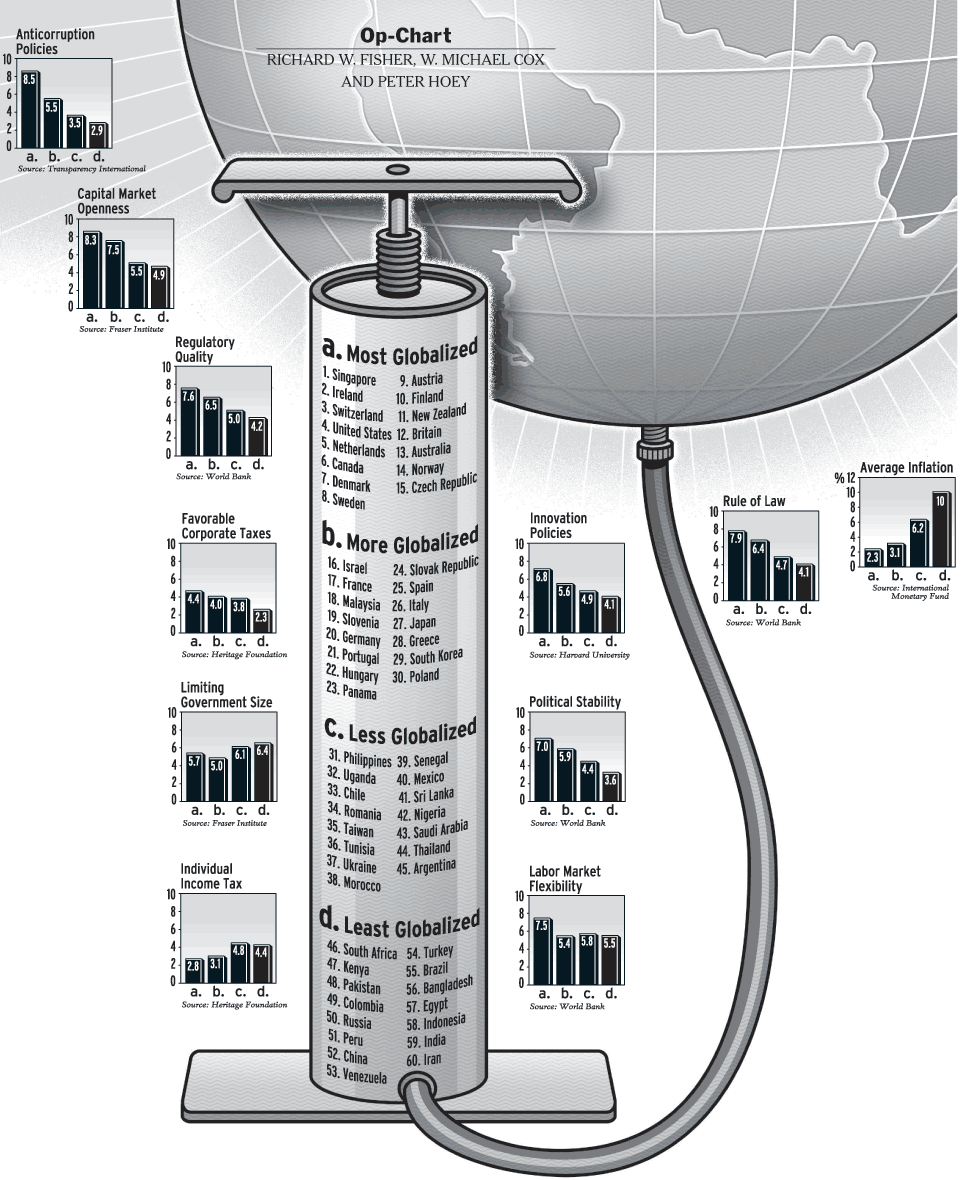
With this in mind, the Federal Reserve Bank of Dallas set out to
document the connection between globalization and public policy. We found that the more globalized nations
tend to pursue policies that achieve faster economic growth, lower
inflation, higher incomes and greater economic freedom. The least
globalized countries are prone to policies that interfere with markets
and lead to stagnation, inflation and diminished competitiveness.
For our study, we began with research by Foreign Policy magazine and AT
Kearney, a management consultancy firm, which ranked 60 countries by
degree of globalization. Singapore, Ireland, the United States and
other countries at the top of the rankings are far more integrated into
the world economy than the insulated nations at the bottom like Iran,
Egypt and Bangladesh. As the accompanying charts show, we divided the
countries into four groups and looked at how each faction performed on
policies that shape economic performance.
Take inflation. In a world where investment capital can flit anywhere
in the world with the click of a computer mouse, nations should see the
virtue of price stability and preserving the value of money. And they
do: the more globalized countries we studied had an average inflation
rate of 2.3 percent from 2001 to 2003, compared with 10 percent for the
nations in the least globalized quarter.
This pattern is repeated in more than a dozen aspects of effective
public policy, as measured by the World Bank, Harvard University, the
Heritage Foundation, Transparency International and the Fraser
Institute, a Canadian public policy group. (Although these groups used
various ranking systems to portray their data, we took the liberty of
converting each to a 1-to-10 scale, with 10 being the most successful,
for the accompanying graphs.)
The gist is clear: as nations become more integrated into the world
economy, they tend to maintain fewer barriers to trade and the movement
of money. They are less likely to impose punishing corporate taxes and
onerous regulations. Their technology policies are more favorable to
innovation. Nations more open to the world economy score above the less
globalized countries in respect for the rule of law and protection of
property rights. More globalized countries also offer greater political
stability.
Not all policies fit neatly into this framework. We found that more
globalized counties do no better in limiting the size of government,
which we consider vital to economic prosperity. They are worse than the
less globalized in containing public entitlements and subsidies, which
must be paid for by higher individual income taxes. Perhaps it is
because they are richer and have the means to spread those riches
through their societies.
The French contretemps illustrates why labor policies are less
sensitive to globalization than factors like taxation and trade
barriers. As long as workers refuse
to acknowledge that they are competing in a world economy, they will
petition a wealthy government to protect their jobs. This in turn slows
job growth and raises unemployment, creating a greater demand for
expensive and expansive safety nets for idle workers.
Still, globalization may yet alter
labor policies. France, Germany and other countries are beginning to
recognize that their labor rules are uncompetitive, and the timing of
change is a political question, not an economic one.
So, do our statistics show that globalization is necessarily the cause
of good policies? That would be overstating it — our data simply show
the two trends are complementary. But it is clear that countries with
solid policies will be more successful in the global economy,
encouraging further openness and deeper cross-border connections. The
chicken-and-egg debate shouldn't detract from the fundamental fact that
globalization and good policies go together.
Globalization's critics argue that a more open world economy sets off a
race to the bottom by encouraging countries to jettison protections for
consumers, workers and the environment. In reality, the opposite is
true. If our data demonstrate anything, it is that globalization
prompts a race to the top by pushing countries to abandon policies that
burden their economies in favor of those that fuel growth and economic
opportunity.
Richard W. Fisher and W. Michael Cox
are, respectively, the president and the chief economist of the Federal
Reserve Bank of Dallas. Peter Hoey is an illustrator in Arcata, Calif.