April 30: Third Quiz.
April 28: No class. Online review quiz to be taken in WEBCT.
April 23: September 11, 2001: A Turning Point for America’s Future?
Power Point presentation on 9/11 as a Turning Point in
History. Strauss and Howe: Millennials Rising.
April 21. Social movements are about the Future, they are about
Changing Society. Yet, they often put more effort into denouncing existing
reality than into articulating visions of the future. The future cannot be
studied in the same way as the past, but there are methods of
future analysis. The goal is not to predict exactly what will
happen, which we known what can be done, but to consider four kinds of futures:
the Possible, Probable, Preventable and Preferable. Social movements
might be helpful in defining alternative preferences or visions of what
the world might be, e.g., the slogan of the World Social Forum "Another
World is Possible." We then have to decide whether our preferable
future is possible or probable by analyzing trends, resources, etc. Perhaps
the most we can do is prevent an undesirable future.
Consider the movements we have studied this semester: could we have
predicted them? Some are self-directed (p 59 in the book), they advocate
the interests of groups that believe they are oppressed, e.g, blacks, gays,
women, victims of abuse, . We can predict that groups that are oppressed
and perceive the possiblity of improving their situation are likely to
form a movement. Some are other-directed, acting to help others,
animals, the environment, war, etc. We could predict that as conditions
get worse movements are likely to emerge, or as danger seems imminent, e.g.,
an anti-war movement will emerge if and when war is proposed. Our ability
to predict trends in the underlying problems is weak, e.g, resource depletion.
Sometimes the link between the underlying cause and the movement is questionable,
e.g., recovered memories of abuse, alien abduction. People will continue
to have problems, but there are many possible explanations for their frustration
that can be mobilized by entrepreneurs.
What oppressed groups are there that may become more active in mobilizing
movements? NAMBLA? Hookers? PotHeads?
What social problems are likely to get more acute? The environment
and globalization are most often mentioned
What new technologies may create problems? Robotics, genetic modification,
nanottechnology.
The
Battle of Seattle and the Future of Social Movements. The
Future of Social Movements After the Consolidation of Globalization.
Notes from
a New Social Movements Conference. Book Review: Empire
by Niall Ferguson. World Social Forum.
- What
Are We For? - SingularityWatch.
Vernor
Vinge on The Singularity. Transhumanism. Meet the Extropians.
Music and social movements: Music is used to build solidarity within
movements. Often is expresses grievances and repats messages over
and over. The goal is to build solidarity. However, the music
varies from one historical period to another, and according to the group,
e.g., industrial workers, southern blacks, sixties students.
Some CD's with clips on Amazon.
Fellow Workers. Sing
for Freedom. Vietnam:
Songs from the Divided House. Songs
of Protest. Universal
Soldiers.
April 16 We will begin with a segment from a.video
on Martin Luther King and the Civil Rights movement, begins with
the Letter from a
Birmingham Jail.
What role did King play
as a leader in the Civil Rights Movement? Would the social forces
have played out the same without his personal leadership? Other civil
rights leaders: Malcolm
X comes to mind. Stokeley Carmichael.
Bayard Rustin.
James
Farmer. Jesse
Jackson. Al Sharpton.
Functions of leaders:
Organizers
Decision-Makers
Symbols
Personal Traits of Leaders:
Charisma - an intangible trait but very important. A person
seems to be greater than life, in touch with the divine.
Prophecy - view of the future, inspiring
Pragmatism - gets things done, realistic
US Marine Corps list of leadership traits: JJ DID
TIE BUCKLE
These traits may be in conflict. Also, of course, leaders conflict,
over their prophecies as well as simply over power and influence. Each
movement has different types of leaders, e.g., King and Malcolm X.
Some leaders we can look at: Velupillai
Prabhakaran wanted by Interpol
- Abimael Guzmán
- Osama binLaden
- Jerry
Fallwell - Phyllis Schlafly
- Mahatma Gandhi
- Samuel Gompers
- Eugene Debs
April 14: Social movements are not relatively permanent like social
institutions. They emerge, grow, develop and eventually wither
away. Various authors have observed stages in this process:
| Stages (our book) |
Herbert Blumer's Stages |
Leadership |
| 1. Genesis |
Generaliaed Discontent |
Prophet |
| 2. Social Unrest |
Sharpening of objectives and strategies |
Agitator |
| 3. Enthusiastic Mobilization |
Formal organizations, coalitions |
Statesman |
| 4. Maintenance |
Established Organization |
Administrator |
| 5. Termination |
(Remnant?) |
(Historian?) |
It is hard to say when movements begin. Some theorists believe that
they emerge spontaneously when people who share a common problem begin
to feel dissatisfied, perhaps because conditions have gotten worse, or
at least because they stopped getting better, or not as quickly. There
is Davies J-Curve
theory, which was developed to explain when revolutions occurred,
but can be applied to social movements in genera.. This is the "collective behavior"
school in sociology. Another theory, "resource mobilization,"
says that discontent is always there and that movements emerge when someone
has the resources to mobilize it. Resources include communication
skills, leadership skills, time, money, political support. At the
early stage, the leaders
tend to be intellectuals and public speakers. Sometimes movements
are galvanizaed by books, e.g., Betty Friedan's The
Feminine Mystique or Rachel Carson's The
Silent Spring or Thomas Paine's Common
Sense or Ralph Nader's Unsafe
at Any Speed. . Not all efforts to galvanize movements
succeed, e.g., the Men's Movement. Numerous books have been written
trying to start one, and there have been beginnings, but there
doesn't seem to be a critical mass. Perhaps there is no charismatic
leader. Others are galvanized by brilliant orators - Spartacus,
Martin Luther King. Sometimes the leader is a religious or spiritual
figure, e.g., Gandhi. Or a labor leader, Debs, Marighela. One
could also look at the world's leading religions as social movements started
by charismatic leaders, e.g., Jesus, Mohammed. There are still leaders
starting new religions, the Unification Church. Other movements may
start without a single leader, e.g., the student movement of the 60s and
70s.
There may be a generational cycle to the emergence of social movements.
Strauss and How argue that there are 25 year generational cycles,
with an active generation being succeeded by a more passive one. The
active generations alternate between Idealist and Civic versions.
The Idealist are likely to generate moralistic movements. The
generation that came of age in the 1960 was the last Idealist generation.
9/11 as a Turning Point in History
(power point presentation at the World Future Society, July 20, 2002)
Once movements are started, they develop movement organizations. There
is typically a period of internal conflict as the movement tries to
define its goals and tactics. There are splits between radical
and reformist tendencies. Different agitators compete in offering
visions of the future. The original leaders may be cast aside as
old fashioned. Ideologies may change. This is a difficult
period, and movements may fall apart and lose effectiveness. A statesman
is needed to pull things together.
After this, comes the period of formalized decision-making with strong
organizations exercising control. These may become established
pressure groups with little interest in changing society. If radicals
succeed in taking power, they may become the new established order. One
can think of this in the history of the Christian movement, which went
trhorugh its mobilization stage in the first century or two. Eventually
the church went from a persecuted movement to an established hierarchal
part of the established order, e.g., the Roman Catholic Church with the
Pope. Even so, conflict can break out and new religious movements can
emerge, e.g., Protestantism, but they must deal with the hegemony of the
established church.
We can use this framework to examine the history of certain social movements,
such as the civil rights
movement (timeline2, history)
and the feminist movement.
The antiwar movement may not fit so well, since it is responsive
to international events rather than to its internal dynamics.
April 9:
Peace movements have a long history,
going back to Aristophanes play Lysistrata where Athenian women,
fed up with the Peloponnesian War, barricade themselves in the Acropolis
and go on a sex strike to force their husbands to vote for peace with
Sparta. I think this is just fiction, but it has inspired many
women's peace
movements and activities.
Some religions, such as the Quakers, have renounced
war altogether for hundreds of years. This is based on Biblical
teachings, e.g.,
Isiah, 2:4 He will judge between the nations
and will settle disputes for many peoples.
They will beat their swords into plowshares
and their spears into pruning hooks.
Nation will not take up sword against nation,
nor will they train for war anymore
Luke 6
28bless those who curse you, pray for those who
mistreat you. 29If someone strikes you on one cheek, turn
to him the other also. If someone takes your cloak, do not stop him from
taking your tunic. 30Give to everyone who asks you, and
if anyone takes what belongs to you, do not demand it back
But the other view can also be found in the Bible.
Deuteronomy 12:2-4 Ye shall surely destroy all the places, wherein
the nations that ye are to dispossess served their gods, upon the
high-mountains, and upon the hills, and under eery leafy tree.
And ye shall break down their altars, and dash in pieces their pillars,
and burn their Asherim with fire; and ye shall hew down the graven
images of their gods; and ye shall destroy their name out of that
place.
Deuteronomy 20:10, 12-13 and 16-17:
When thou drawest nigh unto a city to fight against it...and
if it will make no peace with thee...thou shalt smite every male thereof
with the edge of the sword, but the women, and the little ones and the
cattle...shalt thou take for a prey unto thyself...thus shalt thou do
unto all the cities which are very far off from thee, which are not of
the cities of these nations. Howbeit of the cities of these peoples,
that the Lord thy God giveth thee for an inheritance, thou shalt save
alive nothing that breatheth, but thou shalt utterly destroy them:
the Hittite, and the Amorite, the Canaanite and the Perizzite, the Hivite,
and the Jebusite; as the Lord thy God hath commanded thee.
Throughout history the Hawks and the Doves have struggled
against each other. There is clearly an archetypal psychological
difference here, although the metaphor of Hawk and Dove goes back only
to 1962. The Hawks project their hostile feelings outwards, while
the doves p;roject their compassionate and vulnerable feelings onto
others, while directing their hostility towards their own nation's leaders.
These groups fought it out before WWII, with some people, such
as Albert Einstein, changing sides. He abandoned pacifism because
he thought Hitler was just too terrible and would not respond. The US
tried to stay out, through isolationism, rather than pacifism. The
British tried desperately to make peace with Hitler, making concession
after concession. Prime Minister Chamberlain's speech
announcing peace in our time became the classic example of the sin of
appeasement, Churchill's view was vindicated in the judgment of most people.
It seems to me that peace movements often fail, perhaps usually fail,
although it is also true that the nuclear holocaust we feared throughout
the 1955 to 1999 period never materialized. But this was not due to
following the prescription of the peace movement. The Vietnam war movement
succeeded in a sense, but only because we were defeated or worn out militarily.
The anti-Iraq war movement failed to prevent the war. The paper
Why
Peace Movements Fail , written in 1982, may give us some insight
into why peace movements fail. The Anti-War
Movement in the United States. gives the history of anti-war
movements, which does seem to be one of persistent failure.
Does this apply to the Vietnam
War movement? This is one that I was active in for many years,
as recorded in my FBI File. Jerry Rubin at the
Yippee convention. What did Vice President Agnew
think of us? Sometimes there is a generational difference between
professors whose political ideas were formed in the 1960s and students
of today.
Peace
Movements in South Jersey today.
Roots of Arab
Anti-Americanism? And anti-Americanism
in the United States. Is it love of peace,
or hatred of America?
April 7: we had a visit from a member of the Camden 28 who spoke on campus on Saturday,
April 5, 6:30 in the student center.
April 2: Arguments from Conspiracy. Eustace Mullins on the Oklahoma City conspiracy. We will view part of the video Cover-up in Oklahoma which claims that the whole explosion was really a government conspiracy.
Arguments from Transcendence. These are really critical for movements, they argue that their cause or argument is more powerful than the other side's. In many cases, there are simply unreconcilable principles so no amount of logical argumentation or factual information can settle the issue. Narrative argumentation can sometimes help by showing sympathetic cases. Often people just repeat their viewpoint insistently and ignore the arguments on the other side. This leads to polarization. Several kinds of arguments are used::
How can these arguments be applied to the causes that you are arguing?
Take the Gulf War as an example.
Quantity: the whole world is
against the war, or most of it? But most Americans are pro,
at least for now. Which is the constituency? How do you
measure support? This gets into how one poses the question.
Truth: is Hussein really a terrible
danger, does he have WMD's? Is he likely to use them or can
he be contained? These are points that involve large unknowns.
Value: Is war always wrong?
Thou Shalt Not Kill? Or Thou Shalt Not Murder. This raises
the topic of the ethics
of war. Some take an absolute pacifist position, e.g.,
Quakers, peace churches. Most people believe this is not sustainable.
The Just War Theory is more widely accepted. Look at Jimmy
Carter's essay that the Gulf War is immoral, contrasted to John McCain's
essay. Jimmy
Carter - John McCain.
Web sites with Opinions on the war: Patriots for the Defense of
America. War on Iraq. We will
discuss anti-war movements next Monday.
Hierarchy: does the US national interest trump other nation's interests? This seems to be an underlying point that determines people's beliefs on this issue, although it is not so often stated as a rationale.
Another case that revolves around Arguments from Transcendence is the
Palestinian/Zionist conflict.
Historical Background:
In 1947, the UN General Assembly voted the partition of
Palestine into Jewish and Arab states. In 1948, the armies
of Lebanon, Syria, Jordan, Egypt, and Iraq invaded Israel, and many
or most Palestinian Arabs fled from Jewish territory. Some of
them were drive out by Jewish terrorists, many left at the suggestion
of the invading Arab armies. The Israeli army was small and
inexperienced, but it succeeded in holding off the Arabs. Israel
has won a series of wars since then. In 1956 it invaded Egypt,
after Nasser nationalized the Suez Canal, and conquered the Gaza Strip
and the Sinai, but it removed its troops from the Sinai and UN border
guards were sent. In 1967, Nasser closed the port of Elat, and
had the Un troops pulled out and in 6 days Israel occupied the Gaza Strip
and the Sinai peninsula of Egypt, the Golan Heights of Syria, and the West
Bank and Arab sector of E Jerusalem (both under
Jordanian rule), thereby giving the conflict the name of the Six-Day
War. In 1973, Egypt and Syria attacked on Yom Kippur, and were
initially successful, but the Israelis mobilized and drove them out,
crossing the Suez canal and encircling the Egyptian Third Army, clearing
a path to Cairo. The Soviets threatened to intervene and Israel
pulled back. I think the account on page 103 of our book gives too
much credit to the Egyptian army, in fact it was defeated. After
that Sadat made peace with Israel and Israel gave back the Sinai.
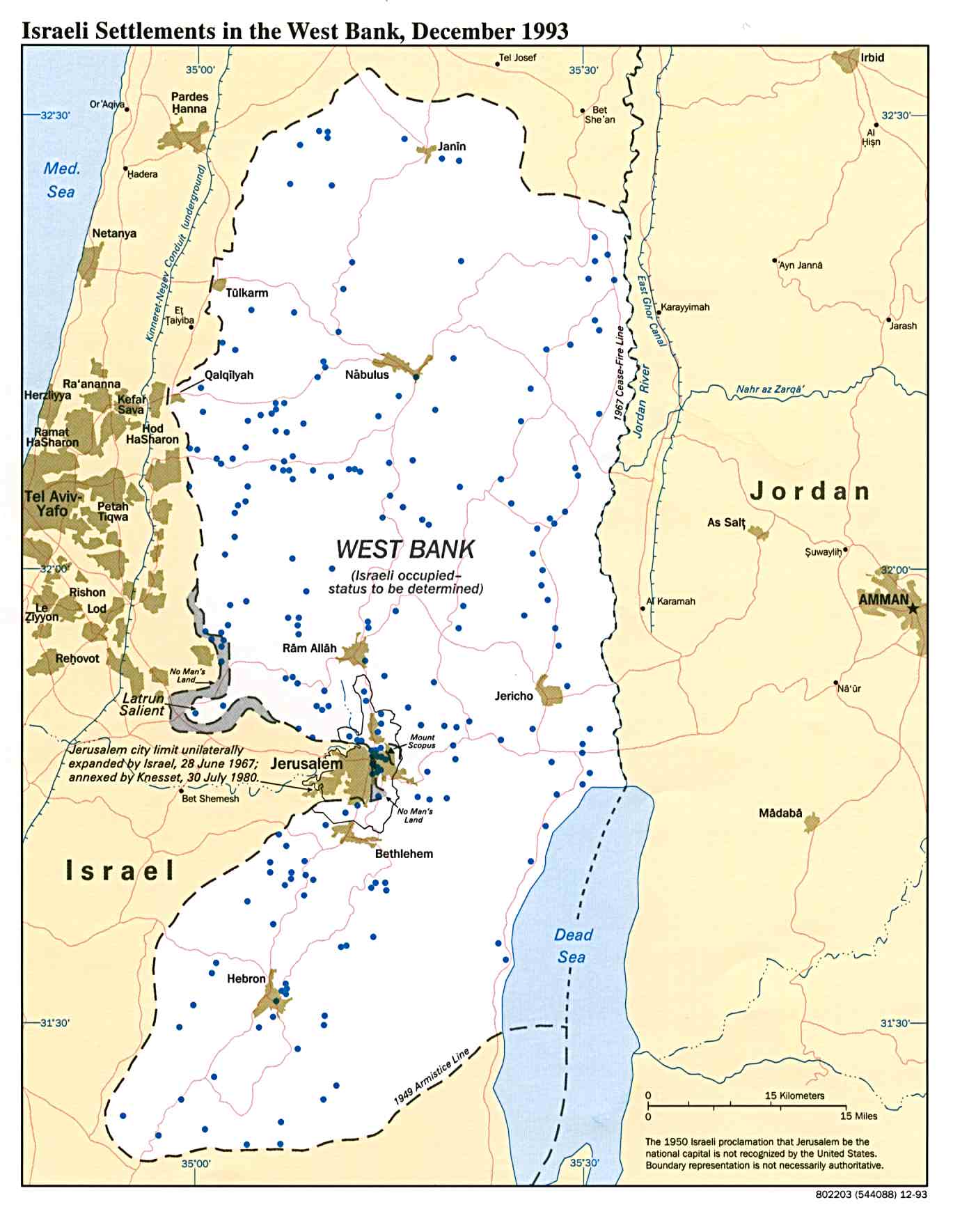
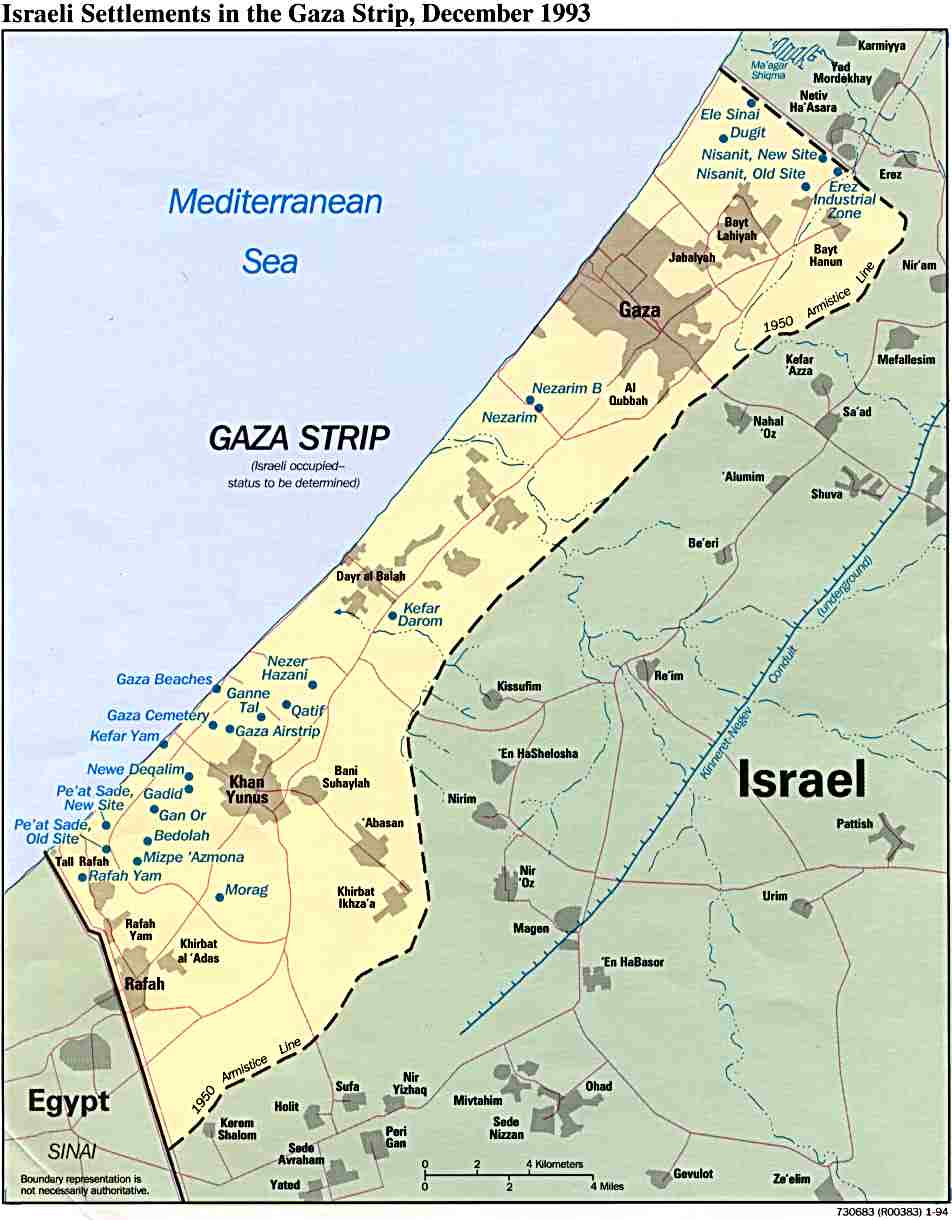
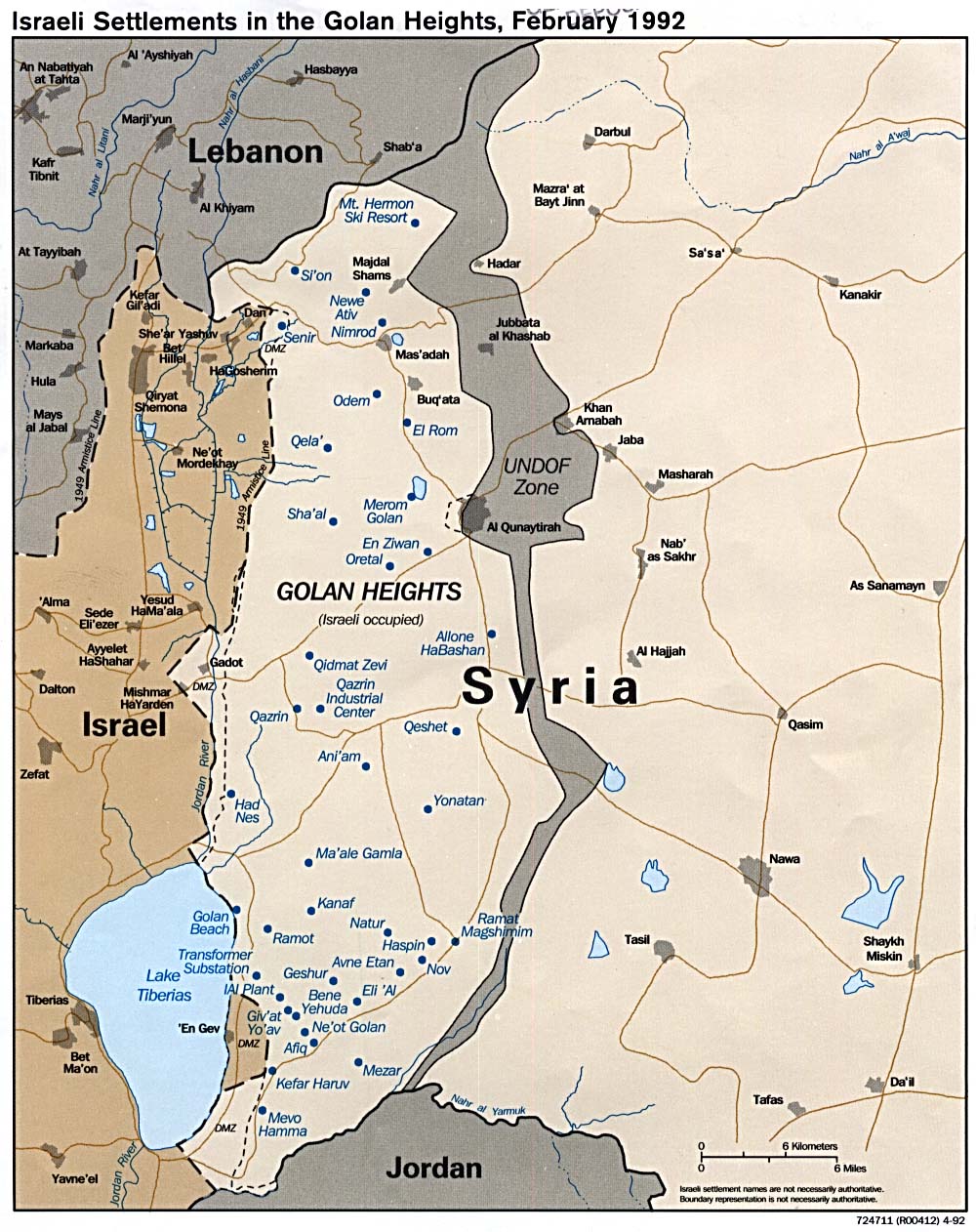
Since this time, Israel has occupied all of Palestine, and the Palestinians have turned to demonstrations, stonings and terrorism - the Intifada - making the struggle one of Israel vs. the Palestinians rather than Israel vs the Arab Nations. The US had consistently tried to mediate. There are moderates or doves on both sides who try to find a peaceful solution and extremists on both sides who want to drive the other side out by force. The Israeli extremists keep building settlements throughout the West Bank and Gaza in an effort to "establish facts on the ground." Maps of settlements in the West Bank, Gaza Strip, and Golan Heights in 1993 show why Palestinians believe the Israelis are trying to take over the whole country. New settlements continue to be built. See UN Site on the Question of Palestine. Many Israelis argue that Israel should have all the land between the Jordan river and the Mediterranean, Palestinian extremists seek it all for themselves. Moderates seek a compromise, a division. The Israeli government under Barak last year offered unmprecedented concessoins, but the Palestinians felt they were not enough and mobilized for more. The Israelis had occupied the south of Lebanon, but they pulled out, giving the Arabs their first "victory" over Israel. Hizbollah claims responsibility for this. The PLO under Yasir Arafat claims not to condone terrorist acts, at least against civilians within Israel, but the Israelis accuse it of tolerating them in fact.
In the last year or so suicide bombings have become the most effective tactic used by the Palestinians to terrorize the Israeli population. This has destroyed tourism to Israel and cut back on immigration. The Israelis have no way to stop all these people and usually respond with retaliatory strikes against Palestinian institutions, often against the Palestinian security forces. These stir up more resentment and hostility and we have an escalation of "tit for tat" violence. Each side can give an extensive litany of the abuses of the other, justifying its behavior by the abuses it has suffered.
Psychology, suicide bombing involves a love/hate relationship, similar to murder/suicides in marital or workplace conflicts. It is rooted in feelings of powerlessness, when people feel they have no way to get what they desperately want. The Arabs both hate and admire the Israelis, want to be more like them. This is sometimes revealed in remarks that slip out. For example, Gen. Rashid Qureshi, the public relations chief for President Pervez Musharraf of Pakistan told Newsweek (April 1, 2002, p. 26) that the attacks on the World Trade Center and Pentagon were so well coordinated, so brilliantly executed, that it was inconceivable an Arab organization could have carried them out. "Who else [but Israel] coudl have done it?" he asked. He since moderated his views, but in September he repeated a rumor that has been heard repeatedly throughout the Pakistan, and reported in newspapers there, that the Jewish employees in the World Trade Center had all mysteriously called in sick on the 11th. One Palestinian legislator said "If you don't choose your type of death yourself, Sharon will do it for you. All of Tulkarm is proud [of Abdel-Basset Odeh, a local suicide bomber]. None of us wants to kill civilians, but we are obliged to defend ourselves. We have nothing else with which to fight this huge machine of israel's. They have everything; they have all the power. We have nothing but our bodies." His older brother said "Everyone's proud of him. this is a war. Yes, he's the one who changed everything."
American Muslims Intent on Learning and Activism say:
Many Muslims both here and abroad have chosen to deal with feelings
of powerlessness and
inferiority by indulging in violent rhetoric or actual violence
against noncombatants, stretching
Islamic justifications to cover up any moral misgivings. This can
only be possible when emotions
rule over common sense, when the world is cleanly and artificially
divided into good and evil, and
when non-Muslims are so dehumanized as to make even the most innocent
among them guilty of
the death penalty.
Unfortunately, many Muslims in America take the simplistic "West
is always bad, Muslims are
always good" line to heart and begin acting like the stereotypes
that we hate so much. Many
Muslims are strangely schizophrenic; on one hand they condemn the
portrayal of Islam in the
media as a violent religion, but at the same time they engage in
inflammatory violent rhetoric
against real or perceived enemies. We rightfully decry the terrorism
of sanctions against Iraq or the
Israeli bombing of Lebanon, but we are studiously silent about
- or worse, supportive of - Muslim
terrorist bombings of Western targets
In an impromptu statement in 1991 to students at Cairo University, Egyptian President Hosni Mubarak is reported (by Ephraim Dowek, an Egyptian Jew serving as Israel's ambassador to Egypt; Commentary, April 2002, p. 26):
Against us stood the most intelligent people on earth--a people that controls the international press, the world economy, and world finances. We succeeded in compelling the Jews to do what we wanted; we received all our land back, up to the last grain of sand! We have outwitted them, and what have we given them in return? A piece of paper!...We were shrewder than the shrewdest people on earth! We managed to hamper their steps in every direction. We have established sophisticated machinery to control and limit to the minimum contacts with the Jews. We have proven that making peace with Israel does not entail Jewish domination and that there is no obligation to develop relations with Israel beyond those we desire.Of course, Mubarak is a politician, and his remarks were intended to persuade the students, so they may not reflect his own most careful thinking. If this is so, they are all the more important, as reflecting his understanding of Egyptian mass psychology.
Israel has a percapita GDP of $18,900 - the Palestinians have a per capita GDP of $1680. The Israelis have an infant mortality rate of .08%; for the Palestinians it is 2.6%. Of all Arab populations, the best off in terms of objective social and economic indicators are the Arab citizens of Israel (with the possible exception of citizens of some small oil rich enclaves on the Persian gulf, if one looks only at statistics for citizens).
Solutions. To many the final solution is obvious: a partition
along approximately the 1967 border lines, with some adjustments
and generous financial compensation for Palestinians not able to
return to their ancestral lands in Israel proper. Barak offered
much of this in 1999, but it was either not enough (he offered 90% of
the land in the occupied territories, but kept 70% of the settlements)
or the Arabs were not ready to accept it. Right now, Israel is
attempting to root terrorism out with military action against the whole
population of the occupied territories. This seems unlikely to
succeed, unless it goes so far as ethnic cleansing, which is probably
impossible in the international conflict. As Prof
Ariel Merari of Tel Aviv University says, "What Israel is doing
now is not helpful, it is not enough to deter the Palestinians
but it is more than enough to provoke them. And that is
quite a serious mistake."
Another example is the Affirmative Action issue, argued
in the Supreme Court on April 1. Here we have two "rights":
racial equality and individual rights. The
Supreme Court tries to find a way to wiggle out of the
dilemma by looking
at nuances. An op-ed essay from today's Inquirer by Acel
Moore. John McWhorter is a
black professor who argues against racial preferences in universities.
March 26 - Last class we focused on political argument in social movements. This approach is analytical, it seeks to persuade through the use of logical argumentation. Usually the argument starts from general premises, which are the person's ideology or political perspecitve, and uses the premises to reach a conclusion about the particular case. Different conclusions come from different premises, in most cases, rather than different facts.
Narrative Argument differs from Analyical Argument. It uses stories or narratives as frameworks for interpreting reality. Perhaps this will fit more of the arguments we are looking at or writing. A narrative has an author, a protagonist and an audience. The goal is to get the audience to identify with the protagonist, to identify with the "good guy" and oppose the "bad guy." Heroes are very important to narratives, as are enemies. There is also a plot, to hold our interest. We want to know how things will turn out. Explanatory stories try to get us to accept certain values and theories about the world by putting them into a story where good and evil are in struggle. How is our Flash Video narrative going?
An example, the Militia or Patriot Movement: Ruby Ridge, Waco and Oklahoma City. Stormfront.org is a source on this movement, as well as on anti-semitism in general. Eustace Mullins' essay on the Oklahoma City conspiracy. . This is one of the terrorist cases we looked at briefly last week, Timothy McVeigh. He bought this narrative, in a book called The Turner Diaries. A novel about a 1991-93 American revolution by "The Organization" against the "Zionist Occupied Government." (this is Revolutionary Reaction). This involves beliefs about the theories about Gun Control.
The other case in the chapter is the Panama Canal controversy.
How about the Gulf War controversy? What was the narrative in the video we saw?
Some Narrative Stories:
Mona Charen: Bush
Shows Vision, Purpose.
Jane Eisner: A
Different Kind of Leadership.
Immanuel Wallerstein:
Bush Bets It All.
Patrrick Buchanan. Is
George W. Bush an Imperialist?
This is a longer essay from the master narrative theorist, Noam Chomsky.
In his narratives, there is a heroic struggle between the Evil
(American) Empire and the innocent victims and resistance fighters.
Confronting
the Empire.
March 24 - Public Opinion in the US more pro-war, rest of the world less so? The Economist March 13. Chileans undress to protest.
An Argument as defined here is:
Although there may be an infinite number of positions that can be argued, in practice they seem to fall into categories such as "left and right" or "liberal, moderate, conservative." The categories vary from country to country and time to time, they are sociological and psychological as well as philosophically logical. E.g., in Latin America "liberalism" means free market capitalism. "Neoliberalism" is under attack by "anti-globalists" or anti-somethings. E.g., The World Social Forum.
Our book uses Clinton Rossiter's typology of seven political philosophies which are drawn from a study of the American political spectrum, but I wonder if Standpattism doesn't go between Liberalism and Conservatism. He is a conservative and puts conservatism in the center. One could view them as a normal curve with standpattism as the mean. Or you can view them as a circle where extremes meet, as the textbook says.
Revolutionary Radicals Radicals Liberals Moderates Conservatives Reactionaries Revolutionary Reactionaries
Or we could view it as multidimensional, e.g., left/right; active/inactive, democratic/authoritarian, pacifist/militarist, feminist/patriarchial, racist/anti-racist, pro-life/anti-life, etc.
The authors also have seven types of arguments that go between the positions. This draws attention to the fact that most debate, or perhaps the most useful debate, is between adjacent ideologies. This is perhaps most useful for our purposes, since it focus on the actual arguments:
How about your arguments, as expressed on your Student Homepages, if we
can access them. What kind of logic do they portray?
Who are they arguing against? Or, what are they FOR? A big
problem with political rhetoric is that it is often clearer who people
are against than what they are for.
Roberty Byrd and George Bush's arguments on page 5 of
the March 24, 2003 Gleaner.
March 10 -
What is terrorism? Not a movement but a tactic used by
many different movements. The definition is controversial since
"one man's terrorist is another's freedom fighter." All military
action can be terrifying, yet we distinguish between terrorism and
legitimate military action. This into the ethics
of war which includes not only the question of when war is
justified but rules about how wars should be conducted. The issue
of the ethics of war is also raised by the Iraq war. Here are
two op-ed essays we can compare: Jimmy Carter
- John McCain.
Ethical theories cnsider intentions (deontological ethics) and/or consequences, eg., in the Arab/Israeli conflict the Israelis kill more Palestinians than vice versa, but they do not intentionally target civilians. Suicide bombers do. Which is more ethical?
Is George Bush an International Terrorist as Bretton Barber,
a high :
school junior in Dearborn Heights, Mich., who is deeply
interested in civil liberties, argued with a T-shirt that got him
sent home from school on Feb. 17. Noam Chomsky, MIT linguist,
is known for denouncing
the US as terrorist. He blames global capitalism
for the 9-11 attacks. But the Turkish
Government is prosecuting Chomsky as a terrorist. People
on the left such as Ed Herman and Noam
Chomsky tend to define "terrorism" as repression by the state,
based on the fact that this causes more misery for people.
They argue that the U.S. is a terrorist state. Governments tend
to define terror as action by non-governmental, clandestine groups.
Why do people commit terrorist acts? Are they irrational or is terrorism a rational way to achieve their goals? All behavior is over-determined, meeting both emotional and rational needs. People tend to see the emotional or irrational factors in motivations of people with whom they disagree, as discussed in Persuasion and Social Movements, Chapter 4:
A good summary is psychiatrist Jerrold Post's testimony to Congress on Terrorist Organizations and Motivations. which is assigned reading for the course. I will not summarize this in the notes, you should link to it and read it.
We can examine this in the lives of terrorist leaders, as in my paper
on Terrorist Beliefs and Terrorist Lives, on WEBCT, which is assigned
reading. We can look at these cases in more detail after the
break.