February 12, 2006
The World - NY Times Week in Review Feb 12, 2006
Beneath the Rage in the Mideast
By MICHAEL SLACKMAN
CAIRO
EGYPTIANS were hardly astonished when a ferry packed with more than
1,400 passengers sank in the Red Sea. Anyone who has struggled to
navigate daily life here knows safety standards are virtually
nonexistent, and the value of human life is often overlooked by a
government widely considered to be driven by corruption and favoritism.
But the loss of the ferry, Al Salam, on Feb. 3, and the government's
delayed and limited response to the emergency, have implications that
extend beyond the scope of the disaster, and beyond the borders of
Egypt.
The calamity speaks directly to the slow burn that consumes many
Egyptians — and many other Arabs — who live under governments that rule
with virtual impunity no matter how bumbling, incompetent or abusive
they are. Similar frustrations, if over other issues, play out around
the region, in places like Syria, Jordan, Yemen, and among the
Palestinians.
It is difficult to draw an absolute link between the ferry disaster and
the violence that exploded across much of the Muslim world last week in
response to Danish cartoons that had lampooned the Prophet Muhammad.
Many Muslims feel it was blasphemous to draw the Prophet at all, let
alone in a mocking manner.
But in the coincidence of the two events, there is a clue to a dynamic
that has played out in this region for many years: Leaders often call attention to external
enemies — most often the Israelis — as a device to allow their own
subjects to blow off steam. The anger itself is almost always home
grown.
The crisis over the cartoons has often been portrayed as a clash in
values between the Muslim and Western worlds, focusing on issues of
free expression and respect for other cultures.
But that crisis and the ferry sinking also reflect another difference
in perspective. While the West speaks of democracy and freedom, Muslims
here tend to speak of justice. There is widespread feeling that the
region's governments deny their people justice, and this feeling has
been instrumental in the increased support for Islamists throughout the
Middle East, whether the Muslim Brotherhood in Egypt, or Hamas among
the Palestinians.
"It has reached to the point where Egyptians do not feel entitled to
anything, and all they want is justice," said Ibrahim Aslan, a leading
Egyptian writer. "Across history, in literature, Egyptian peasants
asked for justice, not for freedom or democracy. Just justice. Social
justice."
Islamists promise not just piety, but an end to corruption and misrule.
That challenge helps explain the eagerness of established governments
to pursue the conflict over the Danish cartoons — to increase their own
credibility on religious issues and resist the Islamists' rising
popularity.
The sinking of the ferry is a case study of this dynamic. More than
1,000 people drowned. By Friday, more than 600 bodies had not been recovered. At least 1,000 people continued
to stand vigil on the streets outside a hospital along the Red Sea.
had not been recovered. At least 1,000 people continued
to stand vigil on the streets outside a hospital along the Red Sea.
It had taken more than seven hours to launch a rescue operation.
Worried relatives had been greeted at the banks of the Red Sea by riot
police who beat them back. For days, people sat on the street, under
the sun, waiting for any information. And the state-run media tried to
turn the whole matter into a public relations victory for President
Hosni Mubarak.
"When Mubarak visited the survivors in Hurghada and decided to grant
them 30,000 Egyptian pounds, every one in Egypt felt safe and
appreciative of the patriarch of the Egyptian family who does not
hesitate to present his condolences and help in such hard time," Samir
Ragab, a friend of the president, wrote on Monday in El Gumhuria, an
Egyptian newspaper.
If the scope of what happened was unusual, it may be the only thing
that was. Pick a day. Pick a tragedy. Match the government's response.
A train loaded with poor Egyptians burned in 2002 on its way to Luxor,
and an official said the driver unhitched the flaming cars and
continued on his way, leaving behind hundreds to die. No high-ranking
officials were ever charged.
A fire tore through a small theater last year, killing at least 30
people. The only emergency door had been bolted shut. The minister of
culture offered his resignation, but the president did not accept it.
"These disasters continue to happen because this is a decaying state,"
said Hesham Kassem, a member of the board of the Egyptian Organization
for Human Rights and deputy managing editor of the leading independent
newspaper, El Masri El Youm. "The corrupt government officials control
all sectors and are responsible for all disasters we face. But the
government would not hold itself accountable."
So far, the general public has been largely quiet over the ferry
disaster. Many Egyptians accept the inevitability of it as evidence
that all events — good and bad — reflect God's will; many others are
resigned based on experiences that taught them the government does not
care.
"All this together," said Mr. Aslan,
the writer, "creates this bewildered citizen who is addicted to sorrow
and suffering."
But that does not preclude suppressed
rage. Islamists, in effect, already preach an alternative to
resignation, saying Islam should become the government. And anger among
those directly affected can explode — as it did among relatives of the
missing. After days of frustration, they burned down the shipping
company's offices.
"The entire government is dysfunctional," complained Ahmed Abdel Rahim,
whose brother was lost. "There is no government and there is no rescue.
They are treating us like animals. And this is not the first time.
There was the train, and another ship, and a plane. The rescue is a
lie. We are sitting here — no tents, no water. They are giving the
people the dirtiest treatment. What did we do wrong? And no money will
compensate us. We don't want money. We want our relatives and we want a
system!"
This overt expression of anger is what
Middle East governments fear most, if it were ever to spread to the
general public. To many analysts, it explains the effort to focus on
objects of hatred abroad — usually Jews and Israel, most recently
countries in Europe.
The ship sinking clearly involved neither of those adversaries, and
Egypt's newspapers reported on it extensively, even if much of the
coverage sought to keep blame away from the president. So a narrative
emerged.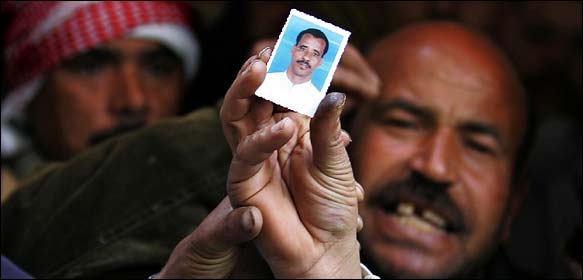
The ferry was overloaded when it left Saudi Arabia, full of mostly poor
Egyptians who work there because no jobs exist at home. When smoke
filled the ship, witnesses said they begged the captain to turn around.
Reports said the captain in turn begged the ship's owners to let him.
But the owner, reports said, told him to proceed.
A day after the accident, President Mubarak went to Hurghada, where the
families were waiting. He spent a short time in the hospital. He
pledged an investigation, and $5,000 each for families of the victims.
The promise of an investigation was met with cynicism — a product of
past promises and of the appointment, by Mr. Mubarak himself, of the
shipping company's owner to the upper house of parliament.
All week, newspapers covered the disaster. They reported the rioting in
other countries about the Danish newspaper's cartoons, too. Egyptian
diplomats, it has been widely reported, were heavily involved in
bringing the controvery from Denmark to the Middle East.
In the end, though, another event competed for Egyptians' attention.
On Friday night, the president, his wife and Prime Minister Ahmed Nazif
attended the Africa Cub soccer match, where Egypt's team defeated Ivory
Coast in the finals — a gift to a nation that has been whipsawed, and a
president looking for distraction.
Though the soccer match was peaceful, in a way it was perfectly cast as
a diversion: an emotion-charged conflict with a foreign adversary.
Mona el-Naggar and Abeer Allam contributed reporting from Cairo for
this article.